
A device to convert plastic waste into fuel
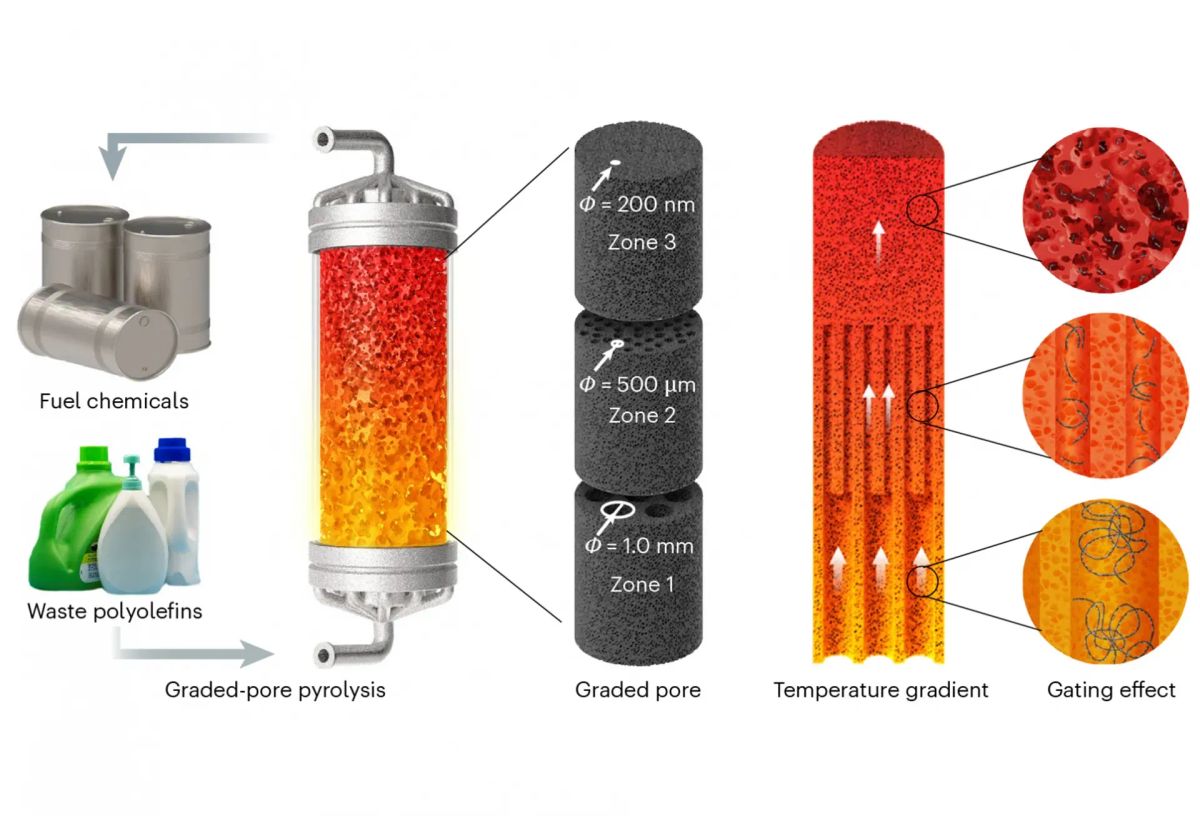
People need more and more energy to power their everyday lives. Unfortunately, fossil fuels and coal are not renewable or clean energy sources. Wind, solar, and hydro are but they require specific conditions and can be difficult to scale up. Nuclear power is also an option but the byproduct is hazardous material that remains radioactive for centuries. However, Yale researchers found a way to turn plastic into energy.
Quotes taken from Yale Engineering article, A device to convert plastic waste into fuel (2025) referencing Yang et al. (2025):
"As tons of plastic waste continue to build up in landfills every day, Yale researchers have developed a way to convert this waste into fuels and other valuable products efficiently and cheaply. The results of their work are published in Nature Chemical Engineering as the cover article" (A device to convert plastic waste into fuel, 2025).
"Specifically, the researchers are using a method known as pyrolysis, a process of using heat in the absence of oxygen to molecularly break materials down. In this case, it’s used to break plastics down to the components that produce fuels and other products. The study was led by Yale Engineering professors Liangbing Hu and Shu Hu, both members of the Center for Materials Innovation and Yale Energy Sciences Institute" (A device to convert plastic waste into fuel, 2025).
"Conventional methods of pyrolysis often use a catalyst to speed up the chemical reactions and achieve a high yield, but it’s a method that comes with significant limitations" (A device to convert plastic waste into fuel, 2025).
“'Whenever you talk about catalysts, they’re very expensive and you have a lifetime issue because catalysts will eventually die by different means,' said Liangbing Hu, the Carol and Douglas Melamed Professor of Electrical & Computer Engineering & Materials Science, and director of Center for Materials Innovation" (A device to convert plastic waste into fuel, 2025).
"Methods that don’t employ a catalyst, though, tend to have low rates of converting the waste into products of use" (A device to convert plastic waste into fuel, 2025).
"For this project, the researchers found a way around both of these obstacles and developed a highly selective, energy-efficient, and catalyst-free pyrolysis method that can convert plastic into valuable chemicals" (A device to convert plastic waste into fuel, 2025).
"The key, they say, is a 3D-printed electrically heated carbon column reactor made of three sections of decreasing pore size" (A device to convert plastic waste into fuel, 2025).
"To test the system, the researchers tried the reactor out on a sample of common plastic known as polyethylene. The results are impressive: They report a record-high yield of nearly 66% of the plastic waste converted into chemicals that can be used for fuels" (A device to convert plastic waste into fuel, 2025).
"To demonstrate a more scalable design, the researchers also used a device made up of commercially available carbon felt. They found that this design - even without the optimization that a 3D-printed structure provided - still improved the selectivity of the pyrolysis products and achieved a satisfactory yield, converting more than 56% of the plastic into useful chemicals" (A device to convert plastic waste into fuel, 2025).
While not directly related to the circular economy, this discovery is a step in the right direction towards a more sustainable future. It solves, at least somewhat, the problem of humanity needing more and more energy as well as the accumulation of plastic in our ecosystem. I do have a few questions though. Would this work for other types of plastic that are not polyethylene? How usable is this fuel? What do we do with the other 40-50% that can’t be converted into fuel? There are so many questions to be answered before we can properly judge how much of a viable solution this is. Furthermore, would this discovery be used to justify even more plastic production?
No generative artificial intelligence (AI) was used in the writing of this work.
References
A device to convert plastic waste into fuel. Yale Engineering. (2025, July 23). https://engineering.yale.edu/news-and-events/news/device-convert-plastic-waste-fuel
Yang, J., Dong, Q., Zhang, C., Zhang, W., Miscall, J., Brozena, A. H., Chen, J., Liu, N., Li, T., Liu, F., Nascimento, C. A., Dantas, B., Zhang, B., Mumtaz, F., Liu, Z., Liu, S., Du, Y., Wang, Z., Pang, Z., … Hu, L. (2025). Selective electrified polyethylene upcycling by pore-modulated pyrolysis. Nature Chemical Engineering, 2(7), 424–435. https://doi.org/10.1038/s44286-025-00248-0