A visual scoping review of plastic consumption in everyday life
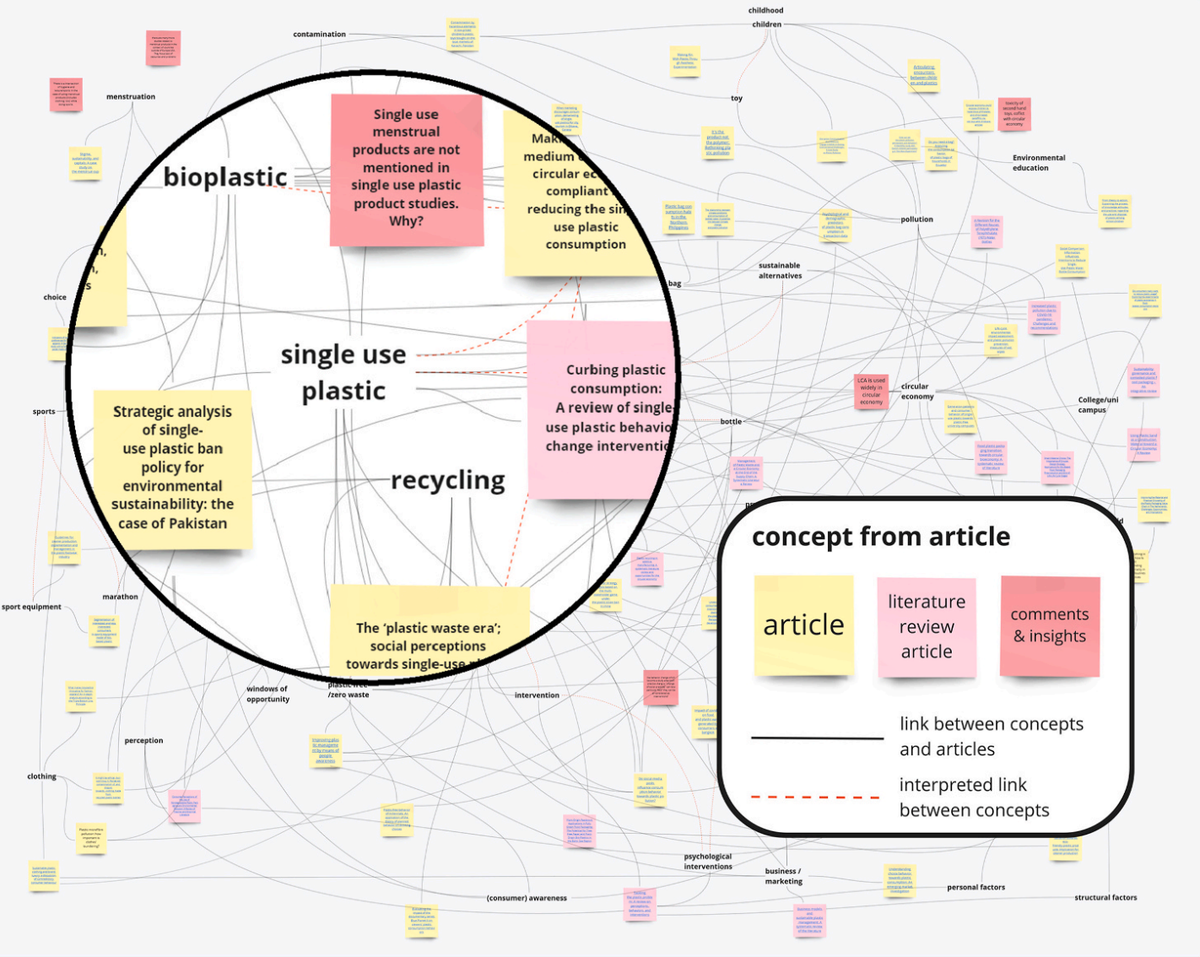
I find this especially relevant because it disrupts the oversimplified narrative that reducing individual consumption alone can solve the plastics crisis. What struck me most was the emphasis on how plastics exist in tangled networks of production, markets, social interactions, and culture. This aligns with my growing realization that any attempt to frame solutions—like in our project on circular economies—can only capture a small portion of the overall picture.
From Kaplan Sarisaltik et al. (2025):
"Plastic products have manifested their tangible presence in domestic activities, thus becoming fundamental components in household practices associated with hygiene, comfort, storage, food, and children’s upbringing" (Kaplan Sarisaltik, 2025).
"In addition, sustainable alternatives are often more costly and rely on connecting with different layers of various existent practices and resources" (Kaplan Sarisaltik, 2025).
"However, the complexity of plastic consumption is not limited to individual consumers alone; it also applies to various stakeholders such as governmental organizations, companies, and local organizations" (Kaplan Sarisaltik, 2025).
"The problems associated with plastics spread in many layers of the world through different kinds of tangled networks consisting of production, market, social interaction, culture and more, posing challenges to different areas of sustainability" (Kaplan Sarisaltik, 2025).
"Another notable limitation in current plastic consumption research is its predominant focus on single-use plastics (SUPs). Certain SUPs such as plastic bags and bottles have become the subjects of numerous studies and policy regulations. As noted by Heidbreder et al. (2019), social scientific research has mostly neglected plastic applications other than packaging or bags. The actual scope and volume of plastics in daily life can be recognized by extending the product types included in plastic consumption research" (Kaplan Sarisaltik, 2025).
"In line with the suggested collective action, Heidbreder et al. (2019) emphasized the shift of responsibility as an important barrier to behavior change in plastic consumption. They concluded that to prevent such a shift, collaboration is essential among stakeholders from the research field, politics, industry, trade, and the general public" (Kaplan Sarisaltik, 2025).
"Likewise, Horne et al. (2022) highlight that policy interventions targeting household behaviors will have limited success without addressing the root causes of plastic production, particularly the role of the petrochemical industry" (Kaplan Sarisaltik, 2025).
"As indicated in the reviewed articles, people have contradictory perceptions of plastics, and as Lofstrom et al. (2021) explained, the positive characteristics of plastics can be used to justify their negative characteristics when no alternative solution is available to overcome this complex and contradictory system" (Kaplan Sarisaltik, 2025).
"While the Commission emphasizes the importance of holistic discussions to address circularity, the resulting policies focus on end-of-pipe solutions that fail to address socio-ecological implications and the root causes for the problems intended to solve" (Kaplan Sarisaltik, 2025).
"In addition, we suggest considering the broader effects of the proposed intervations from a holistic perspective. Embracing interdisciplinary approaches may provide research to deal with these factors contributing to the complexity of plastic consumption" (Kaplan Sarisaltik, 2025).
The article is also critical of existing research blind spots, such as the narrow focus on SUPs, and calls for interdisciplinary and holistic approaches. This raises important questions about how much responsibility can realistically be placed on individuals when the petrochemical industry and policy decisions continue to drive production. At the same time, I was struck by the contradictions in public and institutional perceptions of plastics, where their convenience is used to justify harms. Ultimately, the article pushed me to think about the need for more comprehensive, cross-sector research and collaboration if sustainable transitions are to move beyond surface-level fixes.
This commentary draws on excerpts from the reviewed article (~40%), the author’s own reflections and framing of plastics within circular economy research (~40%), and AI-assisted synthesis and editing (~20%). All interpretations remain the responsibility of the author.
References
Kaplan Sarisaltik, A., Gulden, T., & Boks, C. (2025). A visual scoping review of plastic consumption in everyday life. Cleaner and Responsible Consumption, 16, 100248. https://doi.org/10.1016/j.clrc.2024.100248