Are we scary to animals?
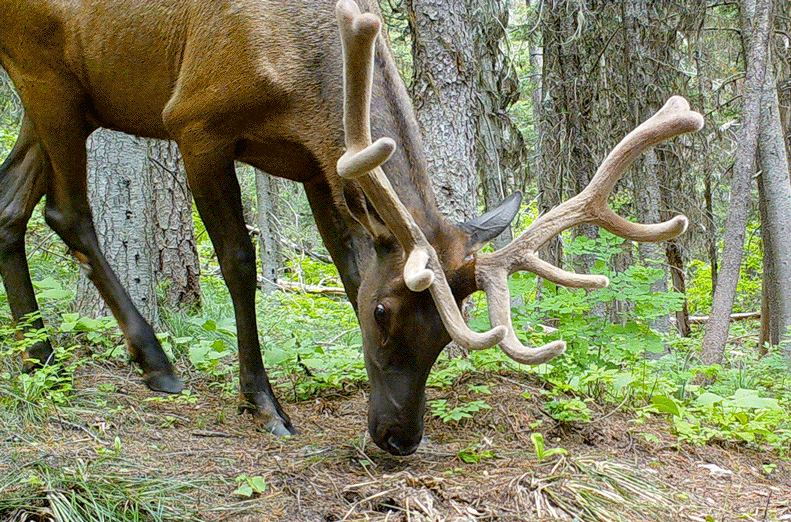
Wildlife are a big part of state parks: Not only are the parks their homes, but many people go to parks to see them (birdwatchers, for example). And, impact on wildlife is one of the things that should be reduced to have a more sustainable park. The following excerpts are from an article by Zaske (2023) who shares that we may have a bigger impact on wildlife that we thought.
Excerpts from Zaske (2034)
Even without hunting rifles, humans appear to have a strong negative influence on the movement of wildlife. A study of Glacier National Park hiking trails during and after a COVID-19 closure adds evidence to the theory that humans can create a “landscape of fear” like other apex predators, changing how species use an area simply with their presence.
Washington State University and National Park Service researchers found that when human hikers were present, 16 out of 22 mammal species, including predators and prey alike, changed where and when they accessed areas. Some completely abandoned places they previously used, others used them less frequently, and some shifted to more nocturnal activities to avoid humans.
“When the park was open to the public, and there were a lot of hikers and recreators using the area, we saw a bunch of changes in how animals were using that same area,” said Daniel Thornton, WSU wildlife ecologist and senior author on the study published in the journal Scientific Reports. “The surprising thing is that there’s no other real human disturbance out there because Glacier is such a highly protected national park, so these responses really are being driven by human presence and human noise.”
The researchers had also expected to find an effect known as “human shielding,” when human presence causes large predators to avoid an area, providing opportunity for smaller predators and perhaps some prey species to use an area more frequently. In this case, they found this potential effect for only one species, red fox. The foxes were more present on and near trails when the park was open — perhaps because their competitors, coyotes, avoided those areas when humans were around.
Several species showed a decline in use of trail areas when the park was open, including black bear, elk and white-tailed deer. Many decreased their day-time activities, including mule deer, snowshoe hare, grizzly bears and coyotes. A few, including cougars, seemed indifferent to human presence.
While the influence of low-impact recreation is concerning, the researchers emphasized that more research is needed to determine if it has negative effects on the species’ survival.
“This study does not say that hiking is necessarily bad for wildlife, but it does have some impacts on spatiotemporal ecology, or how wildlife uses a landscape and when,” said Alissa Anderson, a recent WSU master’s graduate and first author on the study. “Maybe they are not on the trails as much, but they’re using different places, and how much does that actually impact species’ ability to survive and thrive in a place, or not? There are a lot of questions about how this actually plays into population survival.”
The study came about in part because of the pandemic. Both humans and wildlife like to use trails, so the researchers had set up an array of camera traps near several trails to study lynx populations in Glacier National Park when COVID-19 hit. In an effort to keep the virus from spreading to the nearby Blackfeet Indian Reservation, the eastern portion of the park was closed in 2020 with only minimal access allowed to administrators and researchers.
Glacier, which covers nearly 1,600 square-miles of northwestern Montana, sees more than 3 million human visitors a year. It is also home to diverse range of animals with almost the full complement of mammal species that has existed in the region historically.
Thornton said park managers are faced with a balancing act between conservation and public use missions.
“It’s obviously important that people are able to get out there, but there might be a level of which that starts to be problematic,” he said. “Some additional research could help get a better understanding of that and help develop some guidelines and goals.”
This study received support from the Glacier National Park Conservancy and the U.S. Department of Agriculture.
Though I had already become aware of the damage that walking off trail and on user-created trails can cause, both to plant life and wildlife, I didn't realize that as little as our presence in a natural environment can be so effective on animals. I had been told, as well, that the goal of a park manager and park management in general is to balance conservation with recreation. What this article makes me wonder is if that is even possible, especially when humans have such an impact even when maintaining best practices, and parks rely on visitation and recreation to support themselves. Ohio state parks, as well, are used enormously and consistently, by many people. Balancing the wellbeing of wildlife and plant life with the enjoyment of human beings is not easily, if it's even possible.
Resources.
Zaske, S. (2023, January 19). Low-impact human recreation changes wildlife behavior. Washington State University Office of Research. https://research.wsu.edu/news/low-impact-human-recreation-changes-wildlife-behaviorhttps://research.wsu.edu/news/low-impact-human-recreation-changes-wildlife-behavior
No generative AI was used in the creation of this post.