Blurring the Line Between Trash and Creative Treasure

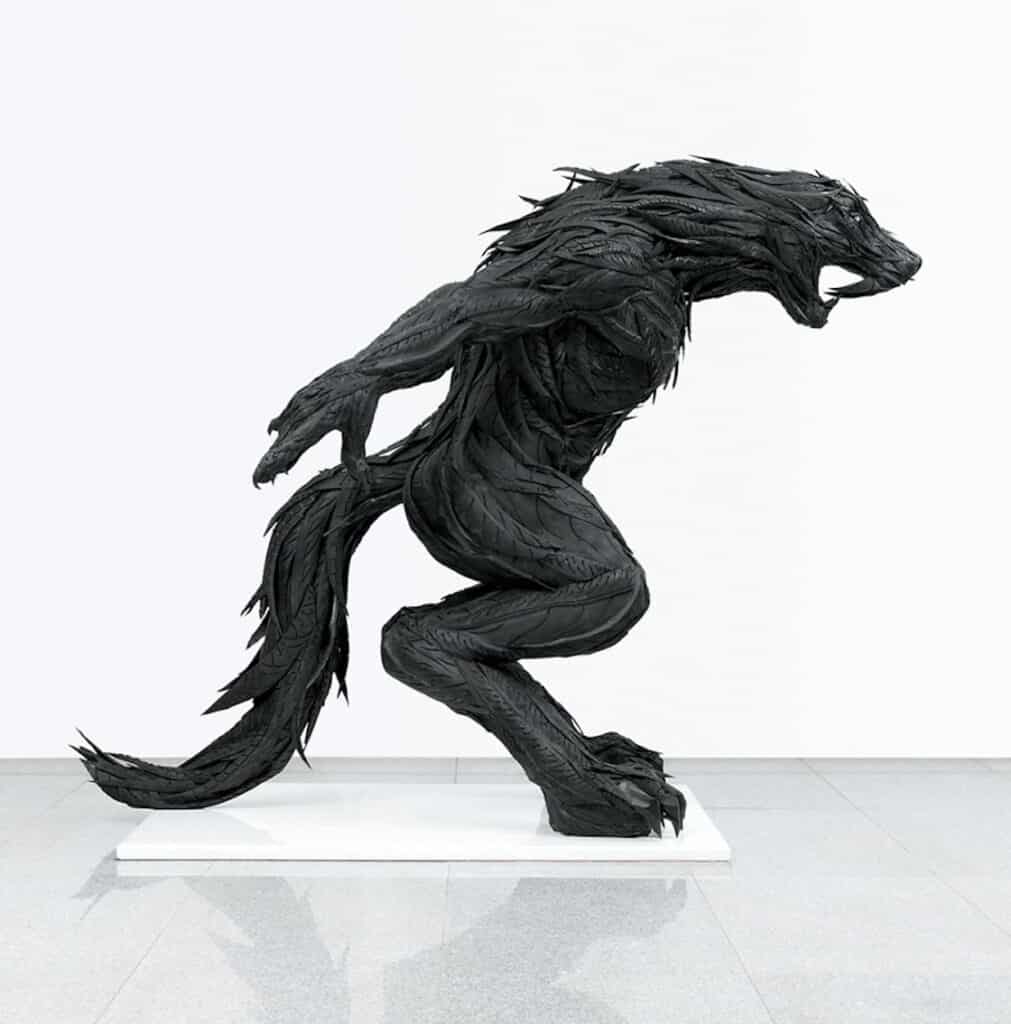
Artists Yong-Ho and the Guerra de la Paz duo convert everyday objects into unique items that challenge the public perception of waste. Ji Yong-Ho is a contemporary Korean sculptor who uses tires to create fantastic creatures inspired by mythology and science fiction.
Throughout his figural sculptures, he depicts a variety of animals and mythological hybrid creatures. The figures created by this young Korean artist mostly remind us of science-fiction monsters, alien creatures, humanoids, and genetically modified organisms (GMO) which appear in myths and in modern science fiction stories and films (Causeartist, 2023).
Yong-Ho specifically invites imagination into his pieces and pushes the viewer to see beyond what tires were intended for. Similarly, the local loops team is being pushed to see new potential in plastic waste; these designers are also finding ways to tell a story using this trash.
Art of Yong Ho Ji clearly expresses and throws a fair amount of skepticism to those who are trying to defy nature by creating entirely new forms or species of animals or plants and even human beings by scientifically modifying the mutation of genes.
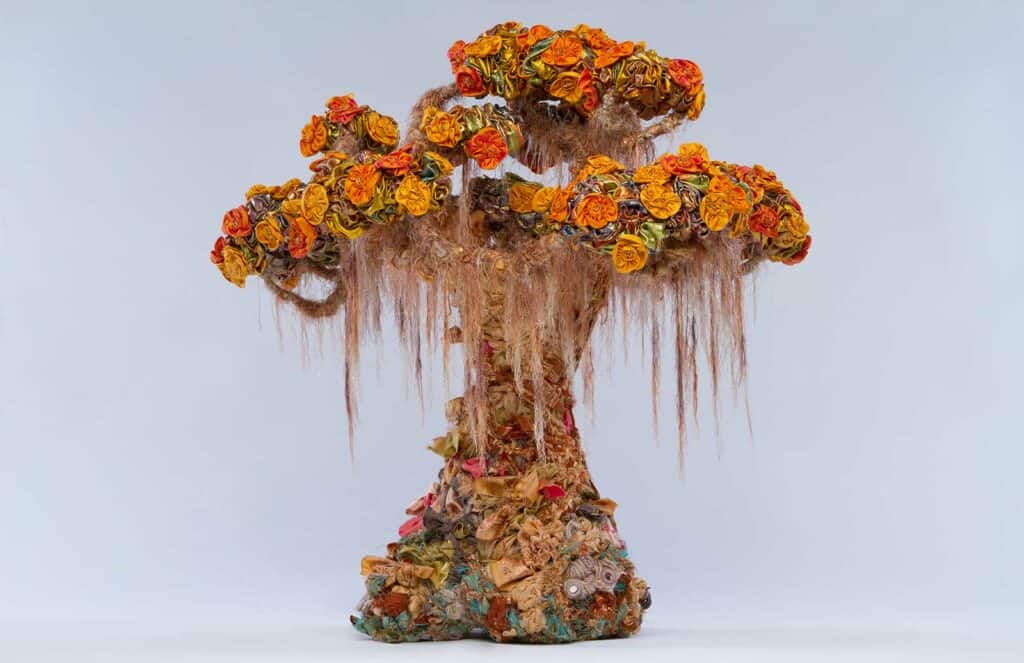
Guerra de la Paz is a collective of Cuban artists founded by Alain Guerra and Neraldo de la Paz. Based in Miami, Florida, they work from unconventional materials like recycled clothing, from which they create very colorful sculptures.
Guerra de la Paz provokes discussion about human activity and the effect on environment and whether we can create a sustainable future beyond consumerism. There is a fascinating juxtaposition when the artists craft the gestalt form of a natural object (in this case, a tree), out of inorganic plastic waste. Its a statement about how the things that did not come from the natural environment (plastic items) are now the very things that make up the natural environment.
The artists find inspiration in the familiarity of ready-made – whose archaeological qualities and encapsulated energies evoke the significance of the human footprint and reveal psychosocial and environmental messages – while exploring themes with cultural and historical relevance.
It is often said that good design is good storytelling. Built artifacts however, like the art of Yong-Ho and Guerra de la Paz, contain within them a material context that adds depth to their stories. I am personally interested in locating this kind of meaning with the plastic waste the Local Loops collects and drawing it out in our design outcomes.
Their pieces are often interpretations of classic artworks and frequently convey deeply political messages. Guerra de la Paz’s art questions modern consumer society, and the way we blindly use and discard objects that are still in good condition, such as clothes.
The 'magic' of an artist is the ability to see something others don't and express that vision in a way that is captivating. Is it possible to inspire this kind of creativity in culture abroad and change the perception of plastic waste? Like Yong-Ho and the Guerra de la Paz duo, how might designers encourage storytelling and incentivize recycling through emotional value? Through partnership with the Neighborhood Design Center of Columbus, The Local Loops team is being challenged to contextualize their design outcomes to not just reflect the communities they are intended for but engage residents in a broader way of thinking and living that positively situates plastic as a resource of potential that must be handled responsibly.
References:
Causeartist. (2023, June 21). 13 incredible artivists using recycled materials in their art. Causeartist. https://www.causeartist.com/incredible-recycled-art-materials-creations/