Efficiency or Social Control?

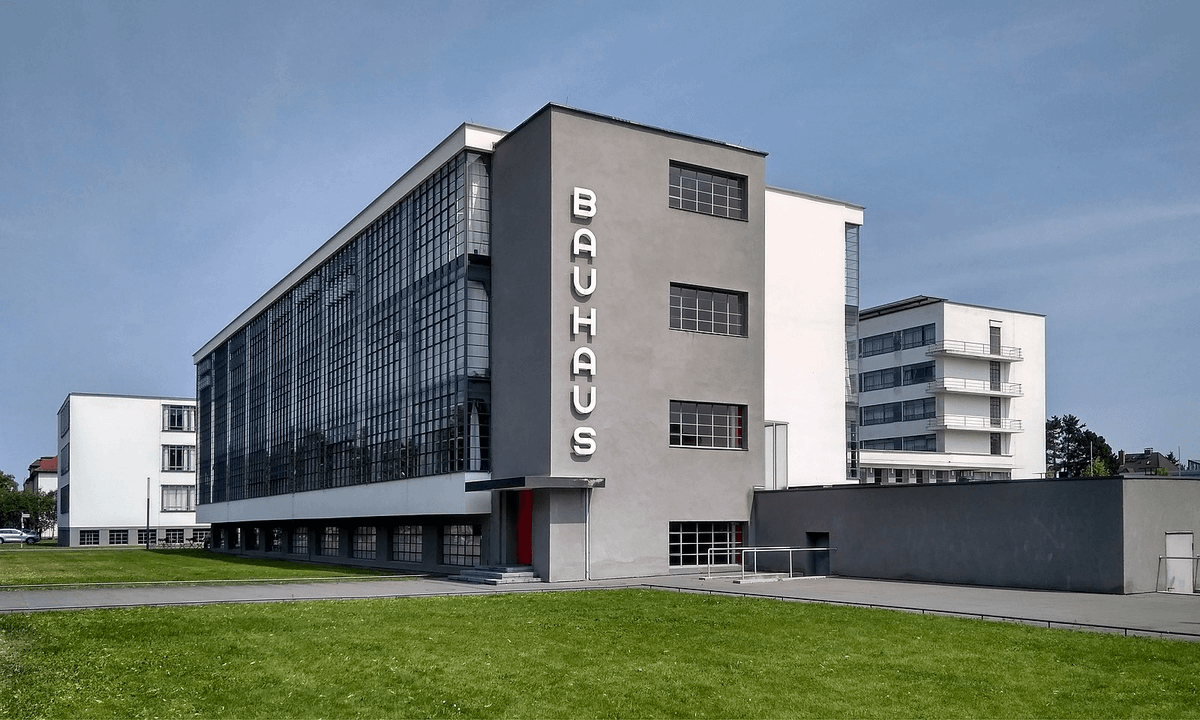
This passage, taking from Story of Bau Haus highlights Reinhold Rossig’s thesis and the Bauhaus engagement with social responsibility in city planning, yet it also exposes limitations inherent in highly rationalized, linear urban concepts. While the linear city aimed to solve social issues by organizing functions into clear zones, it risks creating sterile, homogenous environments that suppress organic growth.
A large-scale settlement, addressing social issues - Reinhold Rossig's thesis work, Design for a Socialist City, shows how far Bauhaus concerns had shifted and expanded over the course of the school's existence (Ambler, Frances, 2018, p. 15).
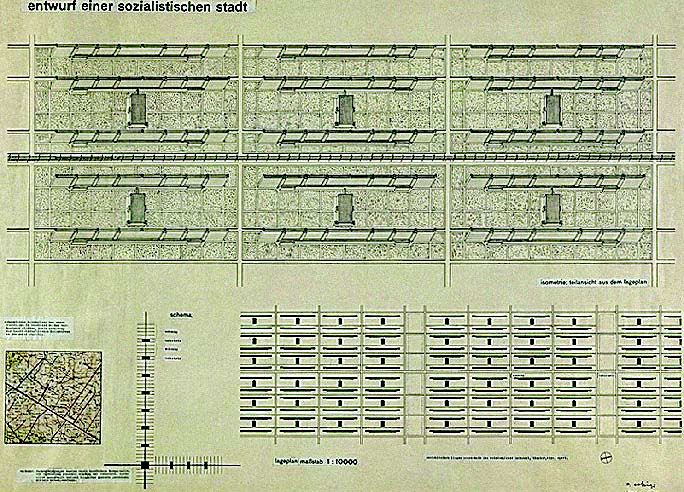
The idea of a 'linear city' - a settlement organized into different parallel functional zones, usually along a river- became influential in 19th-centuryBritain and Spain.
The cities are connected with the facilities of 'a collectivized agriculture'? Rather than running along a river, houses are arranged parallel to railway line, alternating with industrial zones. Houses, work and leisure are connected by subways.
True community thrives on the unpredictable interactions between people, places, and activities—something rigid zoning undermines. When houses, industry, and leisure are segmented into strict corridors, opportunities for spontaneous culture and neighborhood diversity diminish. Such order may appear efficient, but it overlooks the lived experience of complexity that makes urban life rich and humane.
Hilberseimer's plans for such cities typically included a range of different kinds of houses, including single family homes - Rossig's, meanwhile, echoes experiment in collective living that were happening in the Soviet Union. Workers spend their time in the 'residential complex', while facilities such a s the 'main kitchen 'and 'collective spaces" are centrally situated.
The Bauhaus vision had admirable social ambitions, yet Rossig’s socialist-inspired model appears to reduce human life to efficiency metrics. People are not just workers to be housed near factories; they are creators who shape their environments in ways that are often messy but meaningful. Neighborhoods designed with flexibility allow adaptation over time, rather than locking residents into rigid social patterns. Local Loops sponsor, Neighborhood Design Center, recognizes the importance of creating a community that celebrates diversity, complexity, and allows for the spontaneous lives of its residents.
References:
Ambler, Frances. (2018). Story of Bau Haus. Ilex Press.