Bridging the Wealth Gap: Why Intergenerational Knowledge Matters: Op-ed
Overview
Money can be a tricky topic to approach with many people. It is a sensitive thing that requires care as the smallest mistake can cause a person to become defensive. It is often tied to personal values, upbringing, and life experiences, which makes it more than just numbers or transactions—it becomes an emotional subject. Because of this, conversations about money can easily feel intrusive or uncomfortable. Comfort levels around money vary greatly from person to person, making navigating what to say, how much to share, and when to bring it up a daunting task. The difficulty lies in balancing honesty with sensitivity, finding the right balance that acknowledges both practical realities and the emotional weight that money carries.
Working with Huntington Bank, they provided us with two unique opportunity spaces. First, there is pathways, which are designs that aid a user in planning for different financial scenarios. These pathways are meant to be comprehensive, helping people take into account the many facets of life that go into banking. The second opportunity space is designing for multi-party banking. This space explores how people can come together and share in their banking/financial journey, gaining access into each others financial lives.
After hearing these problem spaces I became intrigued in the idea of bringing other people in to share in ones financial journey.
Through my own experiences with finances, I have become quite accustomed to a certain phrase, "I wish I knew that when I was your age." This one sentence has been brought up time and time again with a variety of different people including friends, family, coworkers and online. The concept of looking back on your life and wondering how it could have changed with a few alternative decisions leads to insights that only you would know. The world is full of people who have gained valuable knowledge about all sorts of fields. However none of these fields looms quite as large as finances. A topic which has long been gate kept by those of power and status.
The specific area that I have chosen to focus on is on how I can design a product that facilitates intergenerational communication in order to boost the overall financial literacy of the population.
Sharing information
Sharing information can be a tough thing to get people to do. It requires building a foundation of trust and comfort between people or the organizations people are communicating through. After doing research through the use of surveys and interviews, I found that trust is the number one thing when deciding whether or not a person talk to another. This is backed by an article that depicts how to foster a trusting environment (Adamczyk, 2020). It states that being comfortable allows people to open up more and share more intimate details (Adamczyk, 2020).
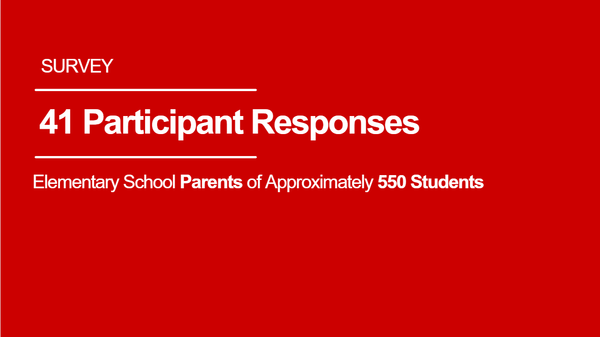
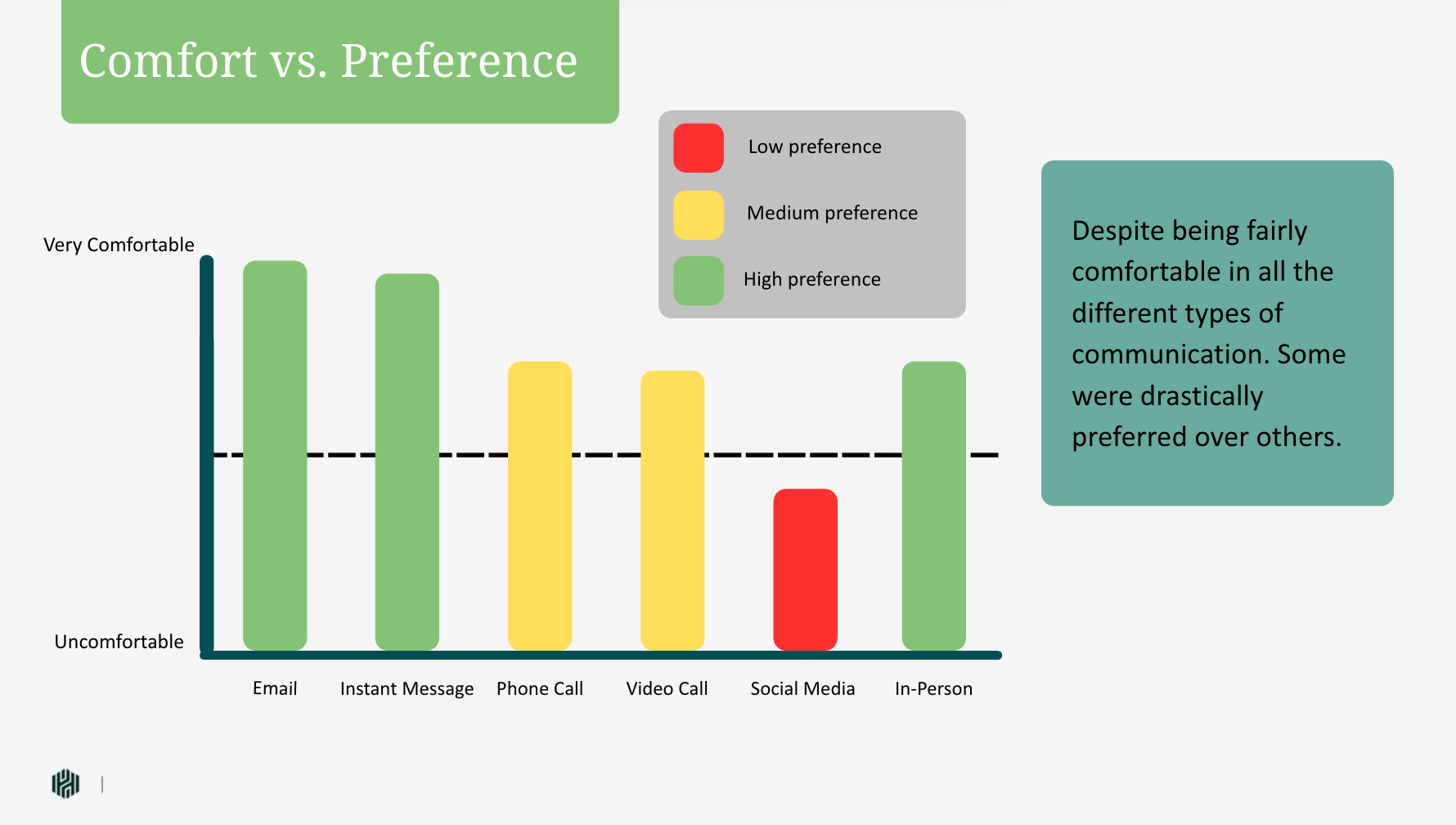
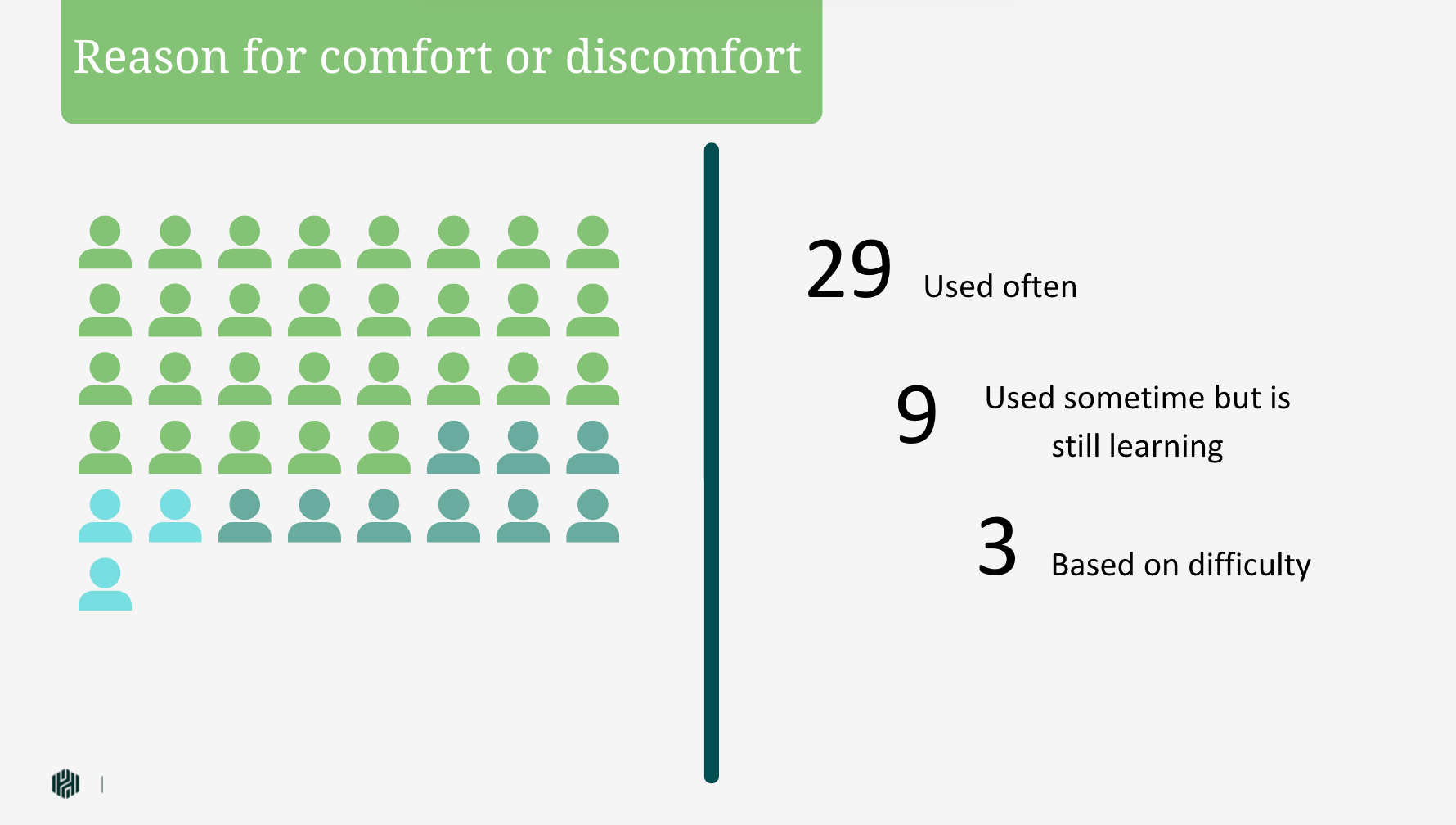
This trust extended into the forms of communication as some methods garnered more use than others. In my survey (n=41), when asked about comfort vs preference in communication methods many showed fairly high comfort levels in all. However, comfort did not correlate to preference as email, instant messaging, and in-person conversations had significantly higher preferences. Both of these can be seen in Figure 1. When asked about the reason why, majority said it was due to having used these methods more often as seen in Figure 2.
Sharing only when "necessary" and only the "appropriate" amount are two interesting notions that came out of the interviews (n= 4) I conducted. What these two phrases insinuate is that there are limits to what any one person deems as sharable. This is understandable as people have a right to privacy. However, withholding information can lead to issues: specifically to open communication strategies. "Open communication is a style of communication in which people share ideas and information honestly and transparently" (Blink, 2023). This makes reservations on communications hindering.
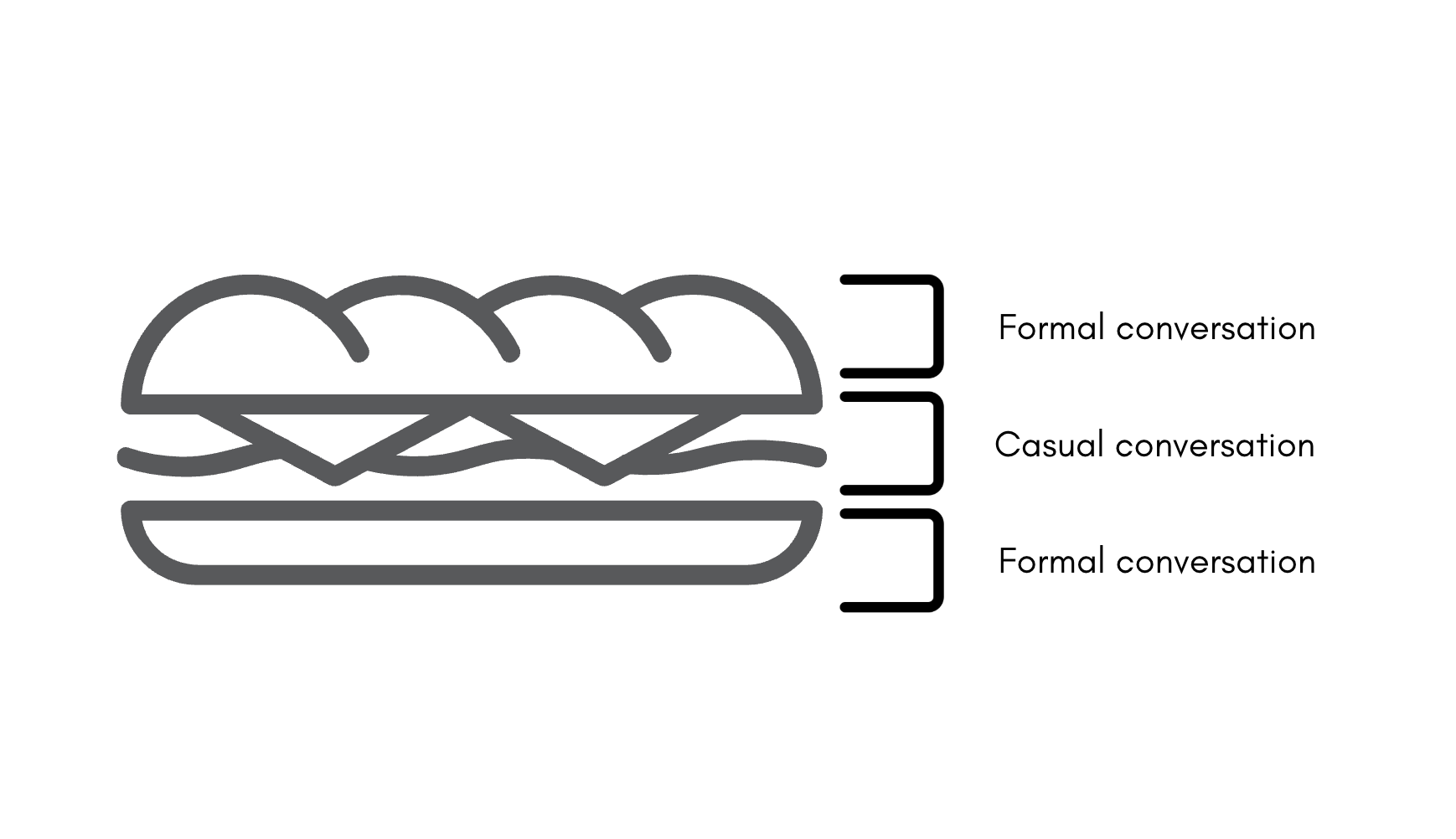
In my observation session at The Marzetti Company, a company based in Westerville, OH, I came across an interesting phenomenon occurring when coworkers talked with one another, I call it a "conversation sandwich" (Figure 3). It's where casual talk was inserted between formal/work related talk. I noticed that this sandwich made it easier for people to converse about more serious topics as the casual slice in the middle made it more tolerable. Applying this to open communication, a conversation sandwich allows people to be more comfortable in sharing what they know.
Bringing in my research niche, information sharing is approached very differently by different generations. Generally younger people find it easier to share information than older people do with "21% of 18-24 year-olds feel comfortable doing so" versus "8% of those aged 45-54"(Lee). Much of this gap is due to mindset, where young people view information sharing as a way to enhance experiences while older people view it much more cautiously. (Lee)
Generational differences
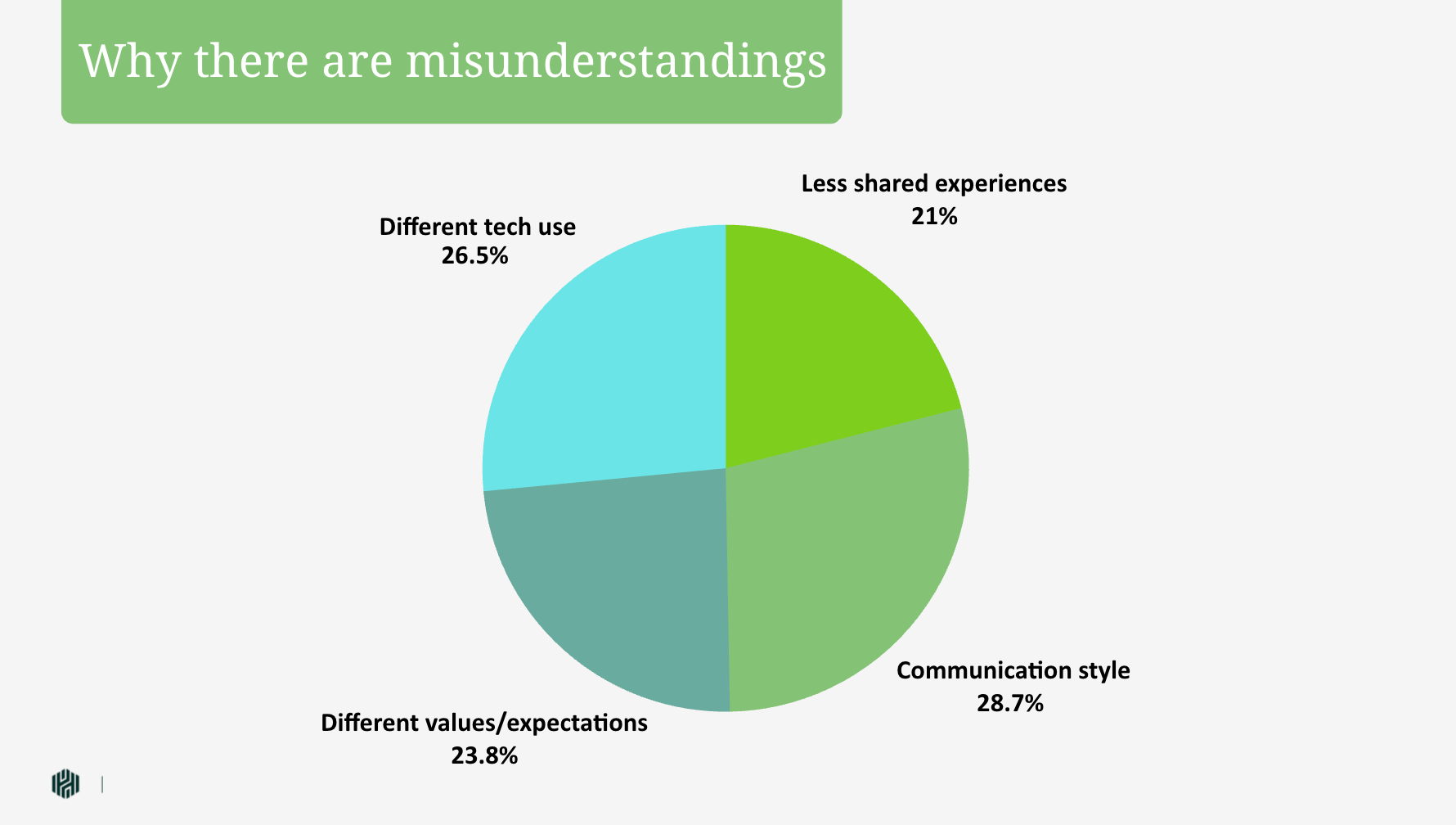
It's no secret that the different generations all have various styles of communication and often times this can lead to misunderstandings and confusion. In a survey of 42 office workers at The Marzetti Company, majority stated that communication style is the reason why generations misunderstand each other. Followed closely by differing tech use, then differing expectations, and finally not enough shared experiences, as seen in the Figure 4 below
When asked about communication style in my survey, generations such as Gen Z and Millennials tend to speak more shortly, opting to use instant messages and emails as their main forms of communications. Especially for formal correspondences. On the other hand, older generations are more inclined to have in-person conversations along with phone calls as well as wanting to stick to methods they have always used rather than use anything new. Emails seem to be the joining factor as it has scored high in ease of use across generations. (Figure 5) What was interesting though is that Teams was mentioned as being a key tool by people across all ages.
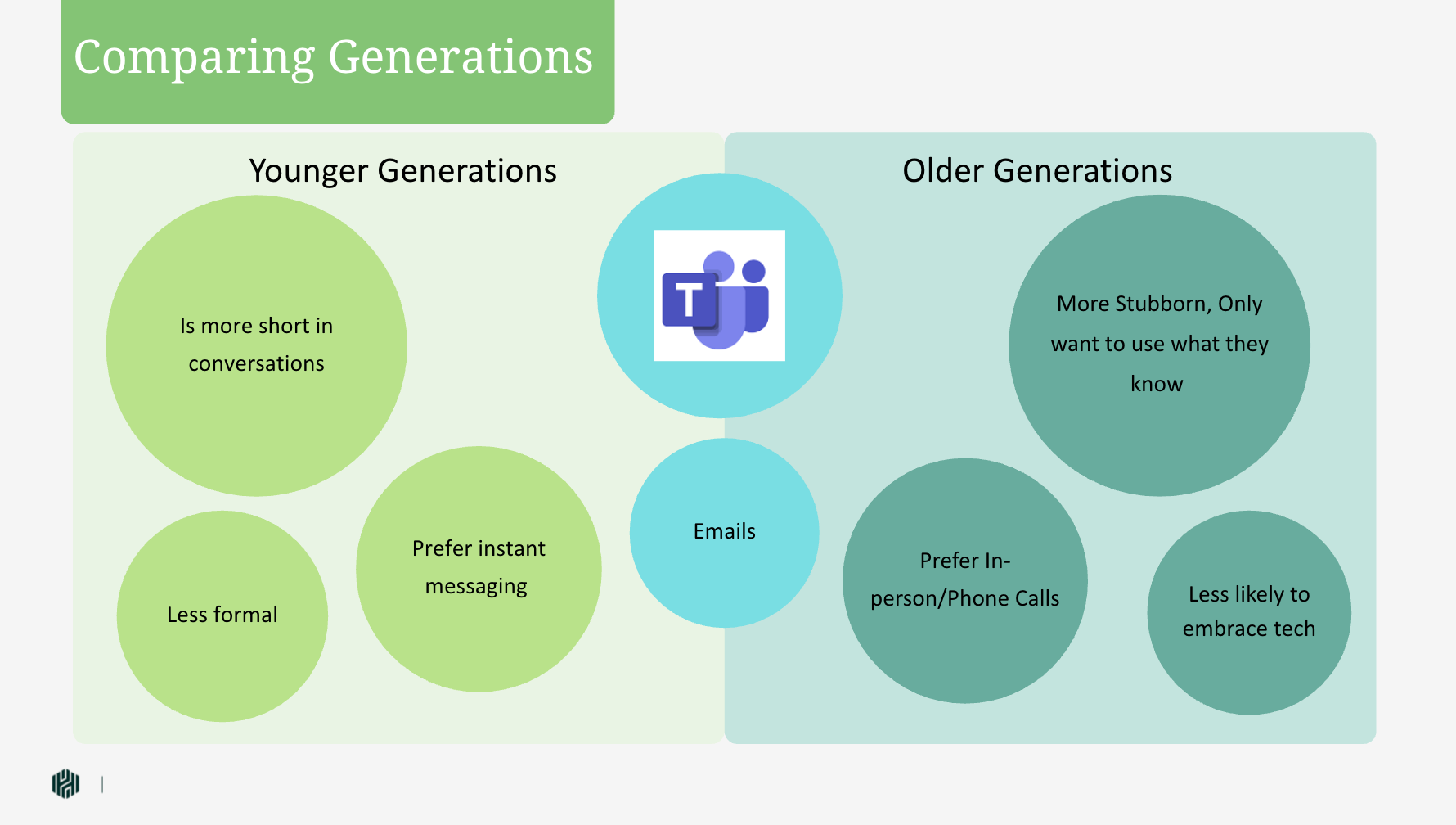
These sentiments were also reflected in my interviews with the only difference was in the addition of the notion that younger generations are more emotional, especially when receiving feedback. As well as younger generation seeking out instant gratification. (Figure 6)
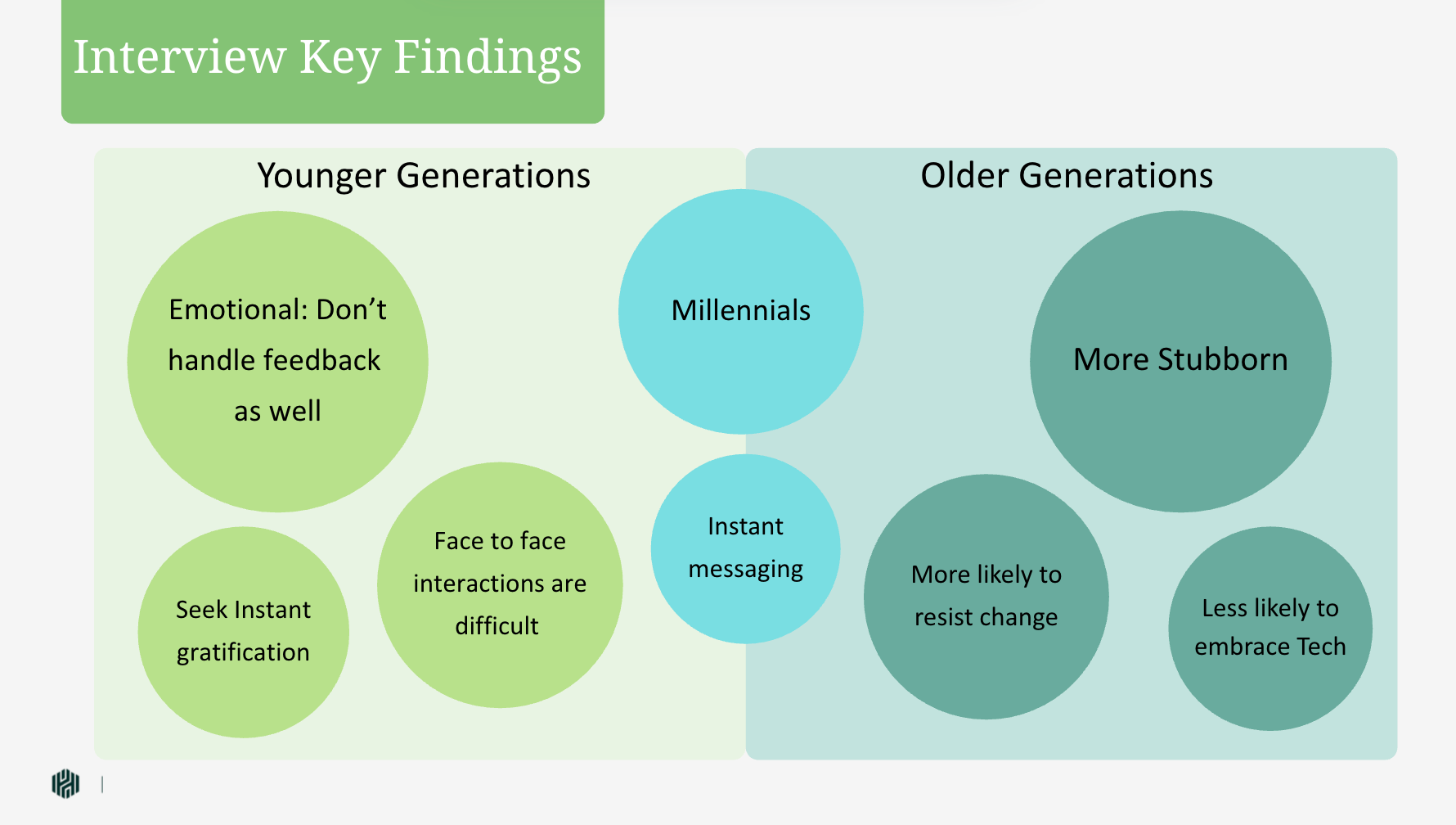
Older generations tend to stick to methods that they are familiar with and can have difficulties adjusting to new tech, stating that if they use the tech often, that is what they stick to. Younger generations have an easier time adapting to new tech, but shy away from in-person interactions.
In recent years, however, there has been a major shift in mentalities. Since the Covid-19 pandemic and lockdown, many office workers have had to adjust to communicating virtually. Making instant messaging a modern development understandable by almost everyone, not just the young (Marzetti communications survey).
Respect, trust, compromise, and paying attention to others were explicitly expressed to me in my interviews as values that make conversations good and productive. Adjusting yourself to match others is a habit that many people do while engaging with others. Either consciously or unconsciously, we follow certain implicitly made agreements with one another in order to have a good experience (Psychology Today, 2023). Its in these implicit agreements where the values that my interviewers look for live. And it was made clear to me that these values are not always met, leading to the misunderstanding and confusions which halt progress of conversations.
Concepts
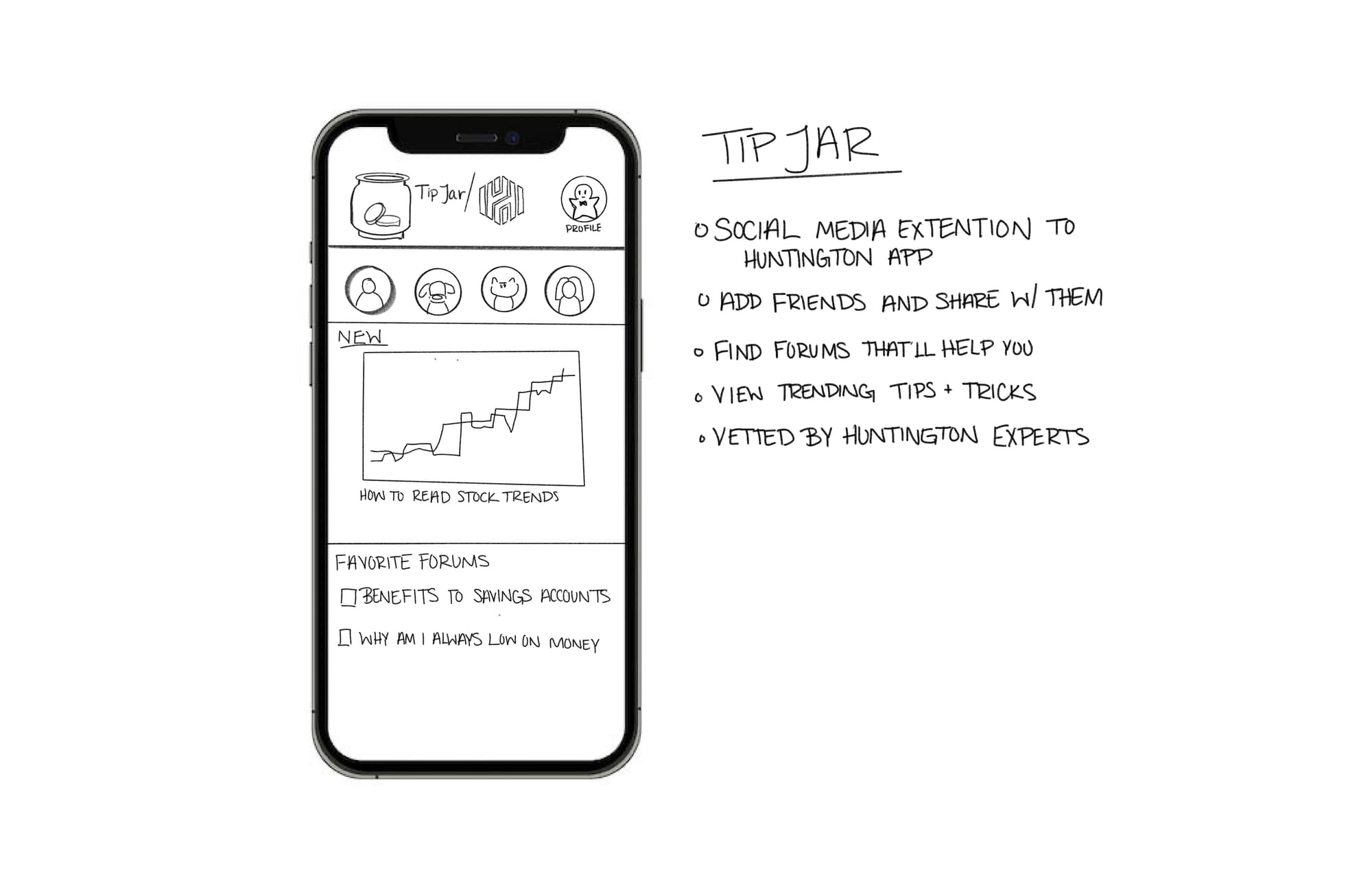
Tip Jar is a concept for social media platform located in the Huntington app which allows a Huntington customer to access or share financial advice with other people. Tip Jar combines typical social media interfacing with online new outlet style posts. You are able to follow people you like getting advice from and join forums discussing various financial topics.
Tip Jar is a interactive platform which is meant to aid in the transfer of knowledge between people of all generations. Making financial literacy available to all people and not just some.
Potential issues I foresee in this concept is how to ensure that the information being shared is accurate and truthful. Along with this making the information age friendly and easy to navigate.
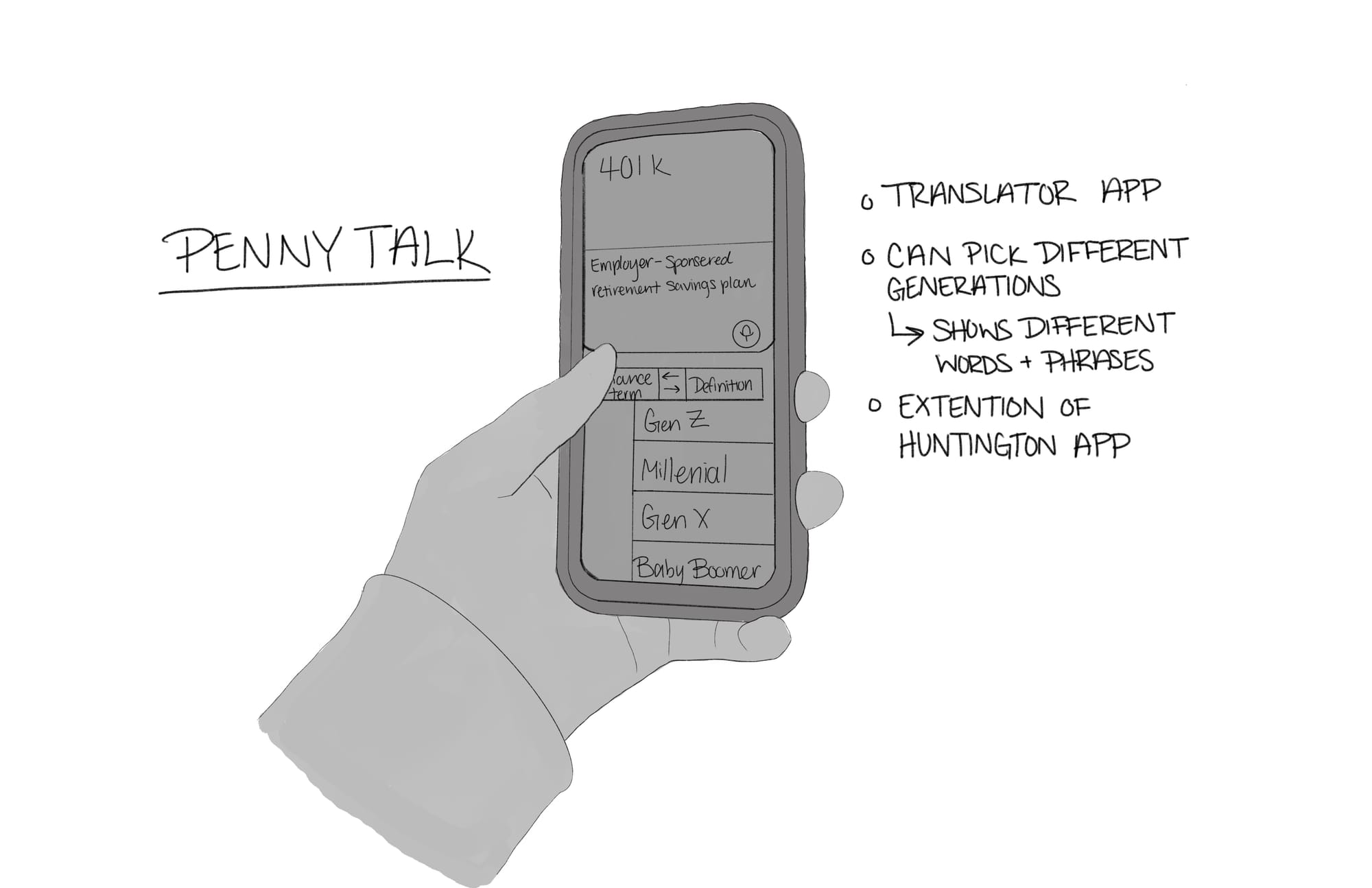
PennyTalk is an extension to the already existing Huntington app. It allows a user to look up specific financial terms and learn their definition. Additionally, the user may select their generation and PennyTalk will provide examples of this that would make sense to them.
The user interface generally resembles the layout of existing translator apps. Making it easy for anyone to log in and navigate their way around. PennyTalk allows people to learn about other generations without worry, increasing knowledge of one another in a safe environment. This in turn provides a gateway to more open communications.
As I have read over and over, trust is a big factor to communication. With PennyTalk, the vocabulary is vetted through Huntington providing the authentication needed.
Some considerations to this concept is that this is a purely human and tech interaction. It lacks face-to-face interactions which create a personal touch and foster trust. Along with this, user interactions are one off which might prove to make engagement hard long term.
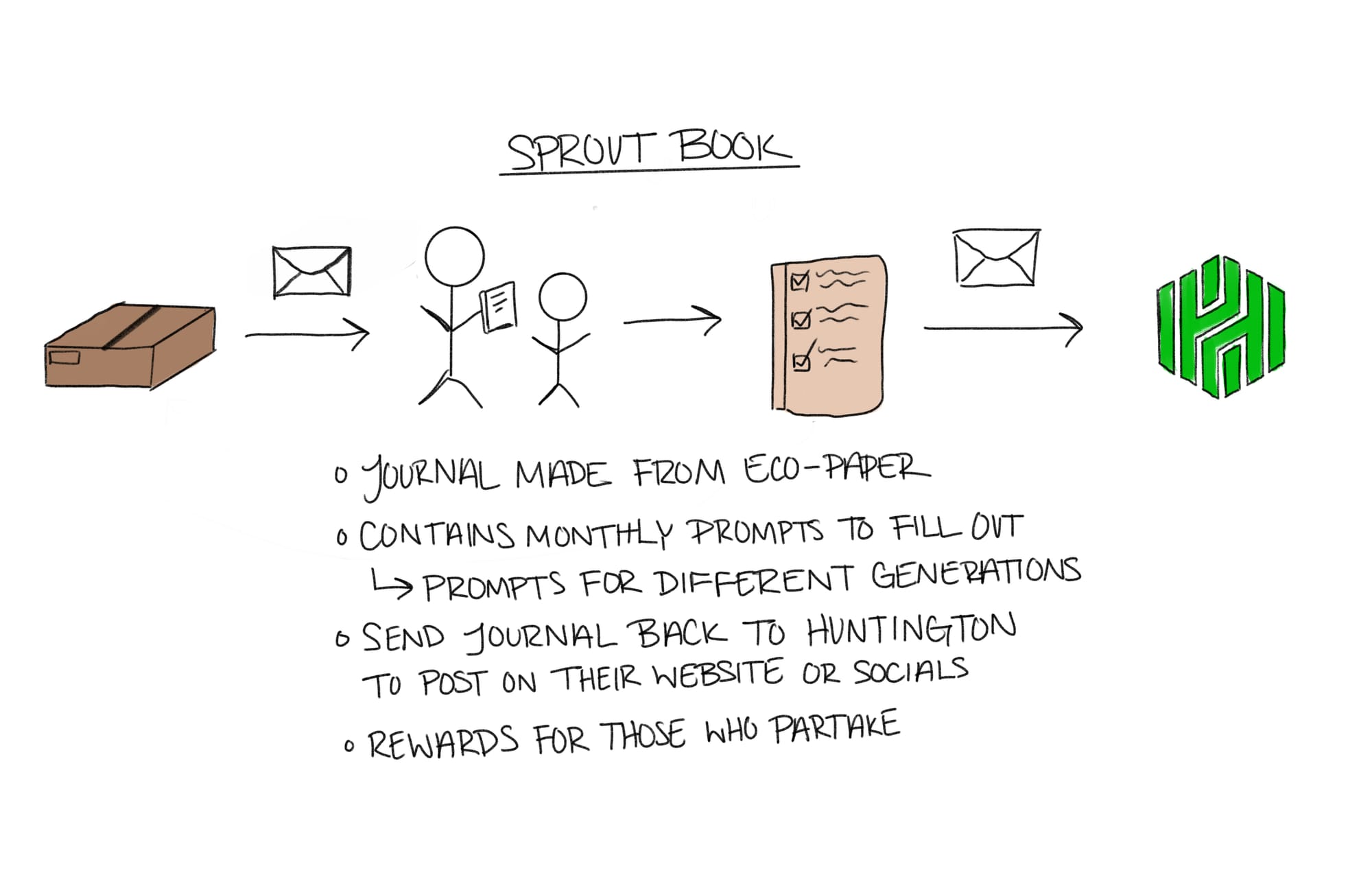
Sprout Book is a physical advice book sent to Huntington customers where they can fill out the prompts and send back to Huntington. Is meant to be a interactive activity accessible to people of any age. The goal of this product is to have a fun way for people to share their knowledge of finances and banking without feeling pressured to share more than they have to.
The physical nature of this product means that anyone, regardless of age, will be able to use it, making it accessible. Being made out of eco-paper means that production of the journals will be sustainable as eco-paper requires less resources to manufacture and is made out oof sustainable material (EcoExplorers, 2023).
Some issues I can foresee in this concept is that many people are not going to want to go through the hassel of so many steps in order to use this product. Along with this younger generations are less likey to actually pick us the book and read it through.
Something to keep in mind after looking at all three concepts is that both TipJar and Penny Talk are digital and I have researched ways that even they can be made more sustainable. I found that while there is less front end material waste, maintaining digital platforms can use huge amounts of resources. For instance, AI data centers requires tons of water in order to keep the computers from over heating. Beckoning the question who is responsible for supplying that water. (Dempsey, 2025) Aside from this there are settings for digital platforms which can minimize energy consumption. Ultimately lengthening product life, and potentially utilizing old hardware: (Vinney, 2025)
Conclusion
Learning to interact with other generations is a skill that is a necessity to engaging in the real world built on respect, trust, and having an open mind. Along with this, there is a difficulty with discussing finances as it is a deeply personal topic. I have learned through my research that any product I make should include the following three ideas. First, trust needs to be established between users and also with the product itself. Secondly, face to face interaction create a personal touch that least to trust. And finally, making a product that helps people understand one another fostering consideration. Ultimately, the future of finances should include creating systems where people can learn from one another, grow together, and make informed decisions.
References
Adamczyk. A, (Feburary 5 2020). I spent an evening sharing my biggest financial worries with my friends—here’s why I think everyone should. CNBC Make It. https://www.cnbc.com/2020/02/05/how-to-talk-about-money-with-your-friends.html
Blink, (September 6, 2023). The importance of open communication in the workplace. Blink. https://www.joinblink.com/intelligence/open-communication-importance#:~:text=Open%20communication%20improves%20employee%20engagement,take%20time%20to%20clear%20up.
Lee. E, The generation gap: understanding data sharing attitudes across age groups. https://technative.io/the-generation-gap-understanding-data-sharing-attitudes-across-age-groups/
Psychology Today Contributors, (May 19, 2023). The Art and Science of Great Conversations. Psychology Today. https://www.psychologytoday.com/us/articles/202305/the-art-and-science-of-great-conversations
Dempsey. M, (September 23, 2025). What's the big deal about AI data centres?. BBC. https://www.bbc.com/news/articles/ckg2ldpl9leo
EcoExplorers, (April 10, 2023). The Beauty of Eco-Friendly Paper: How Sustainable Design Can Make a Difference. Medium. https://medium.com/@ecoexplorers/the-beauty-of-eco-friendly-paper-how-sustainable-design-can-make-a-difference-52ff982fe9aa
Vinney. C, (March 31, 2025). A guide to sustainable product design in the digital world. UX Design Institute. https://www.uxdesigninstitute.com/blog/sustainable-product-design/
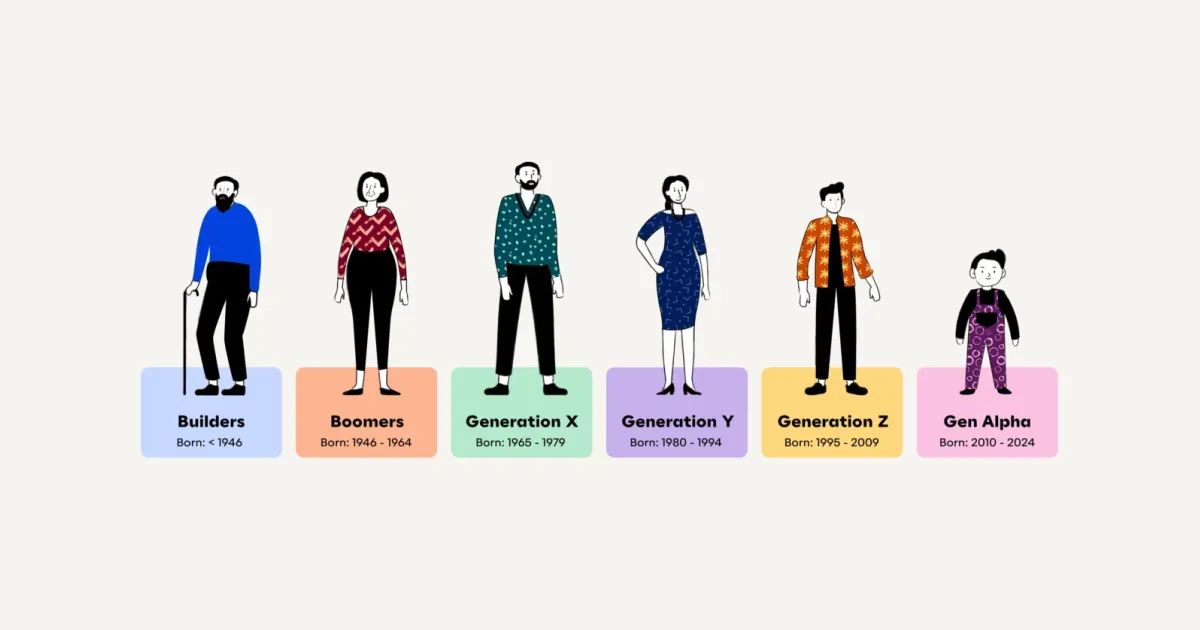
Mccrindle, (n.d). The generations defined. Mccrindle. https://mccrindle.com.au/article/topic/demographics/the-generations-defined/