Budget Planning Tips for Travel
In 12 Travel Budget Planning Tips to Enjoy More While Spending Less (2024), author Tracy Smith shares tips for budgeting while traveling. I will be discussing some of her tips and how I could integrate them into my design.
Before any travel planning and definitely before any travel booking, take time to define your travel goals and purpose. This is often a missed step, but your goals will have huge implications on decisions that cost money. If they aren’t defined, chances are your money may be spent on things that don’t matter as much to you. Are you looking for an escape? An opportunity to indulge in local cuisine, to immerse yourself in nature, to experience a culture, or to see the sights? Clarify your top reasons for an upcoming trip and allow those priorities to influence how you maximize your travel dollars. (Smyth, 2024)
Defining your trip goals and purpose before planning can help people understand where they may want to prioritize their budgets. When designing a system to help people save for traveling, this can be a helpful step to consider to help users better understand their own goals.
There are four primary travel costs: transportation, accommodation, food and activities. Admittedly a basic framework, but this is where the bulk of travel dollars are spent. This is where you can find the biggest opportunities to save on overall costs or to allocate finite travel dollars ( with intention) to things that matter most to you. Whether you build and follow a strict budget or simply give yourself a ballpark figure to help plan your next trip, think about your travel wallet needing four deep but not limitless pockets. Determine which of those pockets (transportation, accommodation, food or activities) matters the most for your next trip to help determine which pocket gets the most money, and which can be tightened up. (Smyth, 2024)
Understanding the four primary travel costs helps me understand what is important to consider. I think defining and integrating these four areas into my design could help users understand which areas are most important to them, allowing them to budget effectively.
Let me use our “retirement” trip as an example. By applying all the money-saving strategies and using the Travel Budget Calculator to sort our expenses, we discovered that we spent a total of $9000 for 10 weeks - an average of $900/week for two people. This is the breakdown of where our money went:
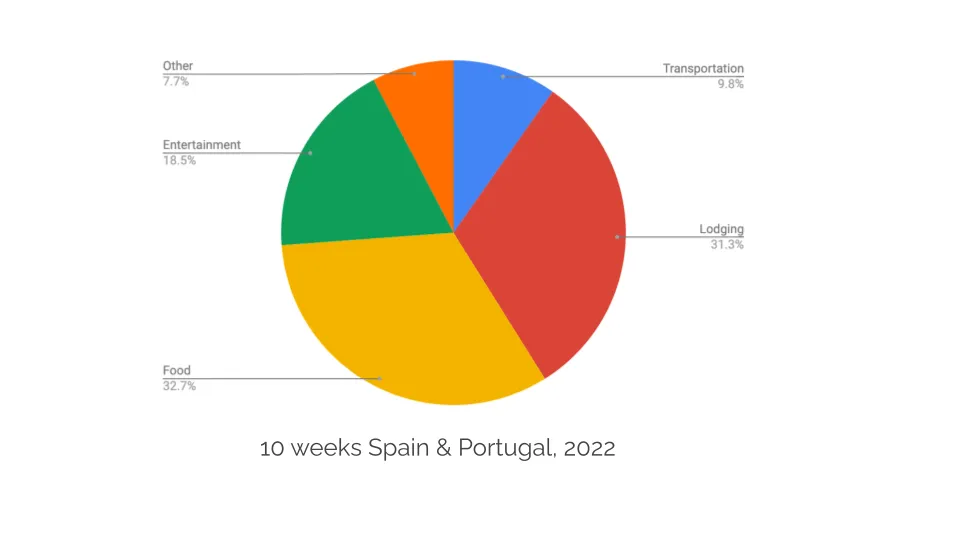
~10% transportation - trains, buses, and flights (Victoria - Barcelona, Sevilla - Porto, Lisbon - Bordeaux return, Lisbon - Victoria)
~32% accommodation - 5 nights using travel rewards, two 1-month stays with 40% discounts, and a “free” week away using Home Exchange.
~33% food - we spend a bit less than this normally at home with a combination of groceries and eating out! So using “traveller’s math” - does that even count!?!?😅
~ 19% activities - walking and food tours, entrance fees, 2 cooking classes, futbol tickets, a flamenco show - ALL the things we wanted to do!
~6% “other” - Airalo e-sim cards, travel insurance, gifts, etc…
I share this not to say that these percentages are a target. Instead, I hope you see that YOU can customize and juggle travel expenses in these four categories to make sure that you can:
a) find a way to afford travel.
b) spend money on the things that most matter to you.
c) learn about your spending habits so you can plan better for future trips. (Smyth, 2024)
This travel budget example seems to break down a budget in a simple way. I think integrating a tool like this, where people can customize their spending priorities, can help people manage their money and stay on budget when traveling. How can I integrate a customizable budget into my design? How can I make a shared, customizable budget for groups? How can I ensure each person’s spending preferences are considered within a shared budget?
References.
Smyth, T. (2024, August 28). 12 Travel Budget Planning Tips to Enjoy More While Spending Less. Travel Bug Tonic. https://www.travelbugtonic.com/blog/travel-budget-planning
A.I. was not used for this article.