Circular Business Models
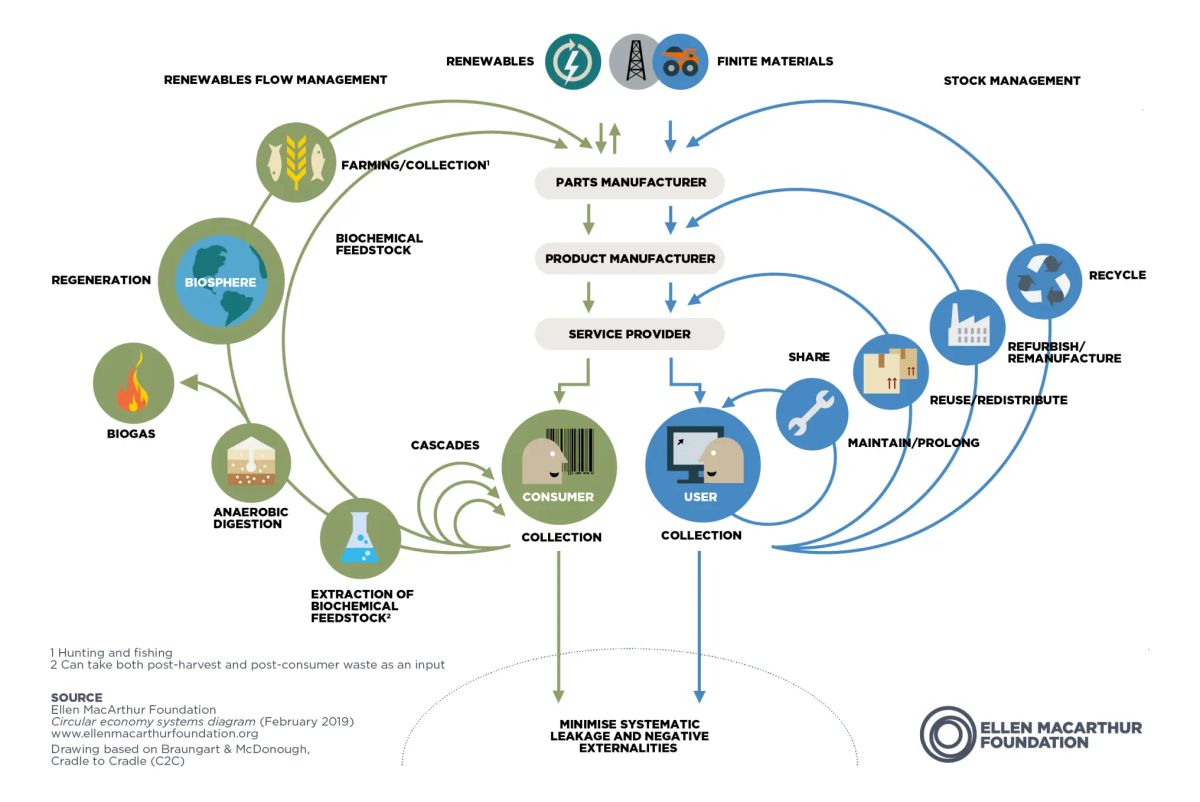
The Ellen MacArthur Foundation’s article “Circular business models: Rethinking how value is created” (2025) outlines how businesses can move from the linear “take-make-waste” model to circular systems that keep materials in use. It highlights strategies such as rental, repair, reuse, and refill to reduce waste while creating long-term economic value.
Circular business models, such as rental and repair, are designed to create and capture value by keeping products and materials in use at their highest value. Instead of following a straight line from production to disposal, resources in a circular business model keep flowing through the economy. In doing so, they decouple economic activity from the extraction of raw materials.
Circular business models aren't just about individual products or processes — they're about redesigning how businesses create and capture value. The ways in which materials are circulated are not just add-on processes to business-as-usual, they are fundamental to how the business model is conceived.
The first principle of the circular economy is to eliminate waste and pollution. Currently, our economy works in a take-make-waste system. We take raw materials from the Earth, we make products from them, and eventually we throw them away as waste. Much of this waste ends up in landfills or incinerators and is lost. This system can not work in the long term because the resources on our planet are finite.
Parks have begun to embrace the first circular principle by implementing new strategies in their stores (like selling recycled plastic goods or reusable goods) to bring sustainable practices that preserve finite resources for future generations.
The second principle of the circular economy is to circulate products and materials at their highest value. This means keeping materials in use, either as a product or, when that can no longer be used, as components or raw materials. This way, nothing becomes waste and the intrinsic value of products and materials are retained.
Park systems can apply this principle by reusing building materials, refurbishing equipment, and composting organic waste, ensuring resources remain valuable while reducing costs, extending product life, and minimizing environmental impact.
The third principle of the circular economy is to regenerate nature. By moving from a take-make-waste linear economy to a circular economy, we support natural processes and leave more room for nature to thrive.
Park systems can implement regeneration by developing landscape areas that restore biodiversity, educating park-goers, and considering the needs of the environment. This allows nature to flourish and thus, enhances visitor experiences.
References.
Ellen MacArthur Foundation. (2022, February 16). Regenerate nature. Www.ellenmacarthurfoundation.org. https://www.ellenmacarthurfoundation.org/regenerate-nature
This reflection draws on Circular business models: Rethinking how value is created (Ellen MacArthur Foundation, 2025) (~40%), my own summaries and applications to park systems (~30%), and AI assistance in synthesizing concepts, drafting reflections, and refining language (~30%); all interpretations remain the responsibility of the author.