Consumer acceptance of products made from recycled materials: A scoping review

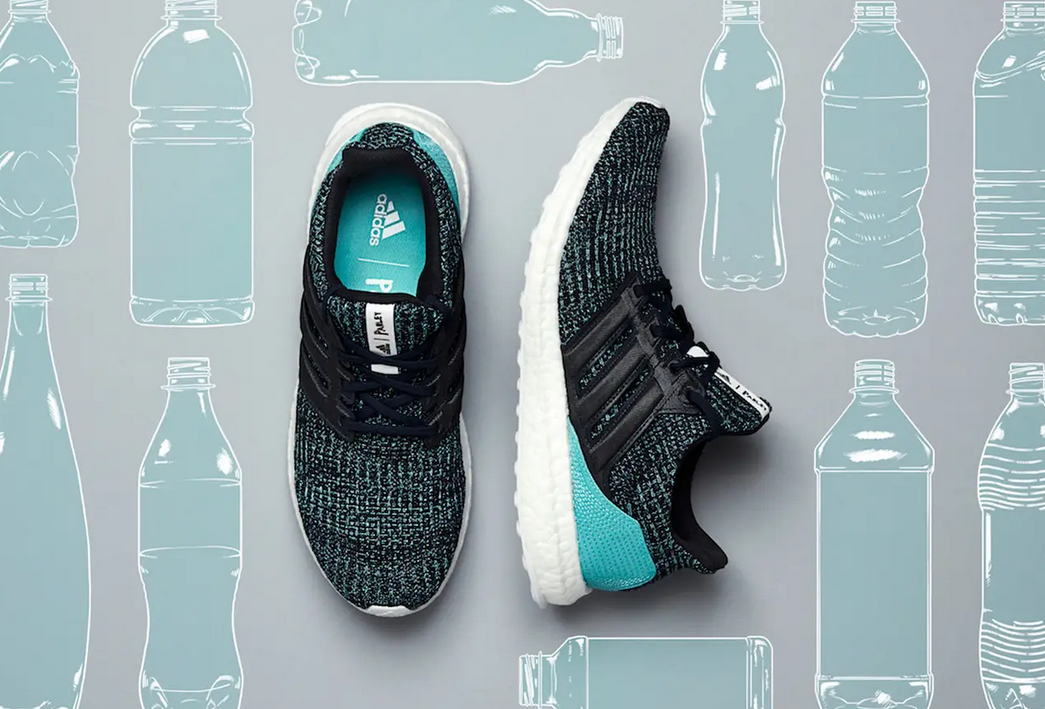
Consumers have a positive attitude towards products made from recycled materials; however, they frequently end up not purchasing them. To shed light on the factors that influence consumer preferences and acceptance of products made from recycled materials, a scoping review was conducted with the following objectives: (1) to explore which factors are drivers of the acceptance of products made from recycled materials, (2) to identify and analyse potential barriers for their adoption, and (3) to formulate recommendations for future research in order to further enhance choices of alternatives made from recycled materials.
Consumers play a crucial role in a circular economy because their choices can either support or hinder circularity (Calvo-Porral & Lévy-Mangin, 2020; Wagner & Heinzel, 2020). Several loops are possible in a circular economy, such as reuse, repair, refurbishment, and recycling. Although recycling is not the most preferred loop in a circular economy (e.g. Sabbaghi & Behdad, 2018; Vanegas et al., 2018), it is an inevitable loop for many products and contexts (e.g. plastic film included in packaging, or a broken plastic box) and thus important to explore. (Polyportis...)
It is important to remember that recycling is not the only step a product can take in its end-of-life journey. Ecologically, it is more beneficial to the planet to have less items produced and items lasting longer. That being said, recycling is still a necessary step to develop and consider when appropriate.
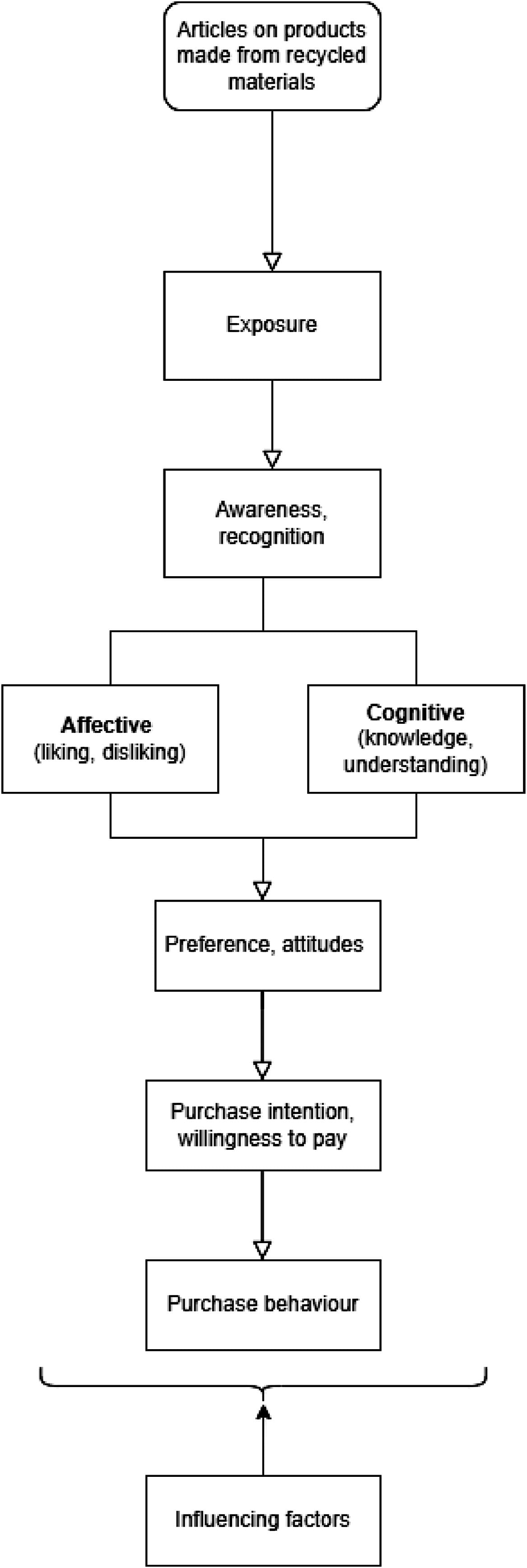
The Hierarchy of Effects assumes that “consumers normally do not go from disinterested individuals to convinced purchasers in one instantaneous step” (Lavidge & Steiner, 1961, p. 59). Rather, they experience a sequence of several stages in order to reach their final purchase decision. (Polyportis...)
Without any recognisable elements, it is hard to identify the fact that the product is made from recycled materials. For instance, Du Bois et al. (2021) found that consumers identify a sustainable material, such as one made from recycled plastic, as one that has a weaker colour intensity, a rather colourless, matte surface, rough texture and many speckles. (Polyportis...)
It’s interesting to see how consumers expect recycle made goods to look and feel like. It has me thinking about how my final capstone project could push against those stereotypes, and when it should embrace them.
In addition, US consumers recognised the recycled nature of kitchen garbage bags (Anstine, 2000) or paper towels (Srinivasan & Blomquist, 2009) through ecolabels and recycling logos. Eco-labelling is a factor that facilitates recognisability among Asian consumers as well. In an Asian sample, 22% of the participants perceived ecolabels as an identifying feature determining subsequent consumer responses towards products made from recycled materials (Kuah & Wang, 2020).
Products made from recycled materials are perceived not only in terms of (environmental) benefits but also in terms of risks; consumers often perceive products made from recycled materials to be inferior to new conventional products (Bei & Simpson, 1995; Hamzaoui-Essoussi & Linton, 2014). To holistically present how consumers perceive the potential risks of products made from recycled materials, we draw on the theory of perceived risk (Mitchell, 1992 in Magnier et al., 2019). (Polyportis...)
Often, for a recycle made product to be recognizable it needs an ecolabel logo. Yet, many people still feel that recycled materials are somehow less reliable.
Finally, aesthetic risk is the risk deriving from a potential lack of attractiveness (Testa et al., 2021), or from the perception that the purchased product will not be in line with the consumer's self-image (Kim et al., 2021). (Polyportis...)
These is very much an aesthetic element to consumerism that allows individuals a form of self expression. It will be an interesting challenge to capture individualism and represent community culture with recycled materials. This may be a chance to shift public opinions if done correctly.
Polyportis, Athanasios, et al. “Consumer Acceptance of Products Made from Recycled Materials: A Scoping Review - Sciencedirect.” Science Direct, 2022, www.sciencedirect.com/science/article/pii/S092134492200369X.