
Does Generative AI Have a Place in a Sustainable Project?
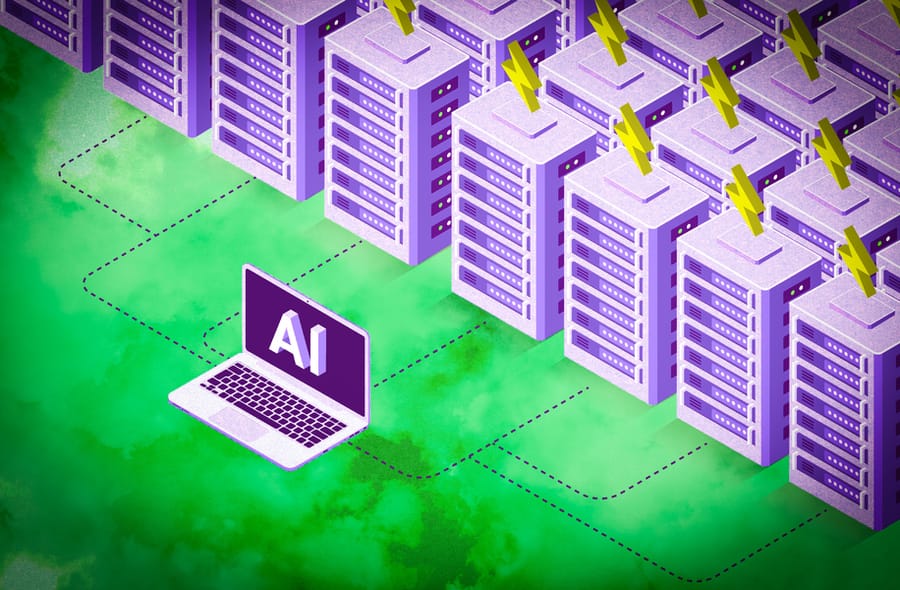
Generative AI is seemingly more common than ever. As designers, it's often at least at the back of our minds. I had heard that generative AI is bad for the environment, so I wanted to find out how exactly it is. The UNEP (2025) and MIT News' Adam Zewe (2025) go into detail in the articles quoted below.
Excerpts from the UNEP (2025)
“There is still much we don’t know about the environmental impact of AI but some of the data we do have is concerning,” said Golestan (Sally) Radwan, the Chief Digital Officer of the United Nations Environment Programme (UNEP). “We need to make sure the net effect of AI on the planet is positive before we deploy the technology at scale.”
Most large-scale AI deployments are housed in data centres, including those operated by cloud service providers. These data centres can take a heavy toll on the planet. The electronics they house rely on a staggering amount of grist: making a 2 kg computer requires 800 kg of raw materials. As well, the microchips that power AI need rare earth elements, which are often mined in environmentally destructive ways, noted Navigating New Horizons.
The second problem is that data centres produce electronic waste, which often contains hazardous substances, like mercury and lead.
Third, data centres use water during construction and, once operational, to cool electrical components. Globally, AI-related infrastructure may soon consume six times more water than Denmark, a country of 6 million, according to one estimate. That is a problem when a quarter of humanity already lacks access to clean water and sanitation.
Finally, to power their complex electronics, data centres that host AI technology need a lot of energy, which in most places still comes from the burning of fossil fuels, producing planet-warming greenhouse gases. A request made through ChatGPT, an AI-based virtual assistant, consumes 10 times the electricity of a Google Search, reported the International Energy Agency. While global data is sparse, the agency estimates that in the tech hub of Ireland, the rise of AI could see data centres account for nearly 35 per cent of the country’s energy use by 2026.
Driven in part by the explosion of AI, the number of data centres has surged to 8 million from 500,000 in 2012, and experts expect the technology’s demands on the planet to keep growing.
“Governments are racing to develop national AI strategies but rarely do they take the environment and sustainability into account. The lack of environmental guardrails is no less dangerous than the lack of other AI-related safeguards.”

Quotes from MIT News' Adam Zewe (2025)
The computational power required to train generative AI models that often have billions of parameters, such as OpenAI’s GPT-4, can demand a staggering amount of electricity, which leads to increased carbon dioxide emissions and pressures on the electric grid.
Furthermore, deploying these models in real-world applications, enabling millions to use generative AI in their daily lives, and then fine-tuning the models to improve their performance draws large amounts of energy long after a model has been developed.
“What is different about generative AI is the power density it requires. Fundamentally, it is just computing, but a generative AI training cluster might consume seven or eight times more energy than a typical computing workload,” says Noman Bashir, lead author of the impact paper, who is a Computing and Climate Impact Fellow at MIT Climate and Sustainability Consortium (MCSC) and a postdoc in the Computer Science and Artificial Intelligence Laboratory (CSAIL).
“The demand for new data centers cannot be met in a sustainable way. The pace at which companies are building new data centers means the bulk of the electricity to power them must come from fossil fuel-based power plants,” says Bashir.
The power needed to train and deploy a model like OpenAI’s GPT-3 is difficult to ascertain. In a 2021 research paper, scientists from Google and the University of California at Berkeley estimated the training process alone consumed 1,287 megawatt hours of electricity (enough to power about 120 average U.S. homes for a year), generating about 552 tons of carbon dioxide.
While all machine-learning models must be trained, one issue unique to generative AI is the rapid fluctuations in energy use that occur over different phases of the training process, Bashir explains.
Power grid operators must have a way to absorb those fluctuations to protect the grid, and they usually employ diesel-based generators for that task.
With traditional AI, the energy usage is split fairly evenly between data processing, model training, and inference, which is the process of using a trained model to make predictions on new data. However, Bashir expects the electricity demands of generative AI inference to eventually dominate since these models are becoming ubiquitous in so many applications, and the electricity needed for inference will increase as future versions of the models become larger and more complex.
Plus, generative AI models have an especially short shelf-life, driven by rising demand for new AI applications. Companies release new models every few weeks, so the energy used to train prior versions goes to waste, Bashir adds. New models often consume more energy for training, since they usually have more parameters than their predecessors.
Chilled water is used to cool a data center by absorbing heat from computing equipment. It has been estimated that, for each kilowatt hour of energy a data center consumes, it would need two liters of water for cooling, says Bashir.
One can object to or support the use of generative AI for reasons based on personal values and beliefs. (Personally, I’m opposed to it for various reasons.) But, it’s not just a matter of opinion. The use of generative AI has real, observable negative effects on the environment that shouldn’t be ignored—especially by those of us who strive for sustainability in our designs.
I don’t have a definitive answer to whether or not generative AI has a place in sustainable design. But I do think that we should all consider the question: Is what we get from generative AI worth the immense usage of electricity, water, and finite materials? Sure, it might make things a little easier for you in your process. But at what cost? Impacting biodiversity, increasing CO₂ emissions, extreme electricity use… all seemingly without end as generative AI tools are perpetually updated. None of that seems worth it to me. Nor does it feel at all appropriate in the context of my capstone project, which is focused on the conservation of natural resources and improvement of sustainability.
No generative AI was used in the creation of this post.
References.
United Nations Environment Programme. (2024). AI Has an Environmental Problem. Here’s What the World Can Do About That. United Nations Environment Programme. https://www.unep.org/news-and-stories/story/ai-has-environmental-problem-heres-what-world-can-do-about
Zewe, A. (2025). Explained: Generative AI’s Environmental Impact. MIT News | Massachusetts Institute of Technology. https://news.mit.edu/2025/explained-generative-ai-environmental-impact-0117