Folding Value: The Art and Design of Moneygami
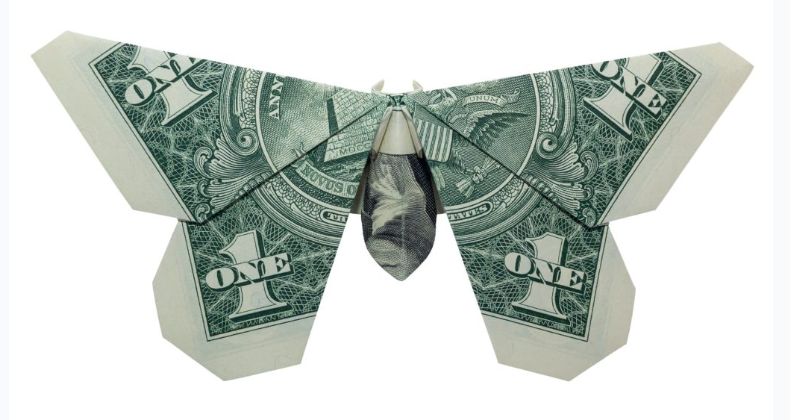
Moneygami (the art of folding banknotes with origami techniques) transforms everyday currency into works of creativity and critique. What began in magic circles in the 1940s has since grown into a recognized branch of origami and a distinct form of money art.
“Popularised by contemporary artists including Yosuke Hasegawa, Moneygami combines the idea of using Origami techniques in the execution of artwork made with banknotes." (Naviere, 2024).
"The earliest publications about folded money were in magic magazines and books from the 1940s, showcasing items such as the US $1 bow tie technique, ring, flapping bird, snapping fish etc. In the 1950s, shapes became more elaborated (pair of shorts, double ring, peacock etc…); they were mostly made out of US dollar and British pound. By 1958, money folding was identified as a branch of Origami, around the same time Victor Frenkil gained in popularity by making initials and words from folded banknotes." (Naviere, 2024).
"Moneygami is a great example of how historical and artistic techniques can be applied in the production of Money Art." (Naviere, 2024).
"In the 1960s, more publications mentioning folded banknotes were released, such as in The Origamian magazine and, “The Folding Money Book” by magician and talented origamist Adolfo Cerceda, entirely dedicated to the technique. By the end of the decade, more creations were developed, such as the popular stag by Fred Rohm." (Naviere, 2024).
During the 1990s, Ron Rotter started to fold banknotes into geometric shapes or animals, to entertain his kids and leave his creations as tips when going out at restaurants. As his technique and popularity rose, so did the recognition from the art world such as the Smithsonian’s National Museum of American History where Rotter’s Interlocking Tetrahedron, made out of 30 banknotes, is displayed.” (Naviere, 2024).
What makes Moneygami compelling is how it layers history, artistry, and meaning. Early dollar tricks evolved into intricate folds like peacocks, stags, and geometric forms, pushing the practice from novelty to legitimate art. Artists such as Victor Frenkil popularized folding initials and words, while Ron Rotter’s playful creations for his children eventually earned a place in the Smithsonian’s National Museum of American History. From a design lens, Moneygami demonstrates how material choice shifts perception. Folding a bill into an animal or tetrahedron interrupts its function as currency and reframes it as aesthetic, symbolic, and even playful. In doing so, it highlights how design can challenge assumptions, redistribute value, and create new forms of cultural dialogue. Moneygami reminds us that innovation in art and design often comes not from inventing entirely new tools, but from reimagining the familiar in ways that provoke curiosity and meaning.
References.
Ignatev, K. (n.d). Money Origami BUTTERFLY [Photography]. The Art of Folding Origami & Moneygami. Banknote Artconcept. https://banknoteartconcept.com/origami-moneygami/
Naviere, Y. (2024, October 5). The art of folding: Origami & moneygami. Banknote Art Concept. https://banknoteartconcept.com/origami-moneygami/
This reflection draws on Origami – Moneygami (Banknote Art Concept, n.d.) for historical and contextual material (~40%). My contributions include the interpretation of Moneygami’s evolution and its implications for design, particularly how it reframes currency as symbolic and aesthetic (~40%). AI assistance was used to synthesize, condense, and edit content into a coherent introduction and review (~20%). All interpretations remain the responsibility of the author.