From Trash to Cash: How AI and Machine Learning Can Help Make Recycling Less Expensive for Local Governments
This article stuck out to me from my own experiences living in Columbus. Our house had a recycling bin that listed everything you could put in there from paper to plastic and cardboard. However, I was always skeptical of whether or not it actually got recycled. Especially looking at my neighbors overflowing with pizza boxes and other items that weren't on the Rumpke list. From the research for capstone, I have seen many articles that touch on the difficulty recycling can be when contaminants ruin a batch. Whether that is from dirty plastics or the wrong type getting mixed in. This researcher is trying to utilize advancing technology to mitigate the time, labor, and costs that have been past pain points when it comes to recycling.
Collecting recycling costs local governments a lot of money. They need to maintain facilities to handle the plastics as well as the trucks and bins to collect them. Governments also need to hire people to do the work. It can be a lot cheaper to just put everything in a landfill (Sutliff, 2025).
However, when local governments recycle, they can turn trash into cash if they have the correct infrastructure. They can offset some of the costs by selling the collected plastic back to manufacturers. Most manufacturers want recycled plastic that is almost as good as brand-new plastic, but that requires careful sorting by the recyclers to provide a consistent product (Sutliff, 2025).
At the local recycling facility in Montgomery County, Maryland, people hand-sort laundry detergent bottles, food containers and more. However, human hands and eyes can only move so fast, and mistakes are easy at that speed. So, recycling facilities focus on sorting high-value or easy-to-identify plastics to have consistency in what they are selling to secondary recyclers. That means detergent bottles and beverage containers are recycled at high rates. Your plastic “silverware” and old children’s toys are probably not (Sutliff, 2025).
Passing over hard to decipher items makes sense in a labor and time intensive process. There seems like an opportunity area for the random items to be donated, but that also would take time and hours.
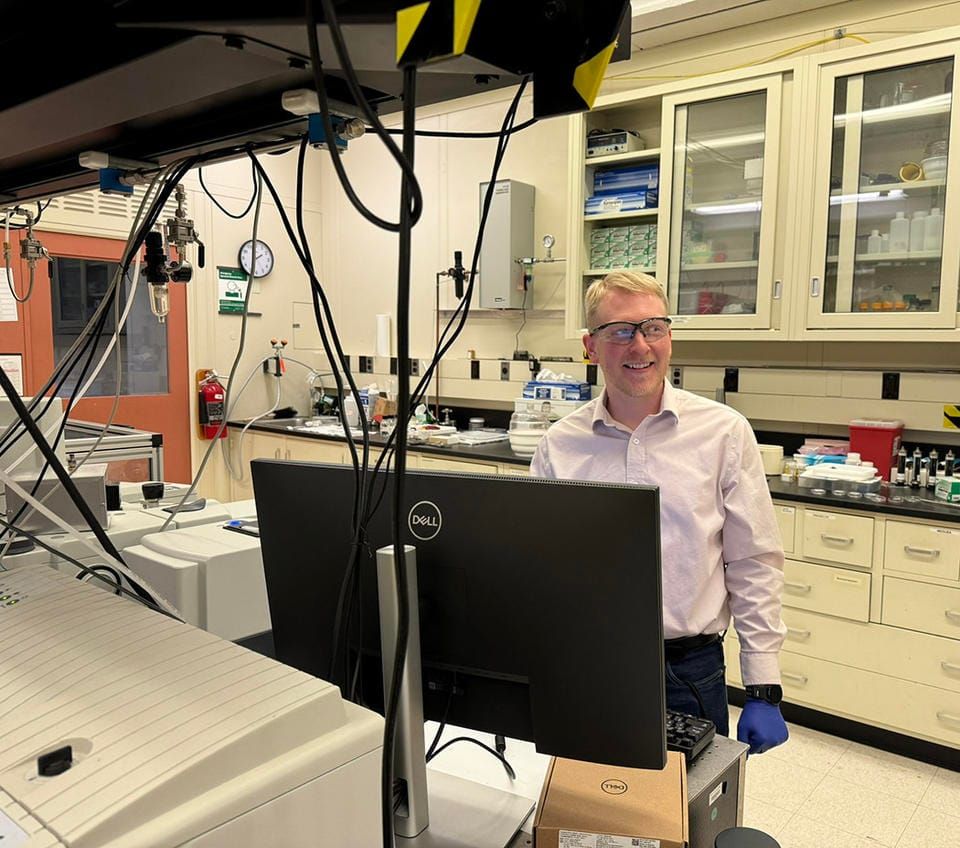
To help facilitate sorting, our work at NIST has been focused on using near-visible infrared light (NIR), a technology that can look at plastics and rapidly tell us what they are. Some top-of-the-line recycling facilities already use lights or cameras that “see” using this approach and sort soda bottles from PVC piping (Sutliff, 2025).
Using machine learning, we can find the NIR fingerprints for many plastic materials. We then “train” the computer to identify the plastic based on how similar the new NIR signal is to the NIR signals of other plastics. This training helps the technology identify the material in a soda bottle, know that it’s different from the makeup of a takeout container, and separate them accordingly (Sutliff, 2025).
To make this research more broadly useful, I’m working to show that we can sort those troublesome polyolefins. With my current methods, we are achieving 95% to 98% accuracy when sorting these plastics. We’re doing this with a process that almost any NIR-equipped recycling facility could start using very rapidly if it wanted to (Sutliff, 2025).
This research is really interesting to me, it seems like a seamless and intuitive solution to the problem of recycling being difficult to sort. As well as an appropriate use of AI. A designers role towards easing the struggles of separating recycling could be to limit the uses of multiple plastics in a single item with their designs. With the system, I wonder how the program would react when scanning a piece that has two different types of plastic like Gatorade bottles. I also wonder what happens to the items that get filtered out as "bad", that seems like an area of opportunity to potentially clean or separate further for a second pass through.
Reference.
Sutliff, B. (2025, January 30). From trash to cash: How ai and machine learning can help make recycling less expensive for local governments. NIST. https://www.nist.gov/blogs/taking-measure/trash-cash-how-ai-and-machine-learning-can-help-make-recycling-less-expensive