Household Plastic Waste Management and Gender Dynamics in Circular Economies
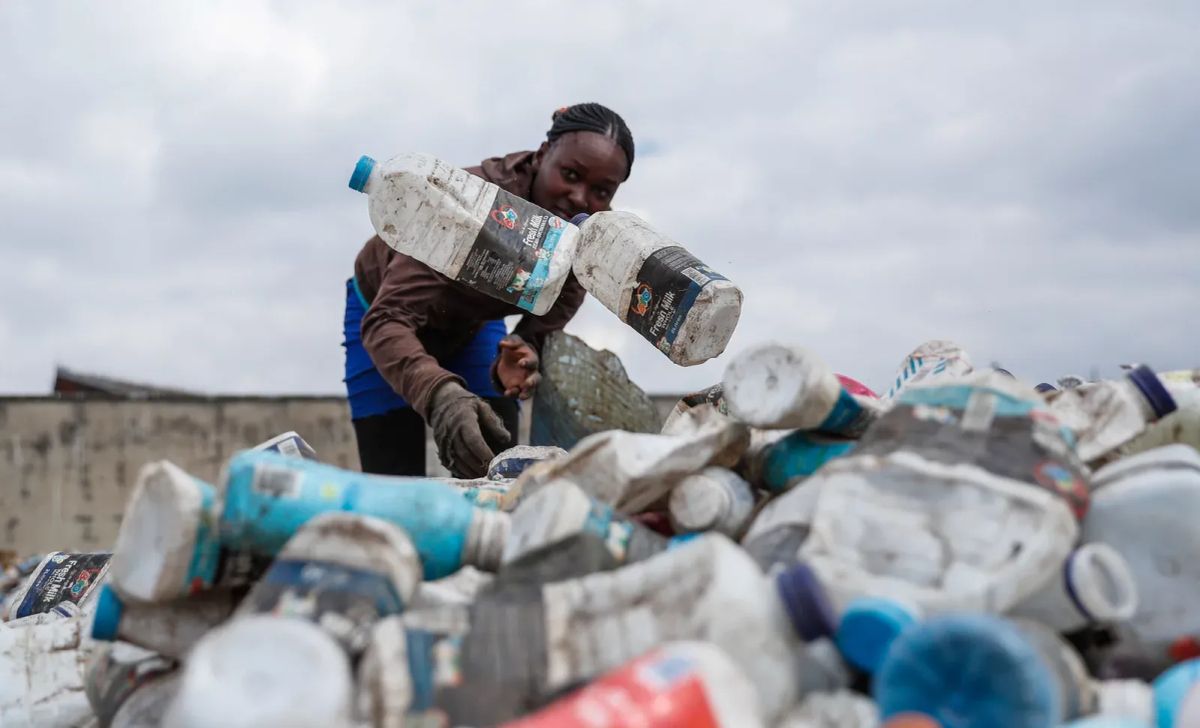
I chose this specific article because I wanted to look at the circular economy with a feminist lens. In my time as a Women’s, Gender, and Sexuality major, we studied how gender impacts everything and the circular economy is no exception. It is a fact that shopping, cooking, caring, childrearing, and recycling are all considered feminized labor. Because of this, women and girls tend to interact with more plastic materials than their male counterparts. When I was thinking about my special interest of plastic intimacy, I immediately noticed gender identity as a big factor.
From Shakuto et al. 2024:
"What are the hidden gendered costs of household plastic waste management?" (Shakuto, 2024).
"A circular economy is committed to transforming waste into resources for the next production cycle, while favoring an extension of a product's life‐span over disposal. Recycling is among a range of R‐behaviours or R‐imperatives (reuse, repair, etc.) that serve to close material loops by producing resources for new commodities out of secondary materials" (Shakuto, 2024).
"Accordingly, a circular economy is often construed as an alternative to a linear ‘take‐make‐use‐dispose’ model" (Shakuto, 2024).
"The plastic cassowary becomes a symbol of the tensions between traditional ways of life and the pressures of industrialization" (Shakuto, 2024).
"Studies have shown that older individuals are more environmentally conscious and tend to carry out actions such as reducing the use of plastic bags due to their familiarity with a culture of thrift and material conservation, in contrast to younger generations that have a ‘throw away’ mentality" (Shakuto, 2024).
"Furthermore, plastics have transnational political implications, as many more developed countries export their plastic waste to developing countries. In ways that Liboiron (2021) calls ‘waste colonialism’, such plastic waste export worsens waste accumulation issues in these countries while encouraging plastic consumption in the waste‐exporting countries" (Shakuto, 2024).
"Governments tend to render plastic waste management a political issue so as to discipline individuals to participate in public displays of responsible citizenship. In doing so, governments individualize responsibilities without addressing the underlying structural causes of plastic waste" (Shakuto, 2024).
"Studies have shown that consumer recycling can only be successful if unpaid labour, particularly the domestic labour of women in households, is co‐opted in sorting and warehousing most of the plastic waste before it is picked up by waste collectors" (Shakuto, 2024).
"Other scholars have employed intersectional lens to note that gendered labour relations, as they intersect with other axes of social identities, are central to creating a circular loop for plastics. In some countries, waste collection efforts are concentrated in urban areas, leaving rural communities to rely on women and low‐income workers to reduce and recycle waste" (Shakuto, 2024).
"It is thus unsurprising that in some countries, households with the lowest income levels may also have the most active recyclers" (Shakuto, 2024).
"These plastic containers, [Tupperware], not only facilitated women's performance of housework but also created opportunities for women to earn a side income" (Shakuto, 2024).
"This is important so that the circular economy policy or any other environmental policies do not exacerbate existing gender inequality" (Shakuto, 2024).
"Ecofeminism argues that environmental exploitation and feminized labour are both rooted in larger socio‐economic structures that devalue reproductive/care work" (Shakuto, 2024).
When it comes to mindfulness, recycling, repurposing, and other eco-conscious practices, we have to keep in mind who is doing all of this unpaid labor. Who is stripping the labels of bottles? Who is thrifting old clothes? Who is turning cardboard boxes into children’s toys?
If we are to create a sustainable circular economy or any other solution to plastic waste, it must not, like the authors said, perpetuate gender inequality. We have to find a way to engage everyone into a circular economy if we want it to work.
No generative artificial intelligence (AI) was used in the writing of this work.
References
Shakuto, S., Yeoh, B.S.A., Reynolds, D., Rahadini, I.A., Tan, Q.H. and Pang, N. (2024), Household Plastic Waste Management and Gender Dynamics in Circular Economies. Sociology Compass, 18: e70023. https://doi.org/10.1111/soc4.70023