How mushrooms and microorganisms could transform food packaging

The Local Loops project has a focus on plastic recycling, but is plastic always the best material to use? I have many questions about when plastic should and should not be implemented. This article gives a glimpse into alternative materials and their applications.
Being able to ensure freshness, convenience and food safety, while meeting esthetical standards and minimizing the ecological footprint, is not an easy challenge. However, sustainable packaging solutions are expected to become increasingly important over the next few years, as consumers’ preferences progressively shift towards products that are planet-friendly at an all-around level.
With two-thirds (67%) of consumers considering it important that the products they buy are in recyclable packaging, and the same percentage consider themselves environmentally aware, the global sustainable packaging market is projected to reach $470 billion by 2027, up from an estimated $305 billion in 2020.
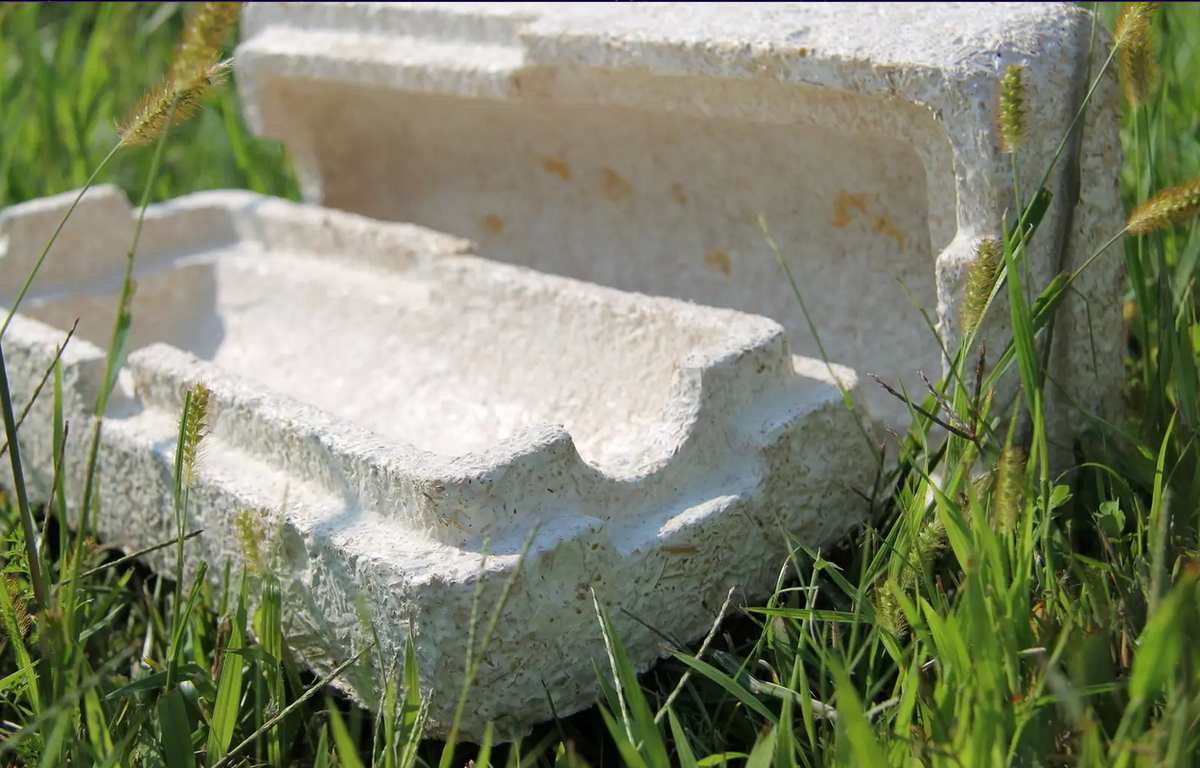
Mycelium is an innovative packaging material very similar to polystyrene foam. Lightweight, easy to mould, and easy to produce – all favourable traits for materials used in packaging – mycelium is cost-competitive with polystyrene foam, making its most common use as a replacement where Styrofoam is typically used, e.g. to protect glass bottles and jars for shipment. (Cecchini)
Polystyrene foam cannot be recycled like other forms of plastic, and it does not go away easily. This mushroom-based alternative is a great supplement that is more environmentally friendly and sustainable.
The possible scope of applications of such materials ranges from textiles to furniture, while in the food sector it currently mostly finds application as biodegradable and resistant foodware. When discarded, it breaks down in a way that allows for the regeneration of the same processes that lead to its production, offering a circular and carbon negative solution which could potentially be perpetual if processed through the right technology.
Thanks to world-class technology, seaweed is processed into a transparent foil that can be used as a sealed drink container or as a food wrap. The obtained material is not only biodegradable, but even edible!
Cornstarch packaging is one of the most widespread sustainable options when it comes to storing food, and chances are that you have already seen it or even used it for your takeaway food. (Cecchini)
Any plastic near food causes complications on many levels. For one thing, adverse health effects may be caused by keeping plastic so close to something that goes into our bodies. Secondly, there is the issue with recycling. The thin sheets of plastic used as food wrappers can be hard to sort into the proper channels for recycling. This leads to most getting thrown into the trash by default. There is also debris left over on the wrappers surface from being so close to food which would be difficult to clean properly, meaning even if they end up in the right spot, it is unlikely they will be clean enough to recycle properly. All these factors would not be an issue for the seaweed or cornstarch alternatives.
For all of us consumers, it’s crucial to spend time learning about the existence of different packaging options, as well as the best ways to process them. (Cecchini)
Cecchini, Chiara. “How Mushrooms, Microorganisms Could Transform Food Packaging.” World Economic Forum, 2021, www.weforum.org/stories/2021/10/how-mushrooms-and-microorganisms-could-transform-food-packaging/.