How 'The Pudding' is Transforming Journalism
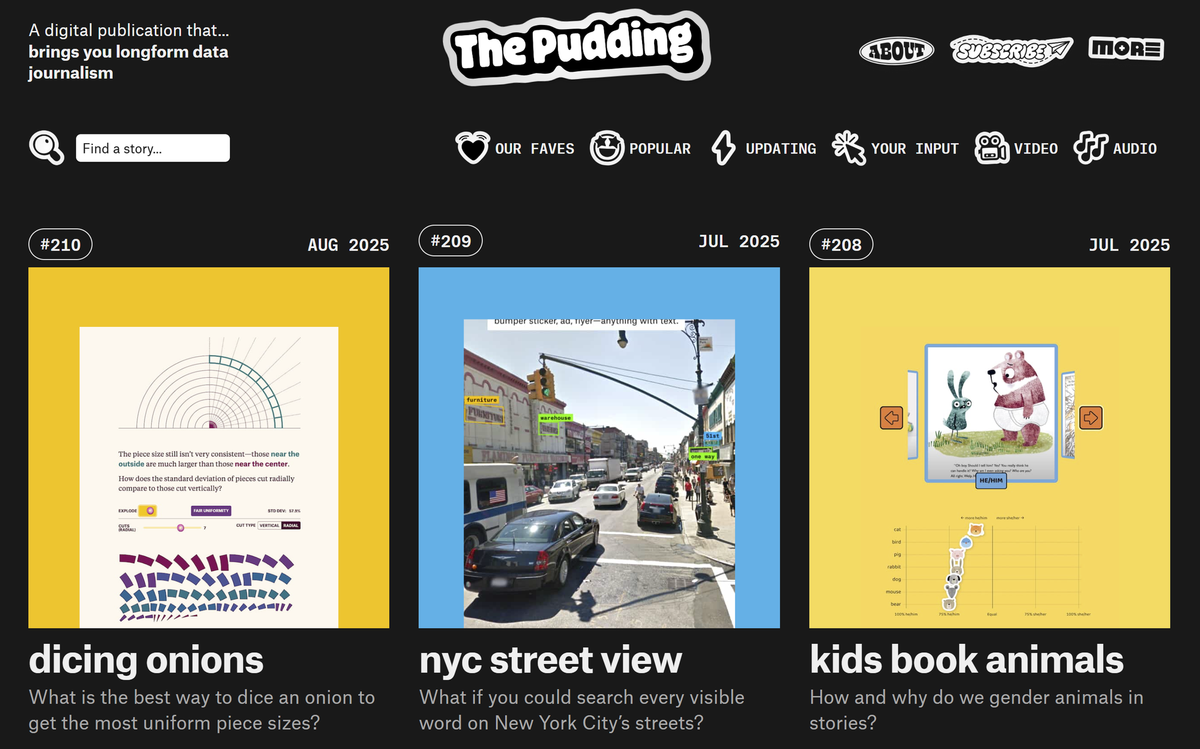
This article from The Pudding is the website's own testimony about its values, strategies, and business model that defy the rules and regulations of traditional journalism. It also describes the relationship between The Pudding as a free-access journalism platform and Polygraph, the content studio in which the visual essays for the site are created.
"The Pudding explains ideas debated in culture with visual essays. We’re not chasing current events or clickbait. We choose topics where visuals inform and entertain. Visual essays are an emerging form of journalism. Some of the most complex, debated topics get lost in 'too long; didn’t read' 10,000-word articles. Visual storytelling makes ideas more accessible—or so goes the adage 'a picture is worth a thousand words'" (The Pudding, n.d.).
"We strive for our journalism to be one of key making, not gate keeping, and we won't shy away from stories that tackle racism, sexism, and classism head on. We are committed to listening, learning, making changes, and being proactive in the fight for equity, inclusion, and racial and social justice" (The Pudding, n.d.).
"We're a small group that operates as a collective rather than hierarchical team. Much of our work is done autonomously, with individuals choosing their essays and owning the whole story, from research to code. Each team member can do every step: research and reporting, data analysis, design, writing, and code" (The Pudding, n.d.).
"One luxury that separates us from traditional newsrooms is our approach to publishing urgency. There are no deadlines because we are not tied to news events. With breaking news, it's difficult to gamble on weird, ambitious ideas if they must be published. No one will take on risky, creative projects when they're staring at a deadline. So, we experiment, a lot. . .Consequently, many of our ideas are killed during production, but we wouldn’t have it any other way! It means we’re trying unproven, never-done-before things" (The Pudding, n.d.).
"We're also trying to advance the craft. Visual journalism is still in its infancy. We don't have an established pattern language found in traditional reporting. Sometimes we’ll attempt an unfamiliar visual approach—not because it's guaranteed to work, but because we won’t know until we try. Rarely do organizations have the liberty to take such risks, yet we’re small enough to experiment in the pursuit of quality" (The Pudding, n.d.).
"We don’t have any ads or subscription walls on The Pudding. However, we need to keep the lights on somehow. Our team creates custom, white-labeled content via our award-winning visualization studio, Polygraph (The Pudding, n.d.).
"We run Polygraph with the purpose of sustaining our work on The Pudding. This allows The Pudding to operate in a purely journalistic space, giving us full creative autonomy on our articles. There’s no brand or client or advertisement contract controlling our Pudding projects, nor are we beholden to what gets the most page clicks" (The Pudding, n.d.).
"Basically, the wall between The Pudding and Polygraph is a business model embodiment of the editorial/advertising wall in journalism. The Pudding cannot exist without Polygraph, and Polygraph would have no need to exist without The Pudding" (The Pudding, n.d.).
"The only time a brand finds its way on The Pudding is through sponsored posts. . .Sponsorship allows us to do what we think is interesting with tools we wouldn’t have access to otherwise" (The Pudding, n.d.).
Review
This alternative approach to journalism and data visualization that The Pudding has embraced through the creation of visual essays is incredibly engaging, especially when you compare their articles to any standard written piece composed of blocks of text and a few photos here and there. One really good example I found was the article "30 minutes with a stranger", visualized by Alvin Chang, that displays a unique presentation strategy through narrative storytelling, is incredibly interactive, and still allows for neat and efficient organization of the data.
 The Pudding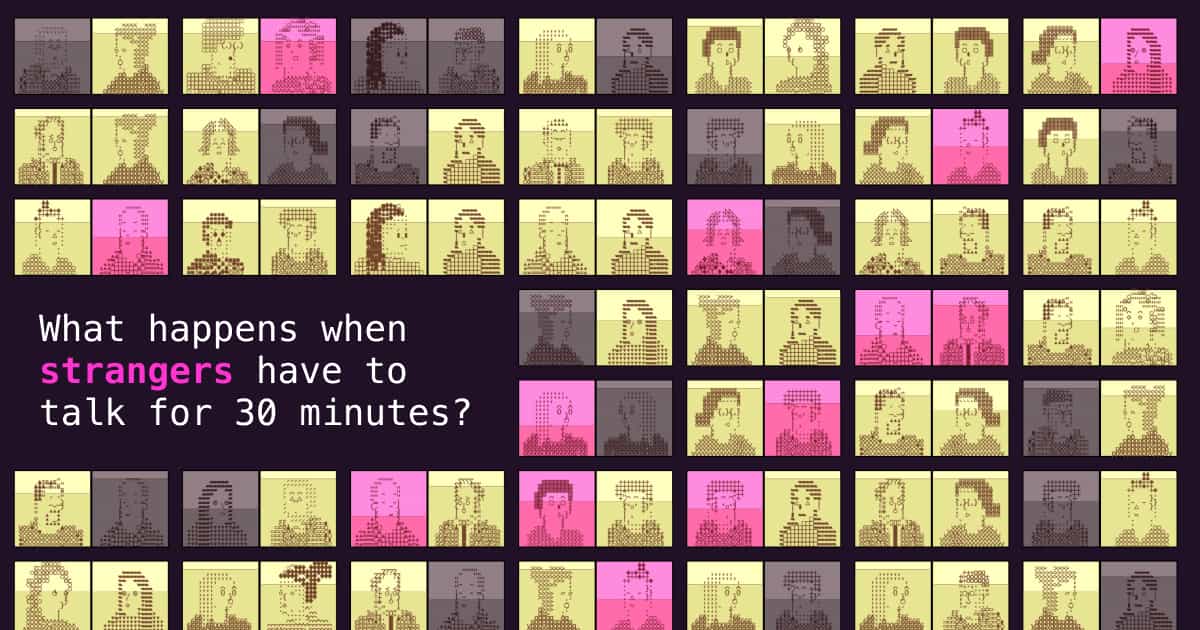
The Pudding team uses an interesting model in which the site itself is freely accessible to the public and does not answer to other companies via advertising contracts, but uses their content studio, Polygraph, to create visualizations for both the site and for clients who hire them. It's also interesting that team members can work on a project from start to finish, and that they aren't forced to write anything that "needs to be published" for news outlets. The Pudding provides an intriguing model for a business practice that could be of interest for designers and displays revolutionary strategies for information sharing that inspire me to create similar visualizations for my own research.
References
Chang, A. (2025, June). 30 minutes with a stranger. The Pudding. https://pudding.cool/2025/06/hello-stranger/
The Pudding. (n.d.). About Us. https://pudding.cool/about/