
Oklo demonstrates fuel recycling process
This article discusses the attempts at processing another waste stream, nuclear fuel waste. Currently there is not a common procedure in the United States because of costs, safety, and security concerns which results in storage being the main solution that facilities partake in. Storage is an okay solution for now, but what about when facilities run out of space or the oldest casks start to show wear? This recycling solution is geared towards limiting the waste issue that is usually ignored.
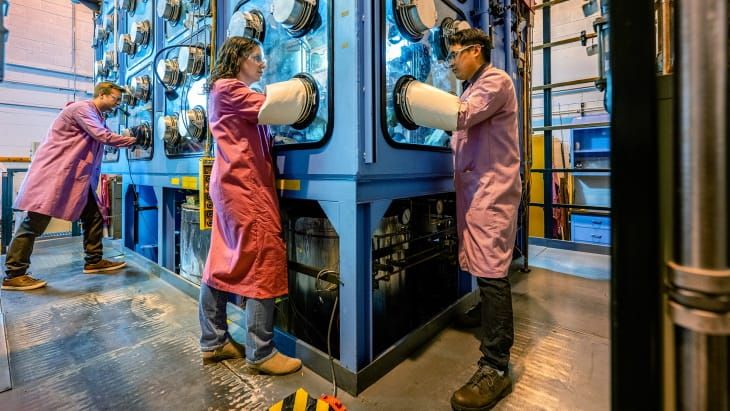
California-based liquid metal fast reactor developer Oklo Inc, in collaboration with Argonne National Laboratory and Idaho National Laboratory, has successfully completed the first end-to-end demonstration of the key stages of its advanced fuel recycling process (World Nuclear News, 2024).
Supported by a USD5 million cost-share award from the US Department of Energy's Advanced Research Projects Agency-Energy (ARPA-E) under the Optimizing Nuclear Waste and Advanced Reactor Disposal Systems (ONWARDS) Program, this project aims to facilitate the deployment of a commercial-scale advanced fuel recycling facility (World Nuclear News, 2024).
Oklo's fuel recycling technology is engineered to extract more than 90% of the remaining potential energy from used fuel, which is expected to be utilised in Oklo powerhouses to generate clean energy. It incorporates unique proliferation-resistant features, including maintaining the consolidation of transuranic materials (World Nuclear News, 2024).
Being able to recycle the used material to that extent is a large opportunity for businesses and reactors to save on costs, but also on the materials and assets that could be reallocated elsewhere, making them useful for longer.
The company said the introduction of commercial fuel recycling operations is expected to save up to 80% on its fuel costs, driving long-term value through enhanced fuel efficiency, alternative fuel source creation, and reduction in high-level waste requiring permanent disposal (World Nuclear News, 2024).
ARPA-E Director Evelyn Wang added: "We know that recycling is an important path to reduce high-level waste, and advance nuclear energy with safe and sustainable domestic fuel stocks. Through ARPA-E's ONWARDS Program, Oklo is working to achieve these goals. This milestone marks an important step forward in the team's progress as they work towards economically viable nuclear fuel recycling." (World Nuclear News, 2024).
ARPA-E Director Evelyn Wang added: "We know that recycling is an important path to reduce high-level waste, and advance nuclear energy with safe and sustainable domestic fuel stocks. Through ARPA-E's ONWARDS Program, Oklo is working to achieve these goals. This milestone marks an important step forward in the team's progress as they work towards economically viable nuclear fuel recycling." (World Nuclear News, 2024).
Through nuclear fuel recycling, it shows another example on how circularity can make an impact on an existing process. By taking a look creatively at a waste stream this company is opening the doors for other nuclear plants to follow suit and utilize potential energy. Cost reduction is a main motivator for a lot of reasoning behind business practices, but this measure checks off two boxes as one, additionally helping the environment and closing a loop internally. Part of the role of a designer currently acts as a problem solver, but how could our actions inform others? And what scale could this recycling system be adopted in?
Reference.
World Nuclear News. (2024, July 18). Oklo demonstrates fuel recycling process. World Nuclear News. https://www.world-nuclear-news.org/articles/oklo-demonstrates-fuel-recycling-process