Op-ed: Why is littering such a problem in Ohio State Parks?
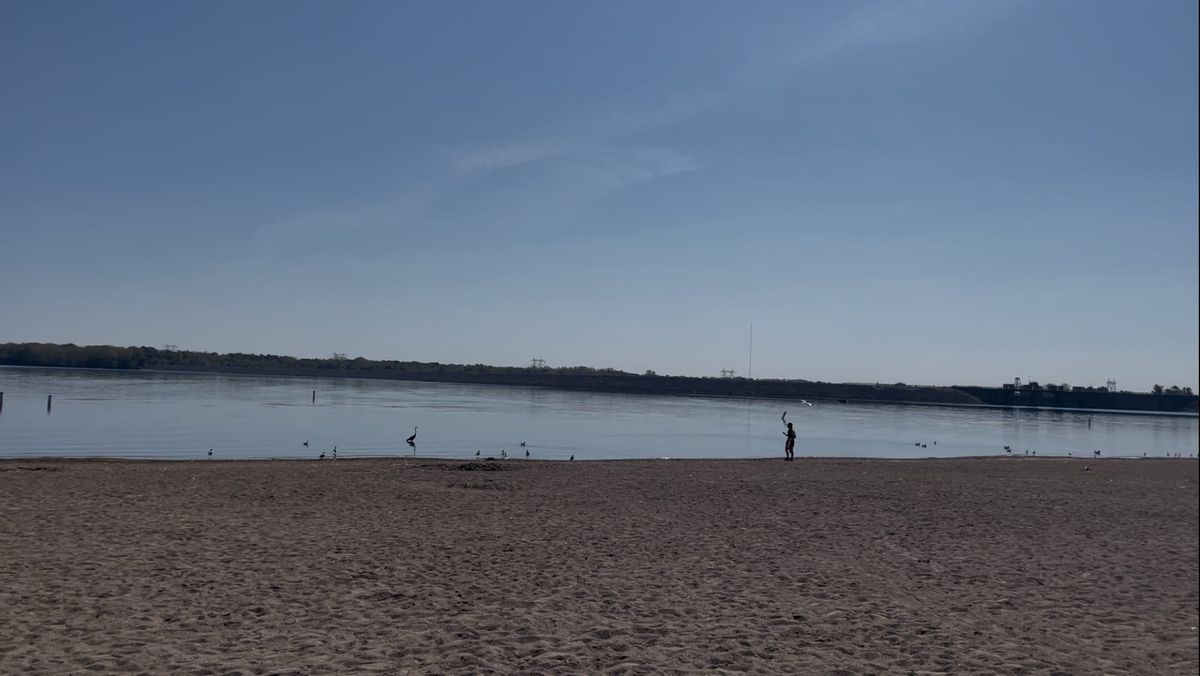
Aliina Lange, Nicole L., Emily Tanchevski, and I attended a project kickoff with our partners at the ODNR Division of Parks and Watercraft: Heather Bokman, Sustainability Coordinator; Tracey Coe, Clean Marinas Coordinator; and Mark Allen, Statewide Trails Administrator.
At the kickoff, we were introduced to the problem of high impacts on public parks due to human recreational activity, the ConServe Ohio Sustainability initiative, and our prompt: low impact recreation–balancing conservation with recreation.
From the kickoff presentation and visits to Alum Creek State Park and marina, as well as some secondary research, I defined my goal for this project: Reducing impact on state parks, plant life, and wildlife while maintaining positive visitor experiences. What I set out to find out, then, is how to do that.
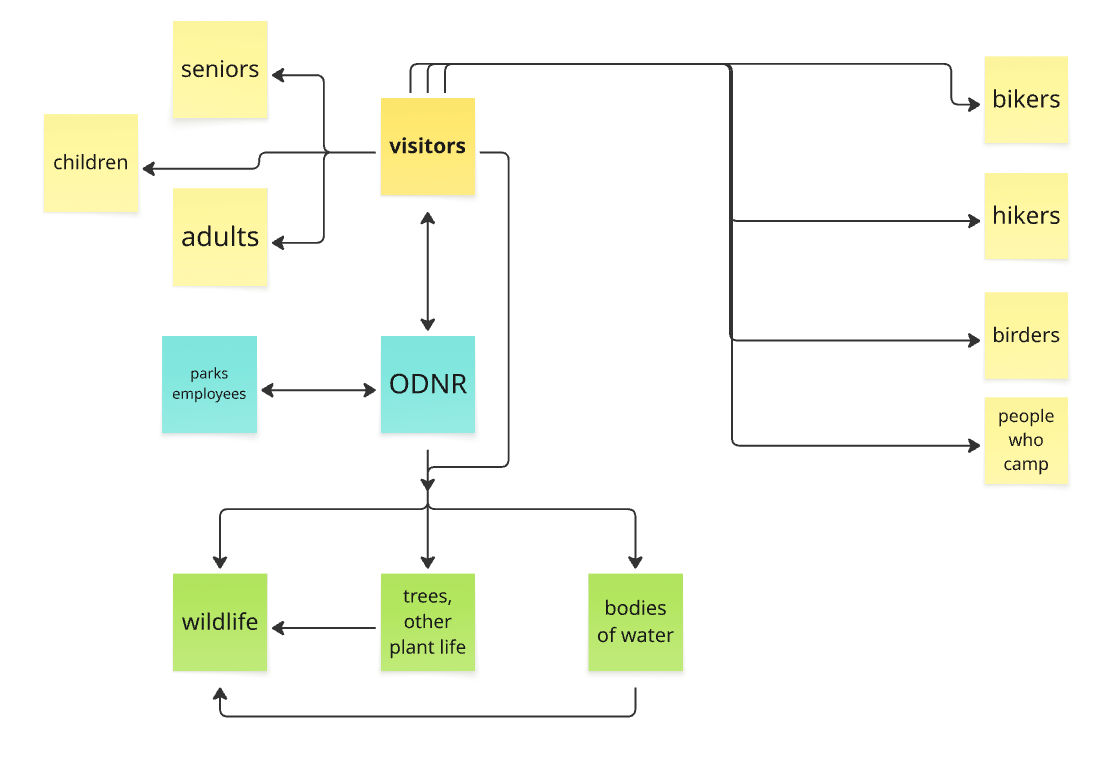
First, I mapped out the stakeholders in this project, thinking about how they relate to and affect each other.
Below is my initial visualization of issues at parks that cause high impact (Littering, Trail Overuse, Off-Trail Hiking, Single Use Gear) and low impact practices that should/could be practiced more (Cleaning gear, Leaving What You Find, Respecting Wildlife). This visualization was based on what we learned from our ODNR visit and some secondary research on the impacts of recreation.
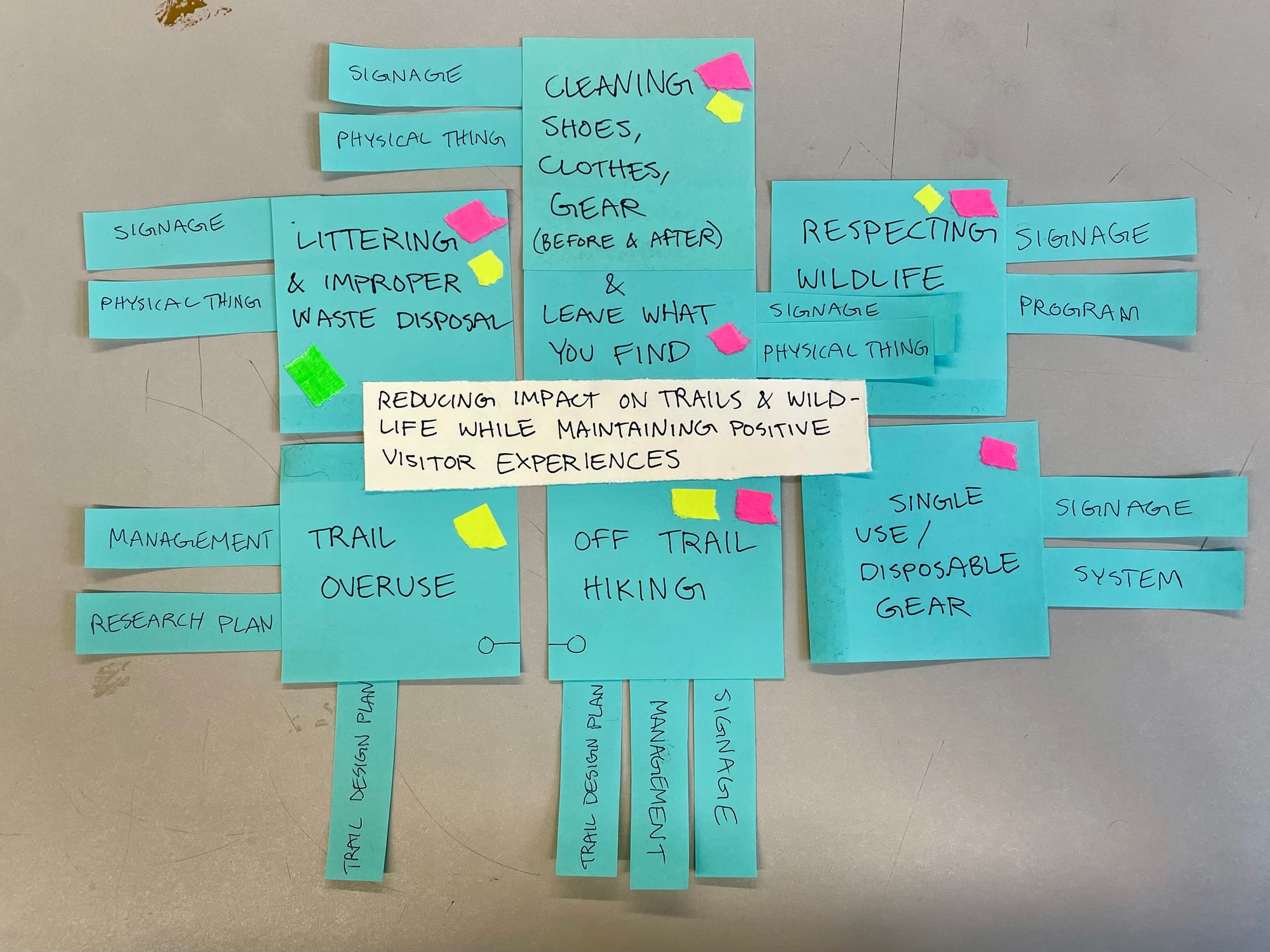
I clustered the issues/practices that related to each other, and marked them with the stakeholders (visitors, park managers, and trail designers) that are involved in the problem or possible solutions. I also noted what type of solution could address the problem: management changes, a research plan, a trail design plan, signage, a physical thing, a program, and/or a system.
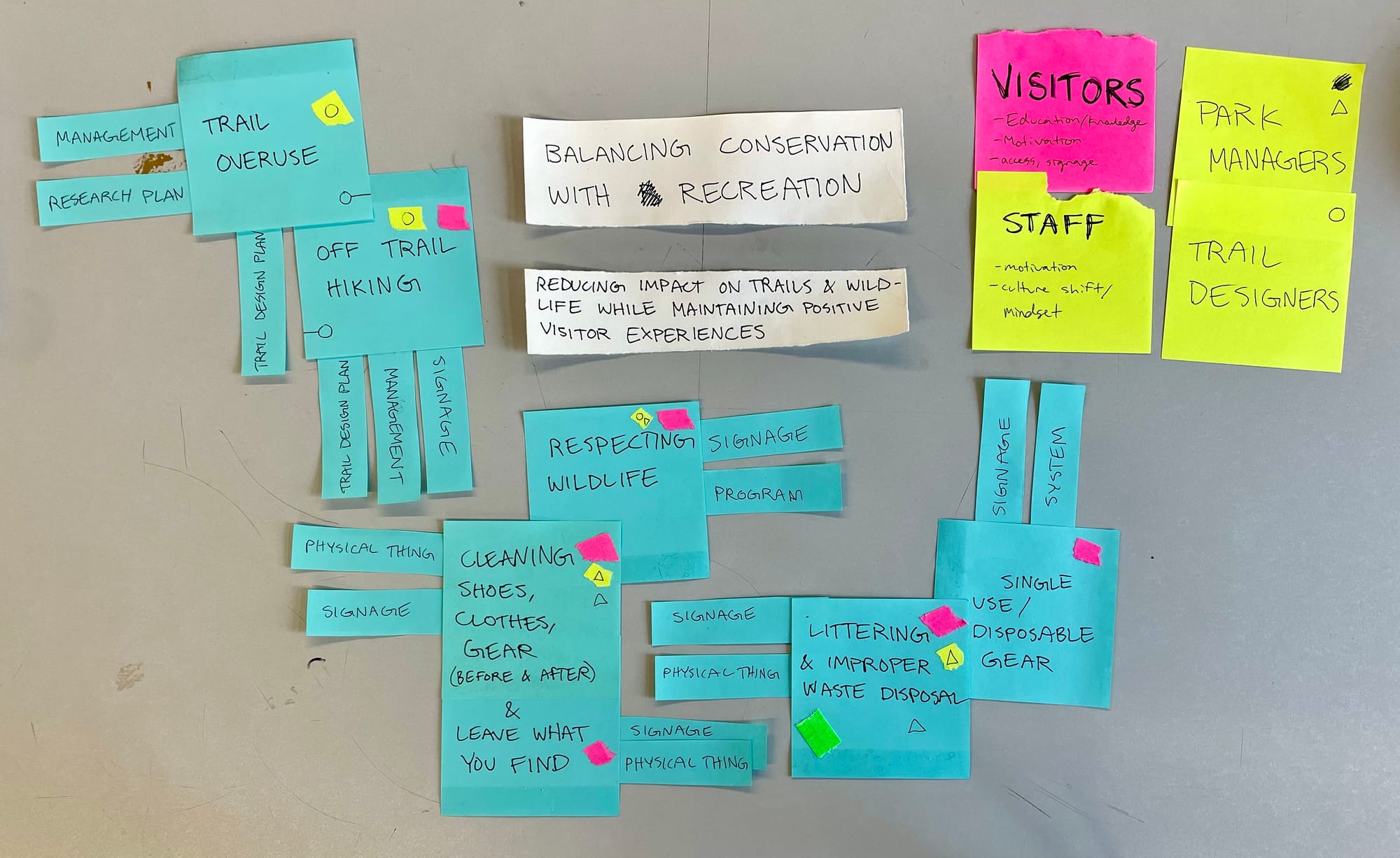
Visualizing, clustering, and tagging issues in this way helped me to frame my research moving forward. I identified approaches, such as signage, physical products, and management, to look into and try to understand better. It was most helpful in identifying knowledge blind spots that I sought out to fill with my research.
Research
What I wanted to find out, through primary and secondary research, was: (1) what are the impacts that recreation has on state parks (including on wildlife, plant life, trails, and staff), (2) which practices have the most significant impact, and (3) how those impacts can be most effectively minimized, managed, or eliminated.
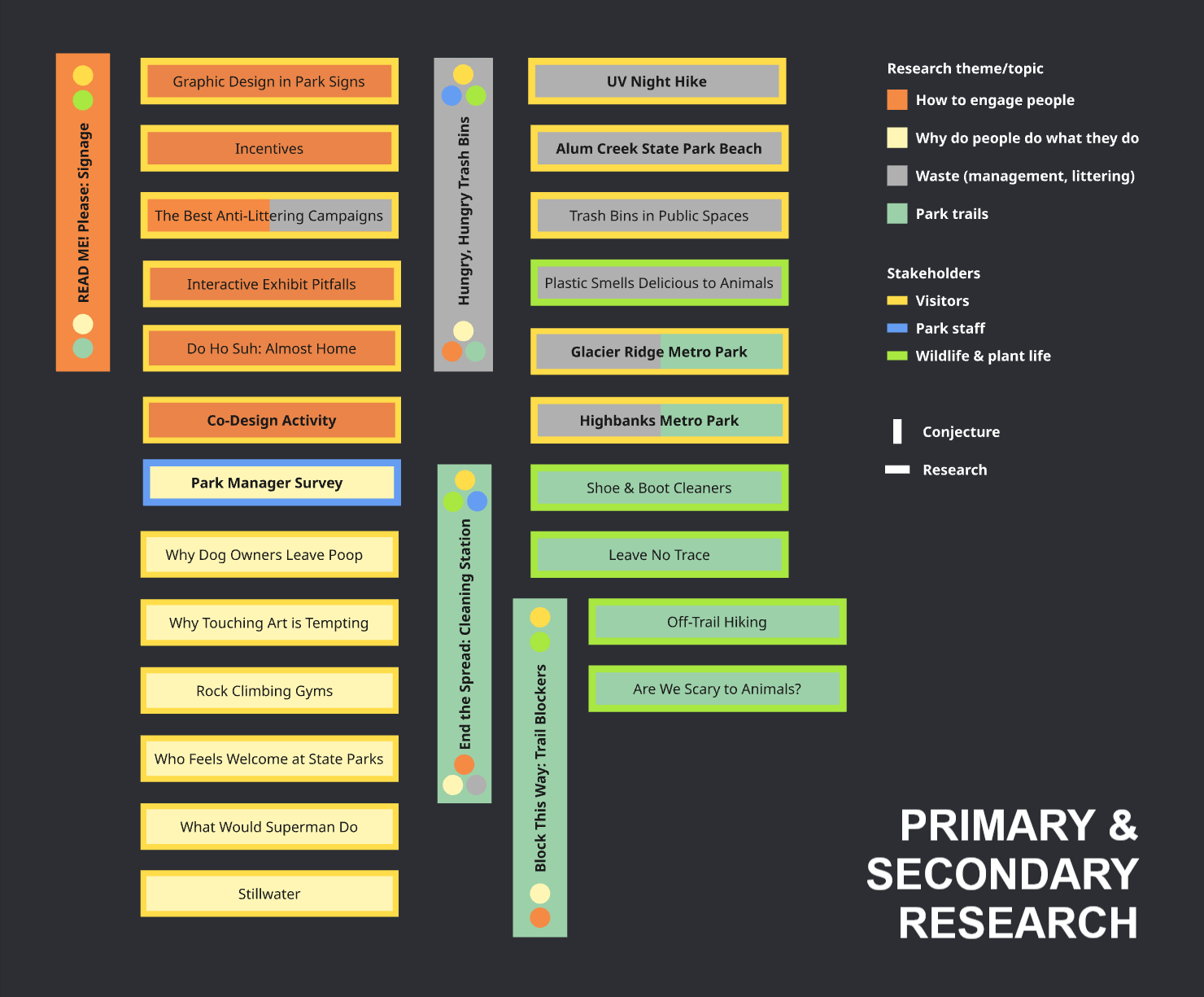
What I Found Out
It’s very easy to harm plant life, wildlife and your immediate environment when visiting a park. The presence alone of a visitor is enough to alter the behavior of wildlife due to fear (Zaske, 2023). There are also many ways to reduce your impact, or ‘leave no trace’. Leaving behind no trash, staying on official trails, and preventing the spread of invasive species are three crucial low-impact practices (York County Conservation District, 2021). Park et al. (2008) found that ‘aggressive’ implementation of indirect management practices (i.e. symbolic fencing, education/informational signage) are most effective in keeping visitors on official trails.
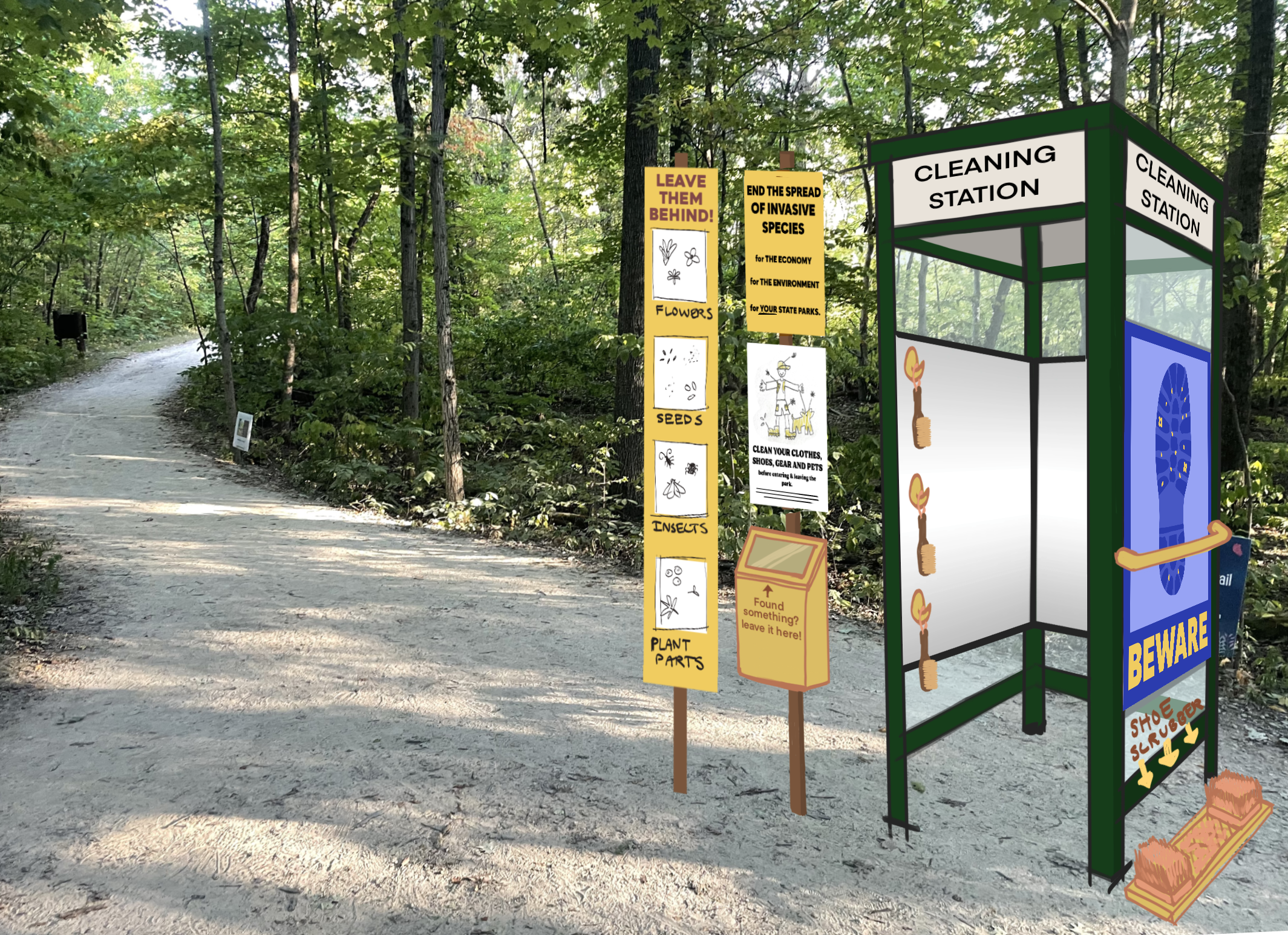
The concept sketch below is the End the Spread phone-booth style station which would provide a spot to inspect your clothes and gear for any hitchhiking bugs, seeds, or plant parts. The response to the concept was that having such a large and eye-catching station communicates the importance of cleaning off your gear to visitors, that it would be more effective to have two stations: one facing arriving visitors and one facing departing visitors, and that it's good that there's an explanation as to why visitors should clean/inspect their gear.
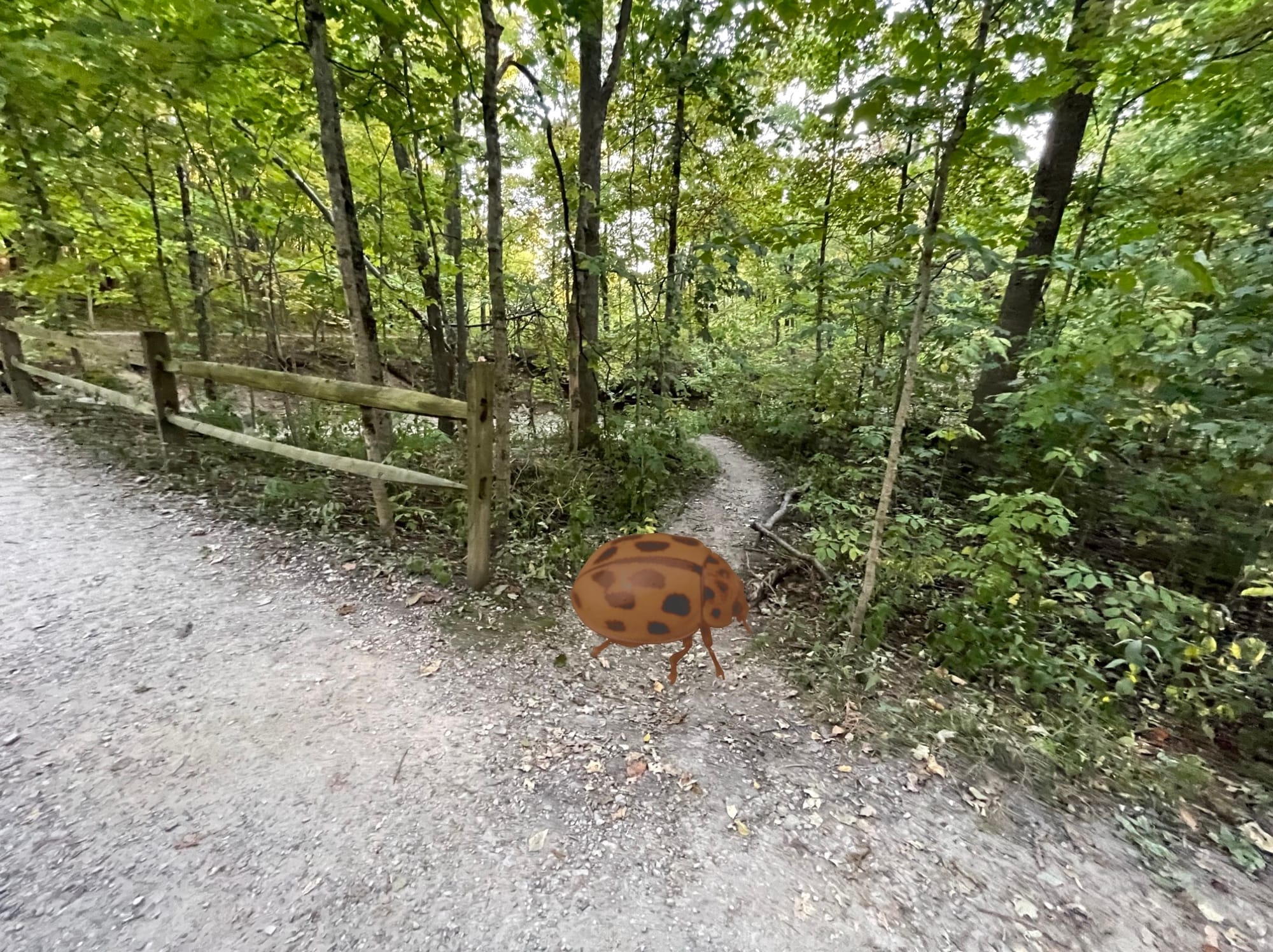
Below is my concept of Block This Way, in which large cast-iron statues of bugs and fruit local to Ohio would block the entrances/exits to user-created trails in the hope that visitors will be discouraged from using those trails, letting the plant life in that area regrow. This concept has a few possible problems: Due to their small size, they are more of a symbolic gesture, meaning that people can easily step over them (or trip over them and injure themselves). Or, walk around them, which would cause even more damage to the plant life. To address this, there could be signage to accompany the statues stating that they are there to block user-made trails, which can be unsafe and are damaging to the plant life. These signs could include information about the local bug or fruit represented by the statue, and tie it into a message on conservation for a connection to state pride. Of course, there is also the issue of cost and feasibility of production. And, bronze statues may invite visitors, particularly children, to climb on them. The Columbus Zoo, for example, has many bronze statues of animals that children are free to climb on.
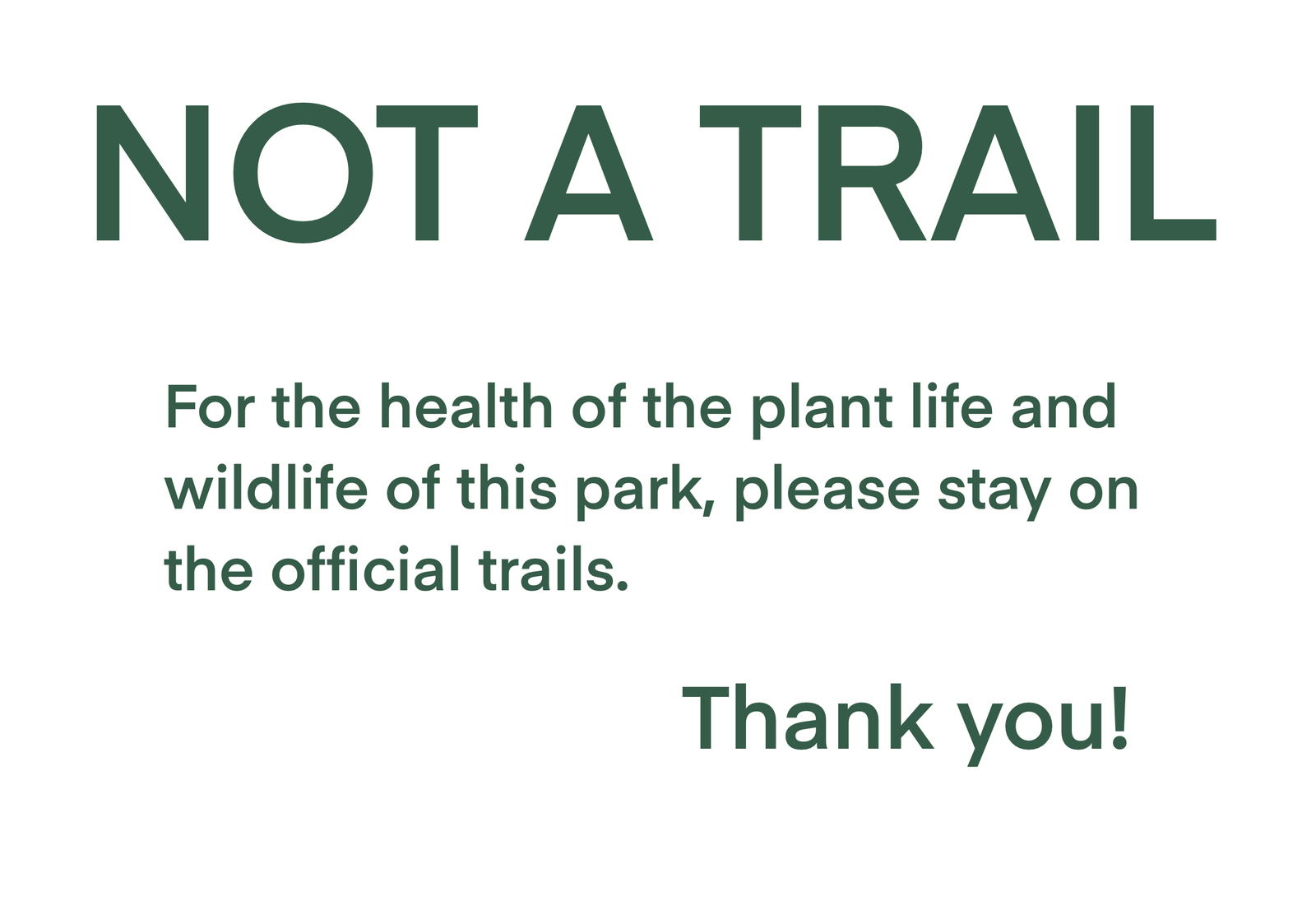
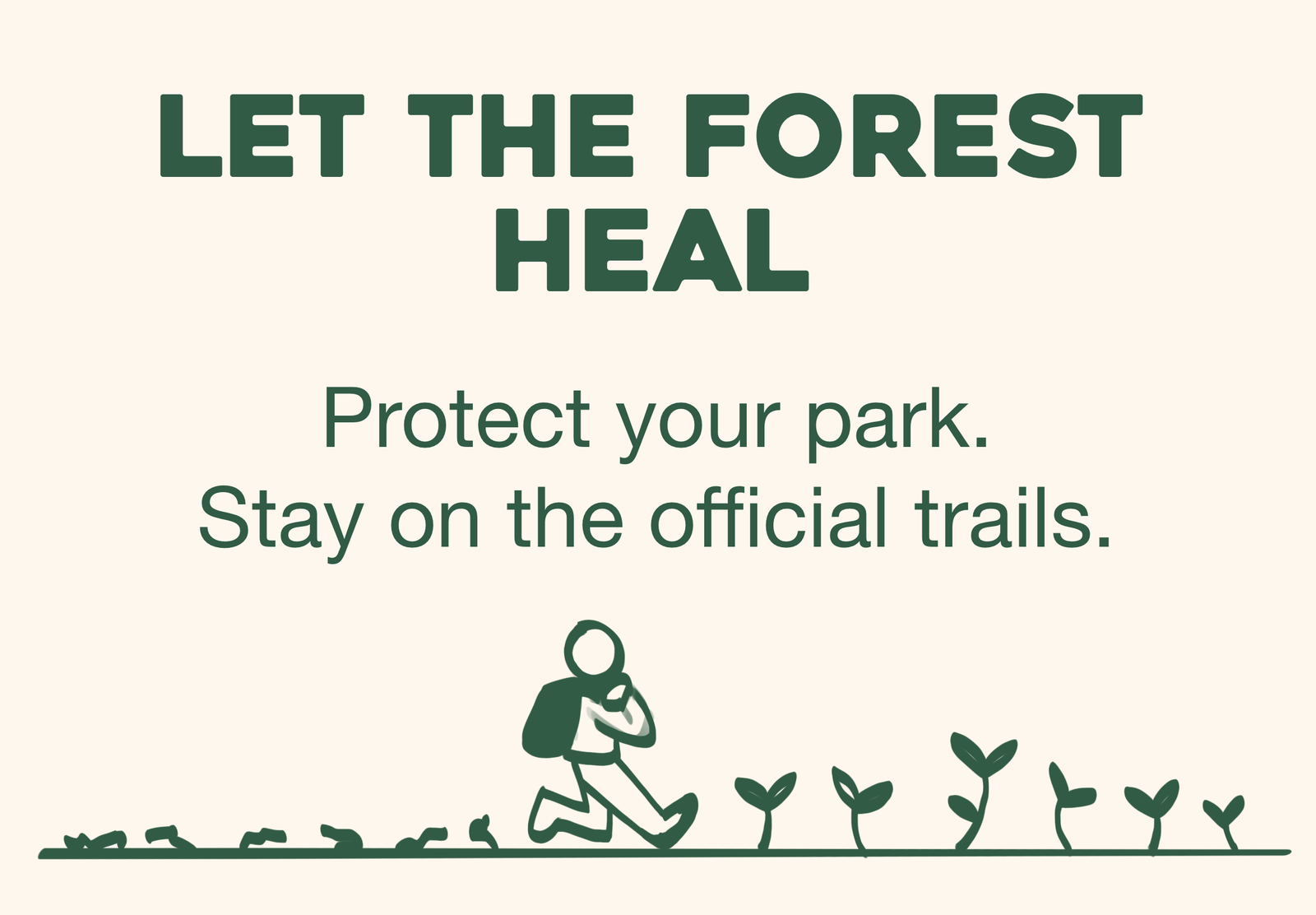
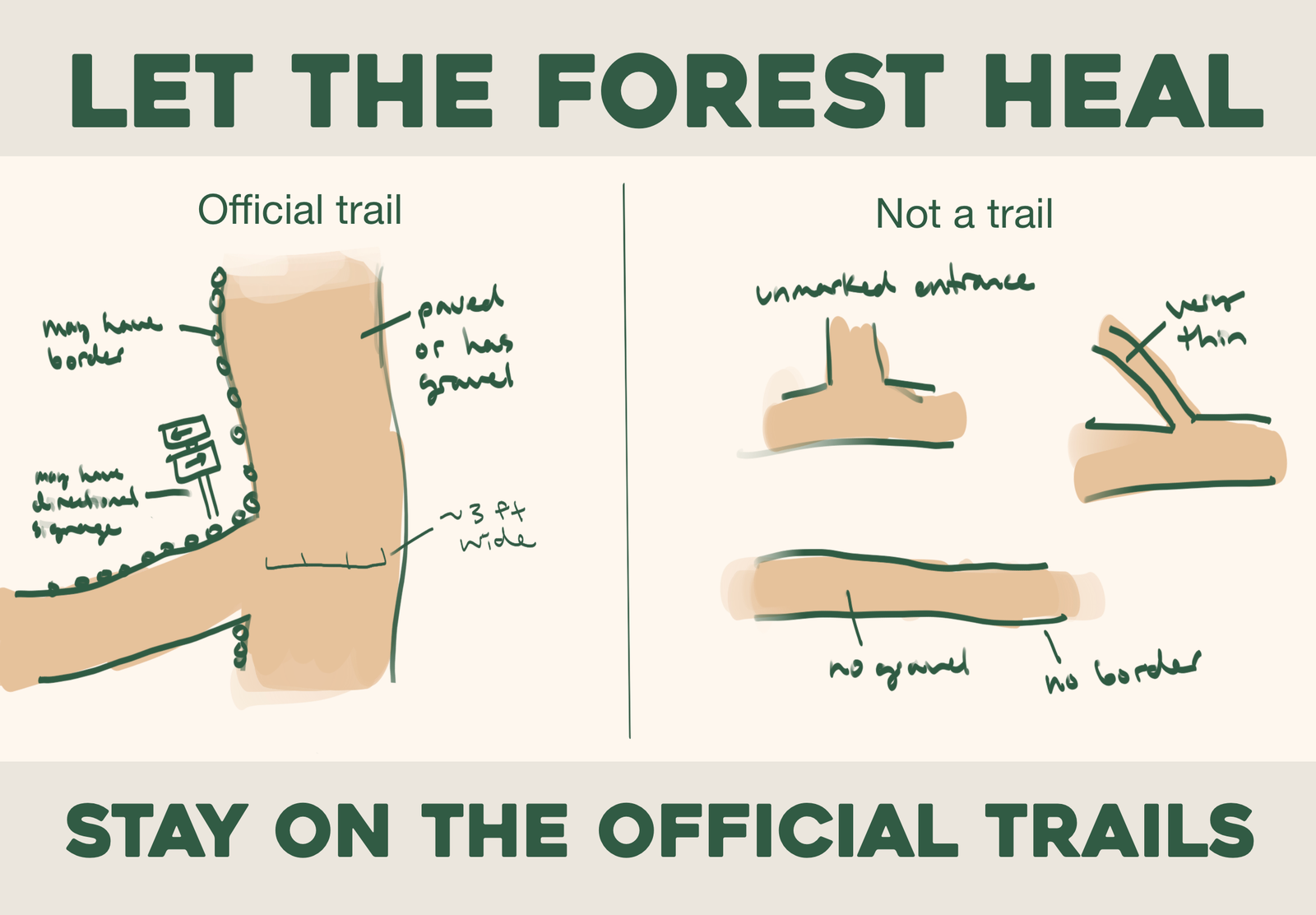
Below are my sketches of signage that could help keep people off of user-created trails.
The Biggest Impact
Littering, though, is by far the biggest beast to tackle.
From firsthand experience at the project kickoff, the UV night hike, and the Alum Creek State Park Beach, littering and improper waste disposal appeared to be the biggest problem at Ohio state parks. Our trail visits during the kickoff were littered with comments on litter. During the naturalist-led night-time hike at Alum Creek State Park, where we searched for fluorescent flora and fauna with UV flashlights, we discovered more trash than anything else. During a visit to the Alum Creek State Park Beach, Nicole and I picked up 234 pieces of trash (more than half of which was plastic) on just 6% of the beach despite the many trash bins present.
Comparatively, metro parks in Central Ohio such as Glacier Ridge, Highbanks, and the Columbus Garden of Roses are relatively litter-free. Throughout an entire hike at Highbanks Metro Park, I noticed less than 20 pieces of trash, most of which was concentrated in one area (a wooden overlook/rest platform with benches). There were only a few trash bins located at parking areas. Glacier Ridge Metro Park had even less litter: only about 3 pieces of trash and one rogue bit of dog waste. This park had several dog waste stations along the trail, each of which had a bag dispenser and a bin with some waste in it, and a trash bin at the only bench on the trail. Both parks had open-top bins, which can result in trash being blown out or accessed by wildlife.
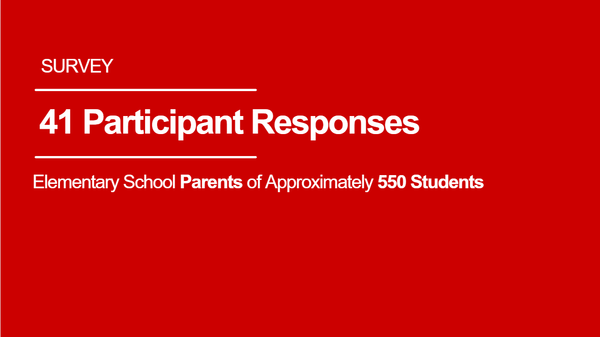
Our group collaborated on a survey which we sent out to 59 ODNR Park Managers, nearly half of which (26 managers) responded. Nicole and I focused our questions on the topic of littering and waste management. My first question asked managers which of the high-impact practices, observed and described by Heather Bokman in ODNR’s sustainability initiative, they noticed at the park(s) they manage in the last year. The majority observed littering (80%) and trail erosion (65%). These results align with my experience; every park I have visited during this project has had litter and user-created and widened trails. When asked what has been most successful at preventing littering, park managers named accessible bins, law enforcement or other authority, and education and signage. When asked if there was anything park managers would like to see to improve waste management/littering, the overwhelming response was a desire for improvements to waste bins (including the addition of bins and bins that are easier for staff to collect from), systemic changes (budget, management, waste collection service), and more (and more effective) education/signage.
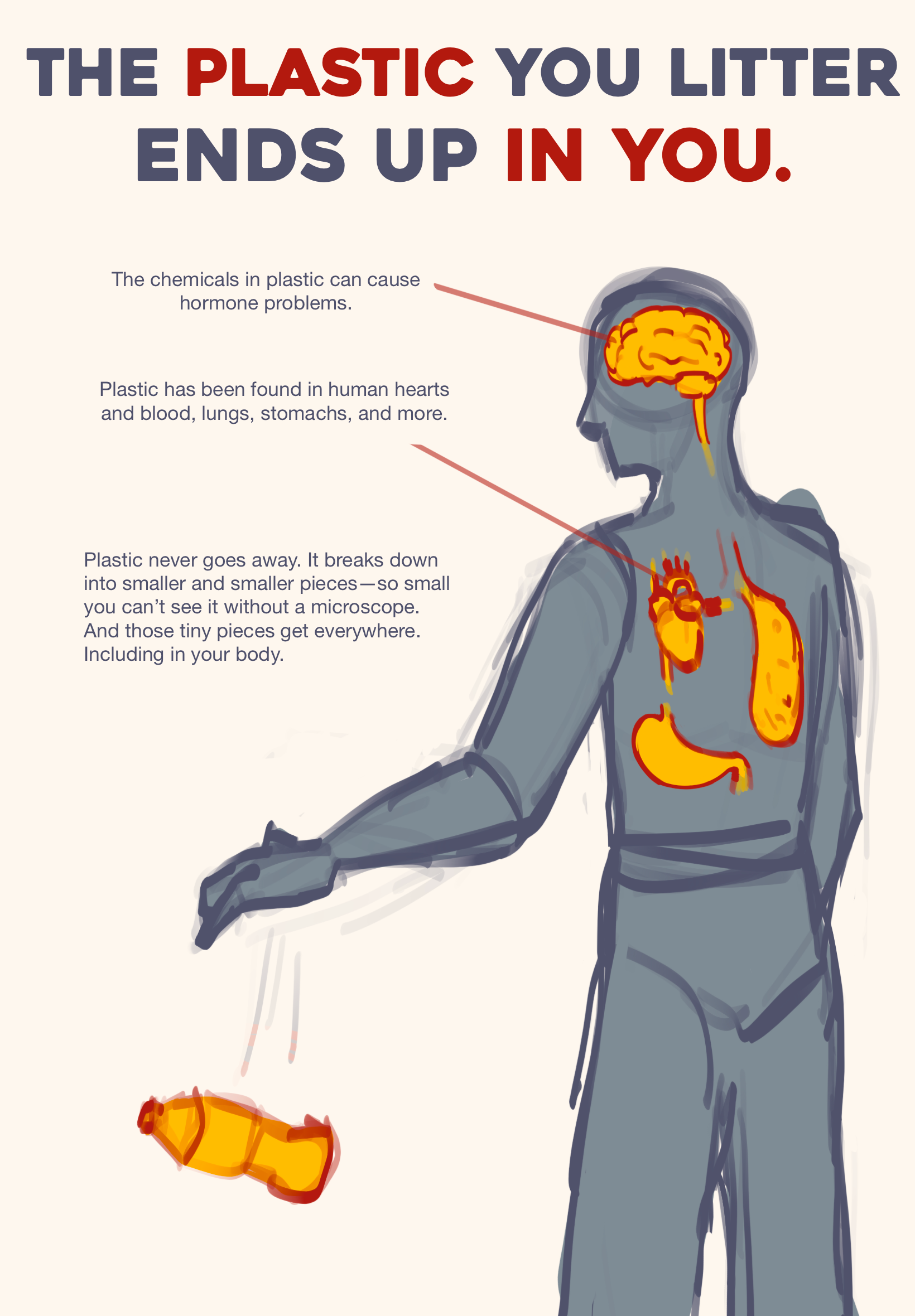
When you litter plastic, there’s a good chance it’ll end up in your very own organs, messing with important bodily functions (Greenpeace, 2025). Litter definitely ends up in the stomachs of shorebirds, not just because it’s abundant but also because it smells like food to them (Perkins, 2016).
And yet, people continue to litter. So how do we get them to stop? Maybe the solution lies in why people do what they do. Why do we use trash bins, when we do use them? What about when we don’t? Why do we read some signs and not others? Why do we learn, or not learn, from them?
A study by Blenderman et al. (2017) found that most dog owners dispose of their dog's poop properly, and that those who don't feel that it's too difficult or inconvenient to do so. Maybe, like ODNR park managers noticed, easily accessible waste bins are the answer.
Some people may feel a sense of entitlement to their space due to a lifetime of human-centered society (Long, 2024). In a co-design activity I conducted, the participant's solutions to high-impact practices at parks confronted visitors directly, attempting to shift their perspectives of impactful human acts to get them to empathize with those impacted. When asked why, she responded that "people don't really realize what they're doing until they realize how it would affect them." Other ideas involved "trickery" in order to change the behavior of people that the participant imagined wouldn't care enough to be responsive to other methods.
There have been several remarkable anti-littering campaigns across the world, whose successes may be due to appeals to local pride, eye-catching designs, and engaging interactive/gamified elements (Zero Waste Scotland, 2023). Interactive elements support education and information retention, but can easily muddle the message that’s meant to be communicated if not carefully designed (Allen et al., 2004). Incentives could be part of the answer, by getting people emotionally engaged and breaking up larger waste management goals into attainable (and rewardable) tasks (Stolovich, 2002).
Visual design choices have a noticeable impact, too. In a study of graphic design in park signs, Rice et al. (2023) found that certain techniques are more effective in influencing visitor behavior: typography as image, high contrast between background and text, and a large scale shift from headline to the call-to-action.
What about trash bins themselves? The design of trash bins has gone through many, many iterations, but even the most successful and innovative ones have profound faults. Some bins claim to solve all the problems, but are hard to maintain–which can end up making littering worse (Rinde, 2023). Not to mention the expensive cost of those innovative features (Bigbelly, 2025). Part of what the parks need may be low-tech bins that are easy to collect from and inviting to visitors.
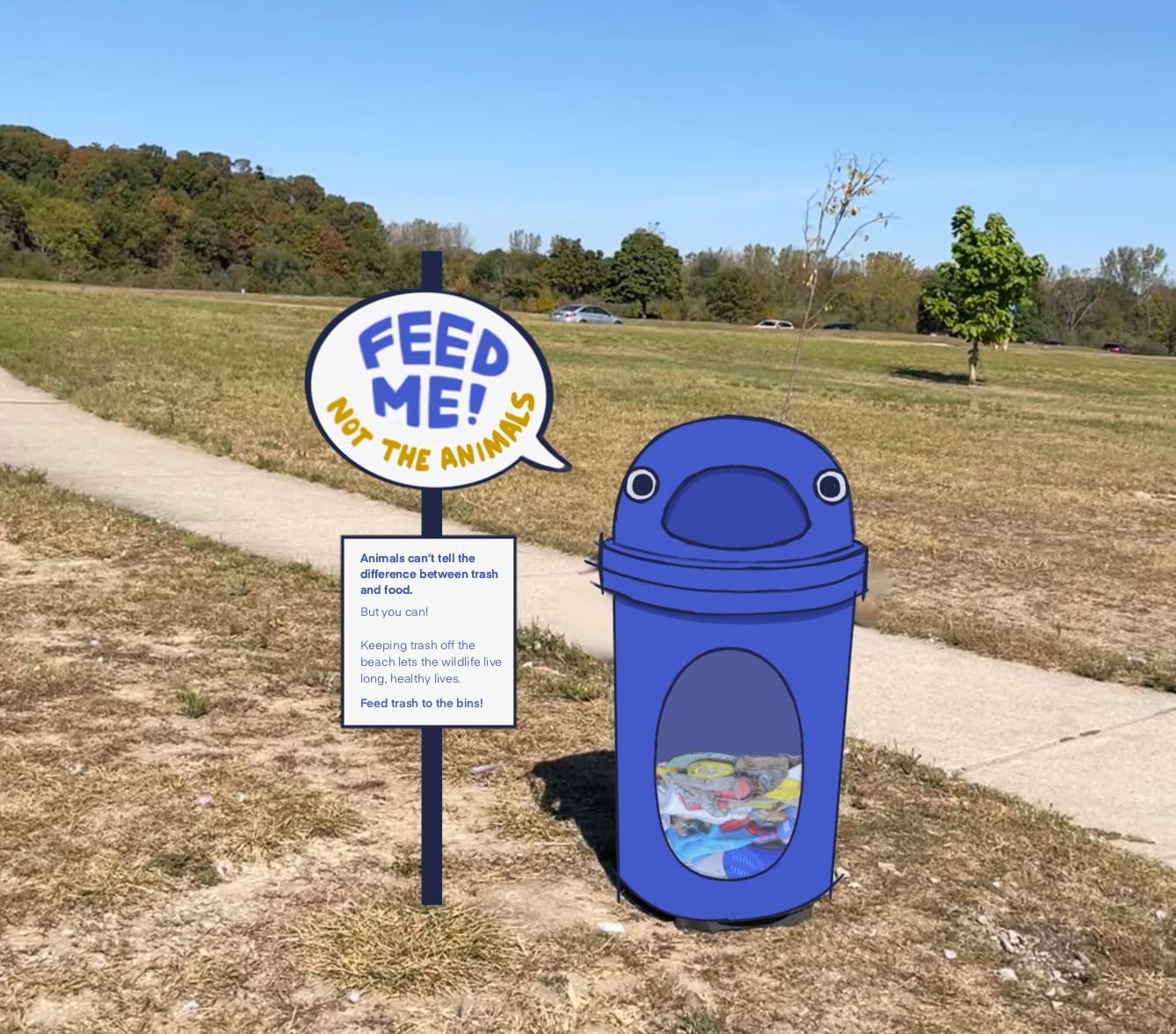
I came up with a concept (sketched below) of bins and signage that might help reduce litter at Alum Creek State Park Beach, inspired by the un-motivating and lacking in appeal Bigbelly trash bins (Rinde, 2023), and the fact that animals (shorebirds in particular) will mistake trash for food (National Geographic Education, 2016).
The Hungry, Hungry Trash Bins are meant to encourage people to throw away their trash by making an emotional connection (littering as equivalent to feeding animals trash), and being fun and motivating/rewarding (giving a task: feed the bins, and see the progress you've made). However, there remains the issue of bins being difficult or cumbersome for staff to empty.
The bins could have arms holding dog poop bags, trash picking up utensils, or hand sanitizer. Or, they could be holding up the informational signs. To incorporate recycling-specific bins, the trash bin and recycling bin could be hugging or holding hands. As for ways to reward people for throwing away trash: Putting something fun on the inside that you reveal when you open it to throw something away. If the opening is pull-out, there could be a tongue that reveals itself. (Maybe with a sound like those toy tubes...)
In conclusion
Overall, I think that the biggest problem is that people aren't motivated to dispose of their waste properly. Either it's too difficult and not rewarding, bins aren't accessible, they don't empathize with wildlife or their fellow park visitor, or they aren't aware of the damage that littering can do. The answer then, is to motivate people: by making bins accessible and inviting, making proper waste disposal rewarding and engaging, and educating them on the effects of littering using effective visual communication techniques and messaging that appeals to positive emotions such as pride and a sense of community.
References.
Bigbelly. (2025). All Together Better. Bigbelly Waste Management Solutions. https://www.bigbelly.com
Blenderman, A., Taff, B. D., Schwartz, F., & Lawhon, B. (2017). Dog Owner’s Perceptions and Behaviors Related to the Disposal of Pet Waste in City of Boulder Open Space and Mountain Parks. Final Report prepared for City of Boulder, Colorado, Open Space and Mountain Parks by Pennsylvania State University and the Leave No Trace Center for Outdoor Ethics.
Greenpeace. (2025). The impacts of plastic on human health. Greenpeace USA. https://www.greenpeace.org/usa/plastics-and-health/
Long, S. (2024, May 6). The Indoor Climbing Industry is Booming, but the Transition Has Changed the Sport. UNC Media Hub. https://mediahub.unc.edu/climbings-indoor-to-outdoor-transition/
National Geographic Education. (2016, November 9). Animals Eat Plastic Because It Smells Like Food. https://education.nationalgeographic.org/resource/animals-eat-plastic-because-it-smells-food/
Park, L., Manning, R., Marion, J., Lawson, S., & Jacobi, C. (2008). Managing Visitor Impacts in Parks: A Multi-Method Study of the Effectiveness of Alternative Management Practices. Journal of Park and Recreation Administration. 26, 97-121.
Perkins, S. (2016, November 9). Why do seabirds eat plastic? They think it smells tasty. https://www.science.org/content/article/why-do-seabirds-eat-plastic-they-think-it-smells-tasty
Rinde, M. (2023, August 24). The problem with North Philly’s new BigBelly trash cans. BillyPenn at WHYY. https://billypenn.com/2023/08/24/philadelphia-new-bigbelly-trash-cans-foot-pedals/
Schladen, M. (2025, July 11). As Ohio budget denies state park resources, experts say parks benefit the economy. Ohio Capital Journal. https://ohiocapitaljournal.com/2025/07/11/as-ohio-budget-denies-state-park-resources-experts-say-parks-benefit-the-economy/
Stolovich, H. (2002). Incentives, Motivation and Workplace Performance: Research and Best Practices. International Society for Performance Improvement (ISPI), & The Incentive Research Foundation. https://theirf.org/research_post/incentives-motivation-and-workplace-performance-research-and-best-practices/#top
York County Conservation District. (2021). Low impact recreation: protecting our forests. York County Conservation District. https://www.yorkccd.org/wp-content/uploads/2021/11/Low-Impact-Recreation.pdf
Zaske, S. (2023, January 19). Low-impact human recreation changes wildlife behavior. Washington State University Office of Research. https://research.wsu.edu/news/low-impact-human-recreation-changes-wildlife-behaviorhttps://research.wsu.edu/news/low-impact-human-recreation-changes-wildlife-behavior
Zero Waste Scotland. (2023, February 21). Some of the best litter prevention campaigns from around the world. Zero Waste Scotland. https://www.zerowastescotland.org.uk/resources/some-best-litter-prevention-campaigns-around-world
No generative AI was used in the creation of this post or its content.