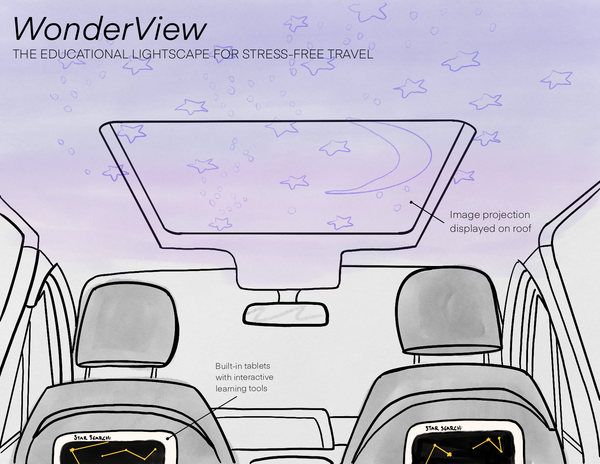
Passengers 150 Years Ago
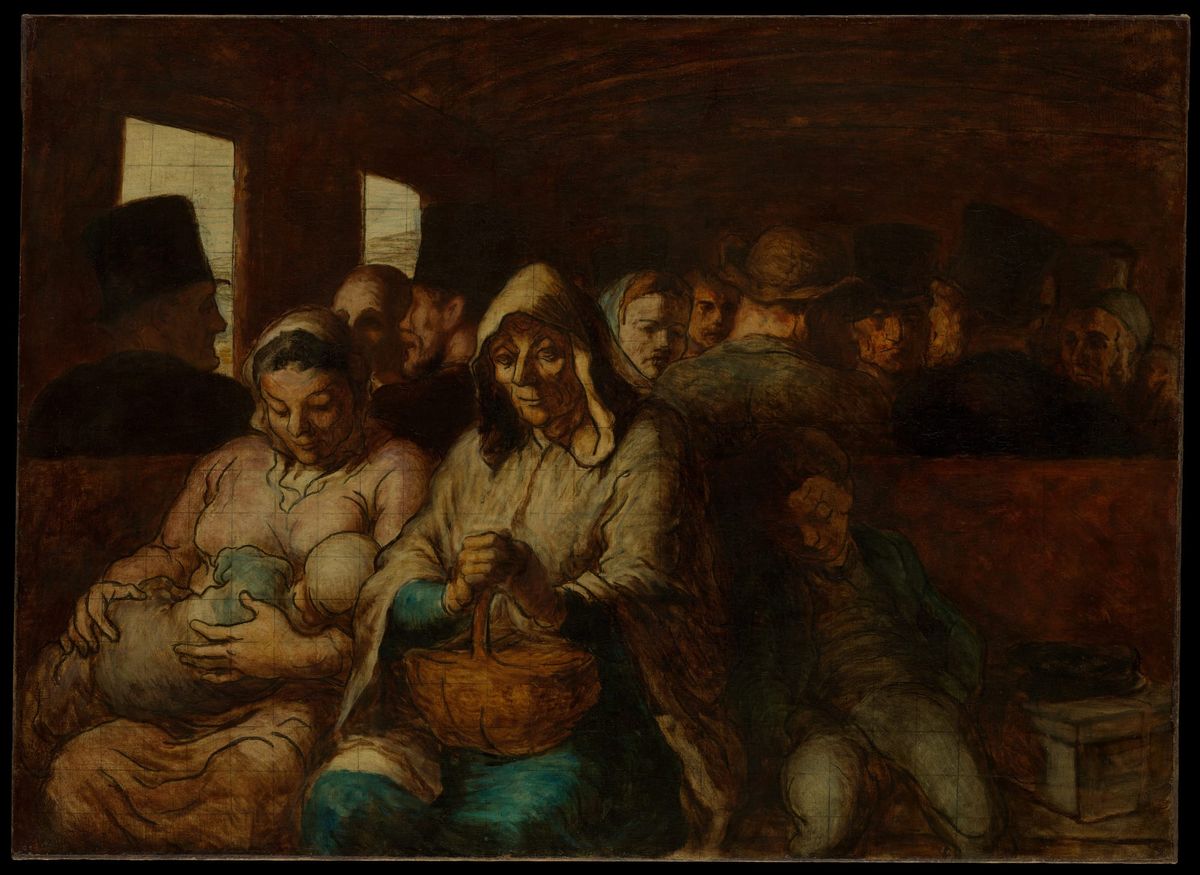
Passengers have been relaxing and catching time to breath on transportation long before the invention of the private car. Some issues, such as the need to relax in unideal circumstances, have persisted even after 150 years as seen in the paintings of Honoré Daumier. Here is an excerpt from the MET:
As a graphic artist and painter, Daumier chronicled the impact of industrialization on modern urban life in mid-nineteenth-century Paris. Here, he amplifies the subject of a lithograph made some ten years earlier: the hardship and quiet fortitude of third-class railway travelers. Bathed in light, the nursing mother, elderly woman, and sleeping boy emanate a serenity not often associated with public transport. Unfinished and squared for transfer, this picture closely corresponds to a watercolor of 1864 (Walters Art Museum, Baltimore) and a finished oil painting (National Gallery of Canada, Ottawa).
From the Gallery of Canada:
The theme of rail travel reflects Daumier’s sympathy for the working class. The artist was caustic in his caricatures of the bourgeoisie and politicians, but here he has created a sensitive portrayal of withdrawn, impoverished and isolated passengers. They sit in the dimly lit carriage, absorbed in their thoughts.
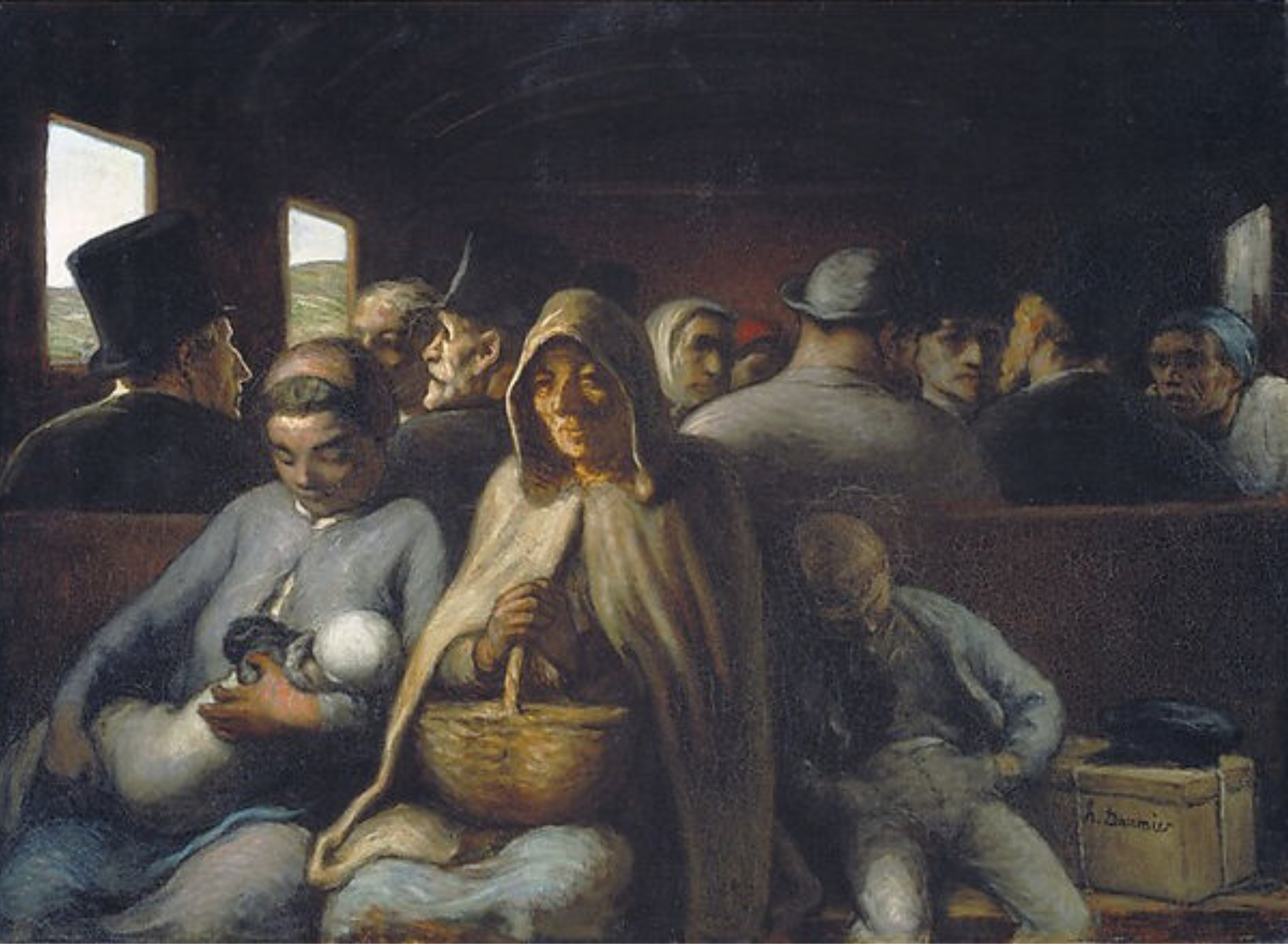
Honoré Daumier painted this scene three times throughout his career. This begs the question: What about this scene did he find so compelling?
The greater subject matter of the impacts of industrialization on the lower class of Paris are fertile grounds for discussion. The nineteenth century found people beginning to travel medium distances for work thanks to the proliferation of railways and other public transport. This caused a seeping of domestic life into public areas such as people catching sleep on the way to work or people eating in public. In an ideal world, the three figures at the forefront of this painting wouldn't have to sleep or relax on public transport. However, for the sake of their careers or due to convenience they did.
As a designer, it is equal parts interesting and disheartening to see what scenes persist from over 150 years ago. The uncomfortable neck bend of the child in the painting is all too familiar for anyone that has fallen asleep in a vehicle. It is important to look to the past to see what design issues have persisted in order to better understand how we might address them now.
References
The Met. "The Third-Class Carriage". https://www.metmuseum.org/art/collection/search/436095
Daumier, Honoré. "The Third-Class Carriage". 1864. Oil on Canvas. The MET. https://www.metmuseum.org/art/collection/search/436095
Daumier, Honoré. "The Third-Class Carriage". 1863-65. Oil on Canvas. National Gallery of Canada. https://www.gallery.ca/collection/artwork/the-third-class-carriage
All original works in this article were done without the assistance of AI tools.