Positives of Pressure and Touch on the Processing of Stress

Have you ever seen a celebrity interview and noticed how someone's knee won't stop bouncing, but then a friend or co-star provides a gentle, friendly, discrete touch, and the bouncing stops, the celebrity breathes, and the whole world barely noticed. What about how a hand to hold is sometimes a life line in times of stress? We know that humans are social creatures and crave touch, but to what extent does it alter the way stress is processed?
In an article from Eckstein, Mamaev, Ditzen, and Sailer (2020), they reviewed the calming effects of touch in human, animal, and robotic interactions. This article discusses in-depth the ways that touch makes a difference in stress processing regardless of living or robotic.
“Tactile perception from different social and non-social contexts is processed in the insular cortex, which has a regulating influence on the amygdala and can therefore dampen the stress response. A calming or relaxing effect of touch might therefore be based on signaling safety (absence of danger) on a neurobiological level.” (Eckstein, Mamaev, Ditzen, & Sailer, 2020)
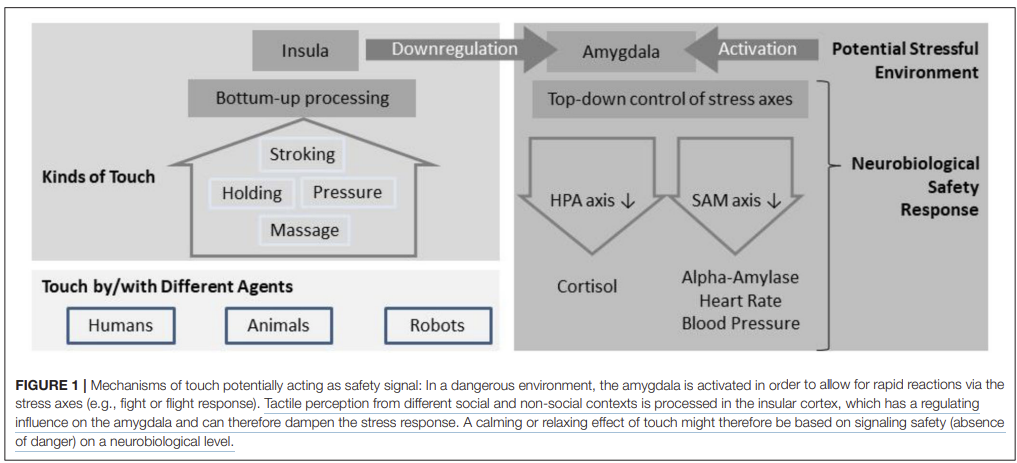
They explain that touch essentially calms the fear processing center of the brain (the amygdala) which is beneficial in stressful situations.
" Taken together, the majority of previous research reviewed in this article indicates a calming/stress-relieving effect of touch, irrespective of the agent that is touching or being touched: effects have been shown both after actively touching, and being touched." (Eckstein, Mamaev, Ditzen, & Sailer, 2020)
Taking from the paper a foundation that touch is beneficial to stress relief, I wanted to include non-human, non-animal, and non-robotic inputs in my exploration. Pairing the paper from Eckstein, Mamaev, Ditzen, and Sailer (2020) with the blog post from Sensory Direct (2023), we can think about how weighted clothing or blankets aim to activate the same down regulation processing in the brain to reduce stress. The blog focuses specifically on weighted clothing where as the paper is looking at touch through human, animal, and robotic applications.
" One of the most well-documented benefits of weighted clothing is its calming effect because the gentle, deep pressure, provided by the weights can have a soothing and organising effect on the nervous system. This can be especially useful for individuals who experience sensory overload or anxiety. Many parents and therapists have reported that using weighted clothing can help reduce restlessness. This in turn promotes relaxation in children and adults alike." (Sensory Direct, 2023)
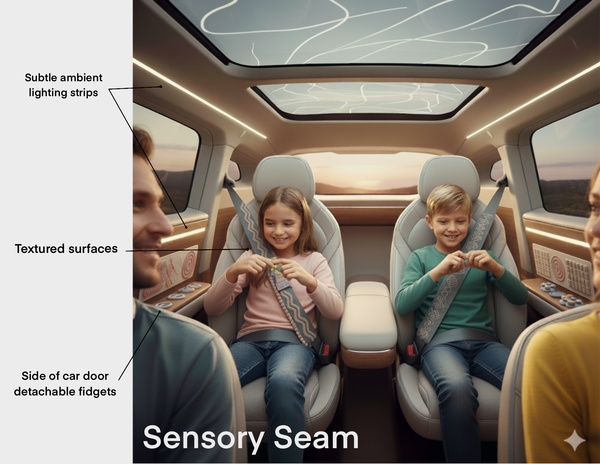
By understanding touch and pressure as a calming experience, how can this approach to down regulation be implemented in vehicles to help passengers relax? Would you ever take a weighted blanket, vest, or plushy to be a back seat companion for kid on a long road trip? What additional parameters could increase the level of relaxation achieved if the environment is one of increased restlessness?
References
Eckstein, M., Mamaev, I., Ditzen, B., & Sailer, U. (2020). Calming effects of touch in human, animal, and robotic interaction—Scientific state-of-the-art and technical advances. Frontiers in Psychiatry, 11, 555058. https://doi.org/10.3389/fpsyt.2020.555058
Sensory Direct. (2023, September 14). Benefits of weighted clothing and sensory integration. SensoryDirect. https://www.sensorydirect.com/blog/benefits-of-weighted-clothing-and-sensory-integration/
Unknown author. (n.d.). Untitled image [Photograph]. Shona. https://shona.ie/app/uploads/2019/10/hugs-1024x722.jpg