Primary Research
CDME - Site visit
- Point of Contact: Lili Hurst
- September 2nd, 2025
- Facilitators: Everyone
- Writer: Jessica
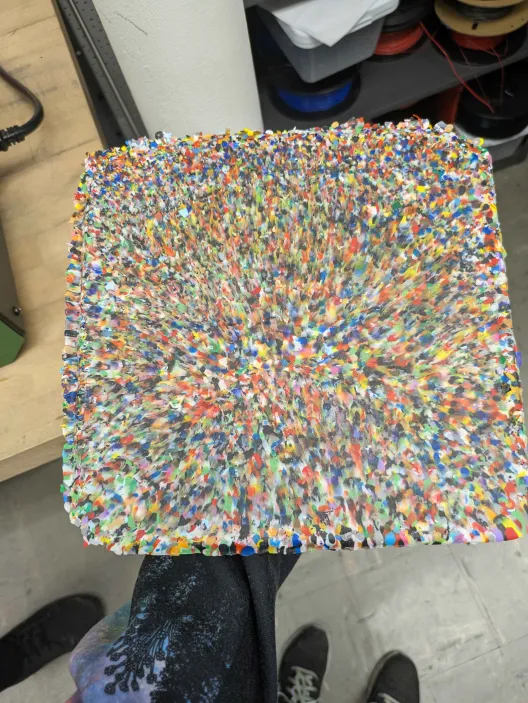
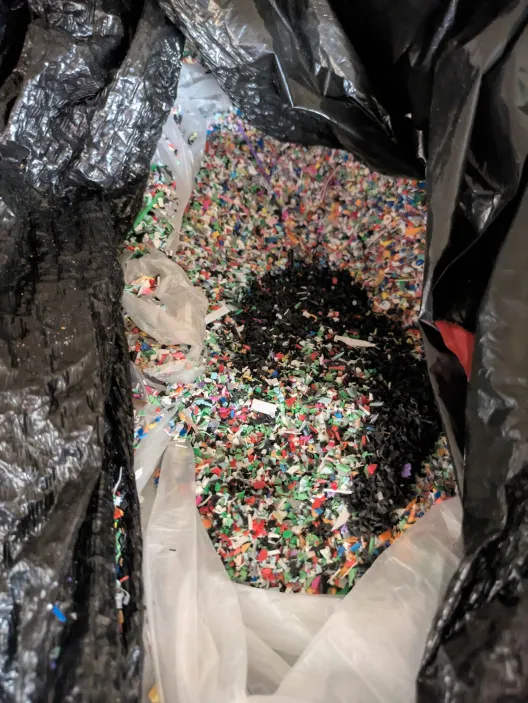
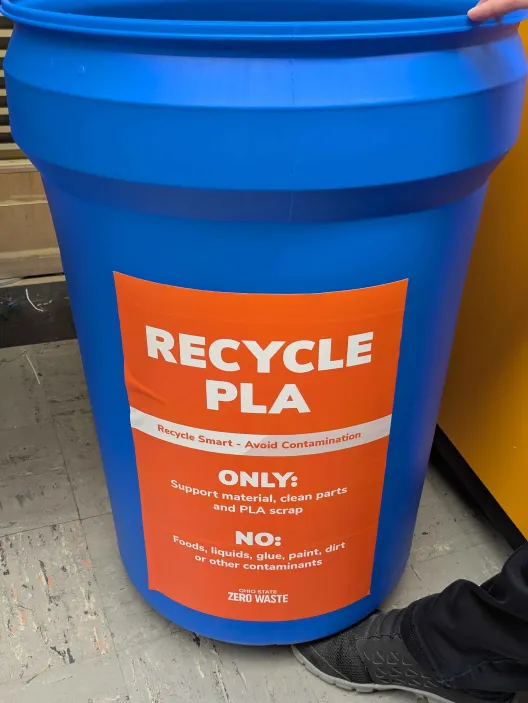
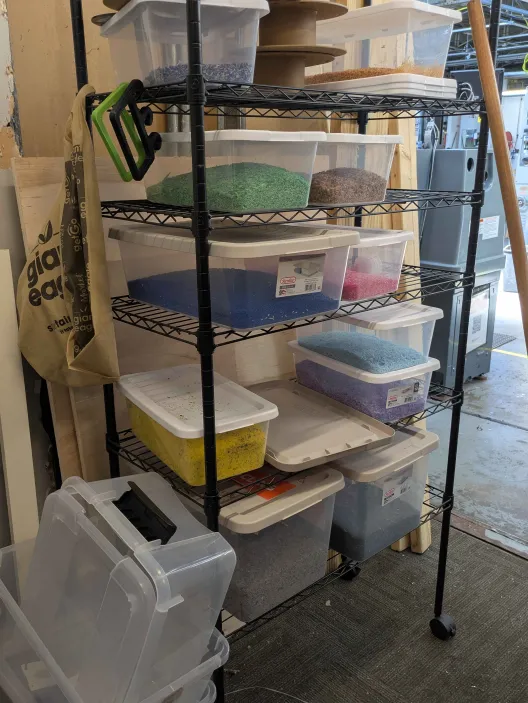
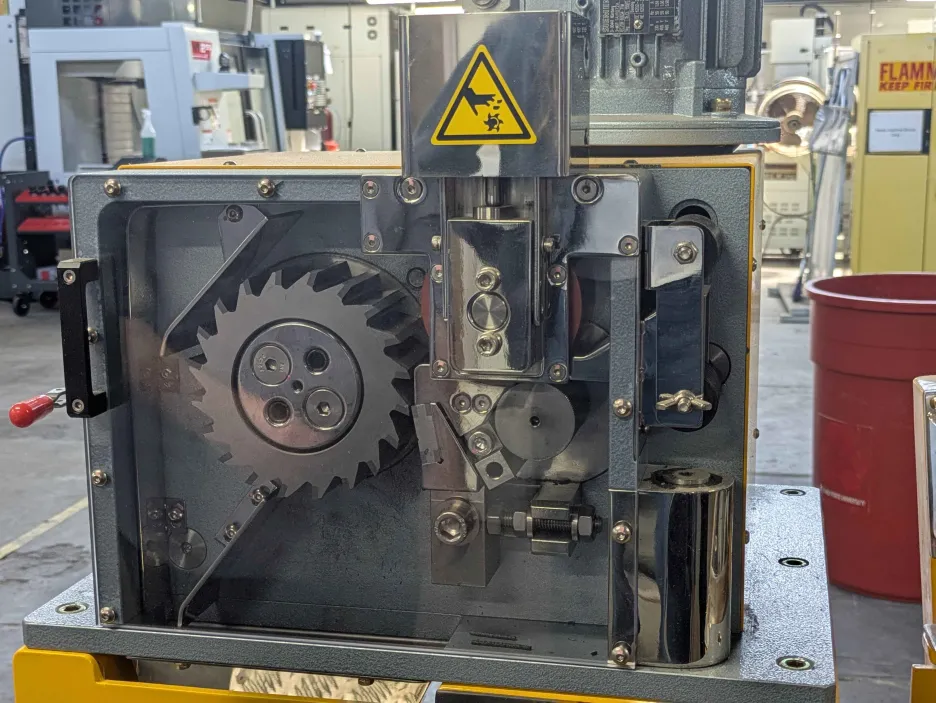
Our team visited CDME, the Center for Design and Manufacturing Excellence, to see how a local Laboratory Coordinator is trying to tackle the PLA waste issue. Lili Hurst has reached out to many schools and libraries in the area that would potentially have a waste stream. To then set up a collection system and utilize the machines at the facility to shred and process the spent PLA. During our tour she showed us the 3D printing room where she has been experimenting extruding the pelletized and shredded pieces in the hopes of creating new 3D printing filament. That process is proving to be difficult due to the brittle state of the material and the tolerances needed on the printers, but pressing the shreds into sheets is demonstrating to be more successful. The plastic sheets can then be used to laser cut and CNC objects like new. She talked us through the collection process which is now mainly just herself making trips to the facilities that agreed to have a recycle bin near their 3D printers. We then were shown the large barrels full of the PLA she has been collecting and walked through the process of sorting the PLA by color, which then gets shredded, and the shreds get fed into another machine that turns the material into uniform pellets.
The tour was very informational about the whole recycling process, Lili shared the successes as well as the pain points. She has adapted with the learning curves and has been able to smooth out the process from the initial attempts. When it comes to creating the plastic sheets she has been using an old panini press with wax paper, and had to work through hot spots and cooling periods to prevent the material from warping after being pressed. Her project to bring a second life to 3D printing waste is an inspiring view of what can be done when communities work together to tackle circularity. For example, Lili has also been in touch with the Neighborhood Design Center over the summer to talk about the possibility of making plaques for the businesses that they work with. Glennon has shared her connections and offered to help widen the collection net with school districts she has worked with. Then using the collected PLA for a business plaque that was involved with the NDC’s programs which involve the community there is a circular move of waste from the community that then goes back to the community.
Marble Plastics - Site visit/Informal interview
- Point of Contact: Joseph Klatt
- September 4th, 2025
- Facilitators: Everyone
- Writer: Chip
Our team visited Marble plastics to form a personal connection with our capstone sponsor, as well as to learn more about how the company operates. Our primary point of contact was Joseph Klatt, an engineer and craftsman with experience working with Precious Plastics in the Netherlands. His time at Precious Plastics challenged him to translate the complex mass-manufacturing methods of plastic material into easy to understand processes for anyone to learn and try at home. For Joseph, he aims to shift mass-manufacturing, to mass craft for hobbyists. Joseph has built and installed custom recycling equipment for others and continues to share his expertise using his company located in Columbus Ohio.
During the visit, we learned about the company’s operations and the recycling process. Joseph’s company has pioneered compression molded plastic sheets at a standard 4x8 foot size. On a good 10-hour workday, his team can create about four of these sheets. They work primarily with high impact polystyrene (HIPS, #6) as well as high density polyethylene
(HDPE, #2). The HIPS plastic is sourced from salvaged refrigerator interiors, and is then pelletized to serve as a milky-white base material for most sheets. The HDPE is sourced from bread tags sold by a woman in Indiana, who then uses that money to buy wheelchairs for her community. While the company has core patterns for their sheets, they can also create a custom pattern based off of an online tool they have on their website. Some of Marble plastic’s clients include chain retail stores, small businesses, artists, and even the Ohio State University.
From a material standpoint, we learned that HDPE performs significantly better outdoors than HIPS, which suffers from UV breakdown over time. This may pose a challenge to the Local Loops team, since we are also working with the Neighborhood Design Center which specializes in co-designed outdoor installations. While it's common for engineers to talk about an upper limit to recycling, Joseph has not encountered such a limit, and is able to re-pelletize and re-use these materials at least 10 times over. The team suspects this is due to the compressive- structural nature of Joseph’s products, which typically don’t experience a lot of mechanical stress. Joseph noted that most companies recycle primarily for cost mitigation rather than environmental reasons. Ultimately if the cost of recycling exceeds the cost of disposal, companies will choose disposal over and over again. Overall, the visit gave us a deeper understanding of both the technical aspects of plastic recycling and the broader motivations driving this company's operations.
There are two key intervention opportunities the team noted after the site visit. The first, is that while the company has an industrial mass of PLA scrap material, they have no clear plans for it. This is partly because Joseph and his team are in the middle of the research and development of PLA products, and partly because PLA needs to be dehydrated before use, which adds a time consuming extra step to the prototyping process. Identifying a market for recycled PLA products and being able to deliver a cost-effective solution is one way the Local Loops team can intervene here. Another opportunity focuses on the singular collection point for the HDPE bread tags. Several collection points could be set up, perhaps participating in a competition similar to the “box-top” in schools. This solution may reduce CO2 emissions caused by shipping across state lines, while also further localizing the source material for Marble Plastics, effectively creating a local-loop.
Kut City Barbershop - Site visit/Informal interview
- September 11th, 2025
- Facilitators: Everyone
- Writer: Sophie
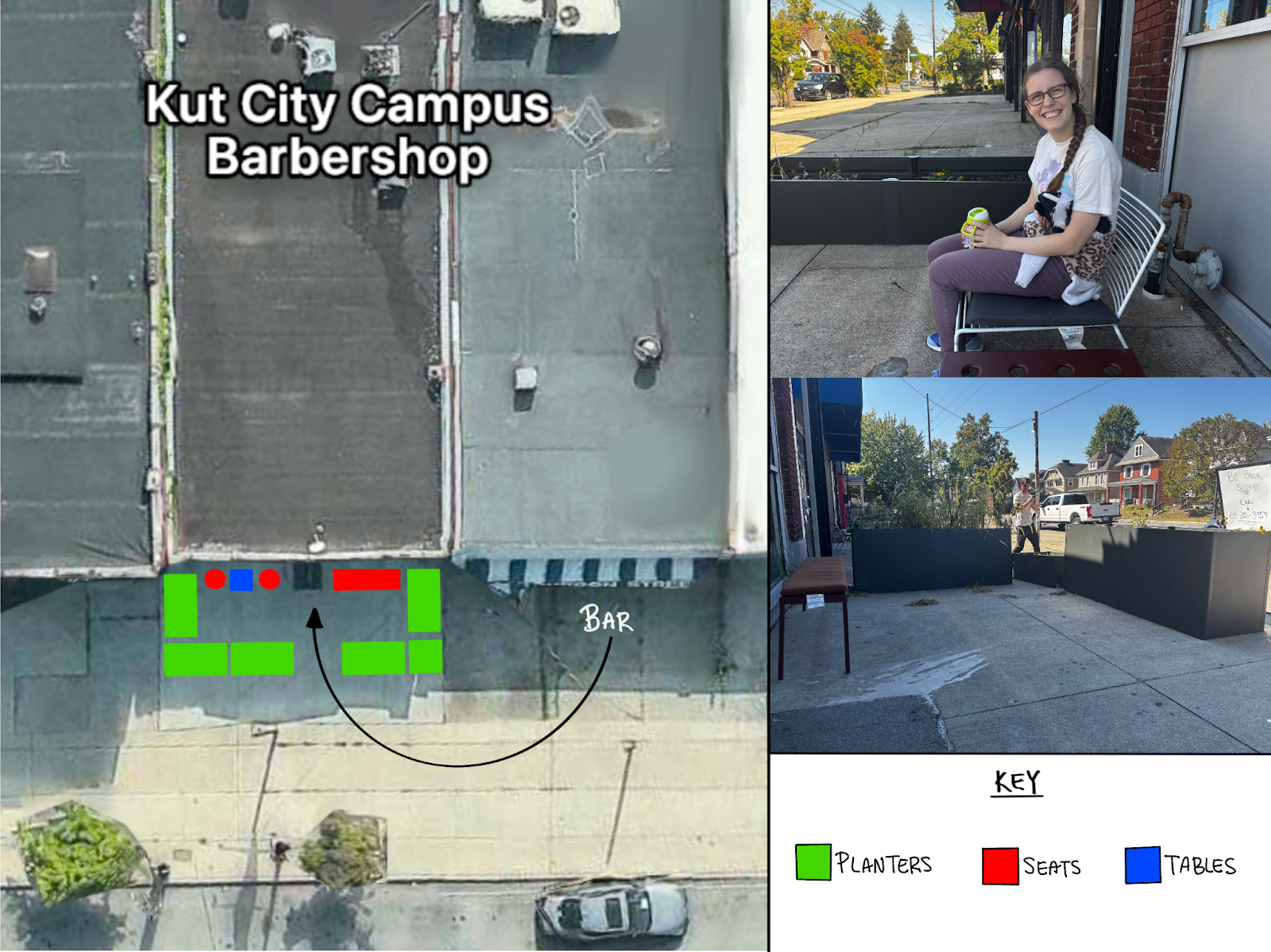
In order to better understand the impact NDC has on the businesses they work with, our team conducted a site visit and informal interview at Kut City Barbershop. Located on Summit, this barbershop received several benches, chairs, and planters for their storefront a few years ago. We went in with the purpose of following up with the workers and understanding the lasting impacts of working with NDC.
Initial Observations
During our visit, we took note of the arrangement of furniture outside the store. The planters were arranged in an L formation mirroring each other. The benches and chairs were placed inside this space facing the street. This created the feeling of an enclosed patio without the need for walls or fences. Walking through this threshold provided a sense of separation from the road and sidewalk. However, we did notice that the plants in the planters were dry and not well-kept.
Interview
Due to our loitering outside the barbershop, the workers invited us inside and allowed us to informally interview them while they worked on their customers. The three employees took turns answering our questions and chimed in periodically. When asked if they noticed any change in revenue after receiving the seating and planters they said not really. Their customer base was not significantly affected. When asked about how they use the new area, they said that occasionally the customers will sit outside while they wait; but in general, it doesn’t get used much by the barbershop. We asked if they received any follow up visits from NDC they said no. One of the employees mentioned that he tries his best to keep the plants alive and that he wants to learn how to garden better.
Glennon, (our NDC contact), says that a lot of businesses they worked with had trouble with theft of outdoor furniture. We noticed that the seating that the barbershop had was movable and not tied down. We asked if they had even encountered stealing before and they said no. One employee mentioned that they have different approaches to the outdoor area. Some of them take the chairs in when they lock up at night, but not everyone. Sometimes, they leave them out because the bar next door has customers that like to wander over and sit. When asked if this annoyed any of them, they all said that they didn’t mind at all. Occasionally, one of the employees will even pull out their trash can outside so the people from the bar have somewhere to throw their drinks. She said that she would rather provide them a place to throw them than have them litter on the sidewalk. Similarly, the seating area becomes a place to hangout during OSU football games. She said it brings about a sense of community between the employees, the neighboring stores, and their shared customer base.
Notable Conclusions
Although the new seating area didn’t fulfill what we predicted was its intended purpose of bringing in more customers, it did create unintended social value. We were surprised at how the barbershop accepted the people in their space instead of reacting defensively. There was this kind of hospitality or community generosity that seems inconsistent with the usual business logic of control, efficiency, and profit.
This visit shifted how we think about businesses. We often imagine them as guarded, cut-throat, and defensive. But at Kut City Barbershop we saw the opposite: a willingness to embrace the unpredictable ways people use public space. They showed us that businesses can be and want to be collaborators in building community, not enemies of it. Even something as small as adding a trash can turned into a gesture of shared humanity, a way of saying the space is for all of us.
Goodale Park Sandbox - Make Method
- September 16th, 2025
- Facilitators: Everyone
- Writer: Chip
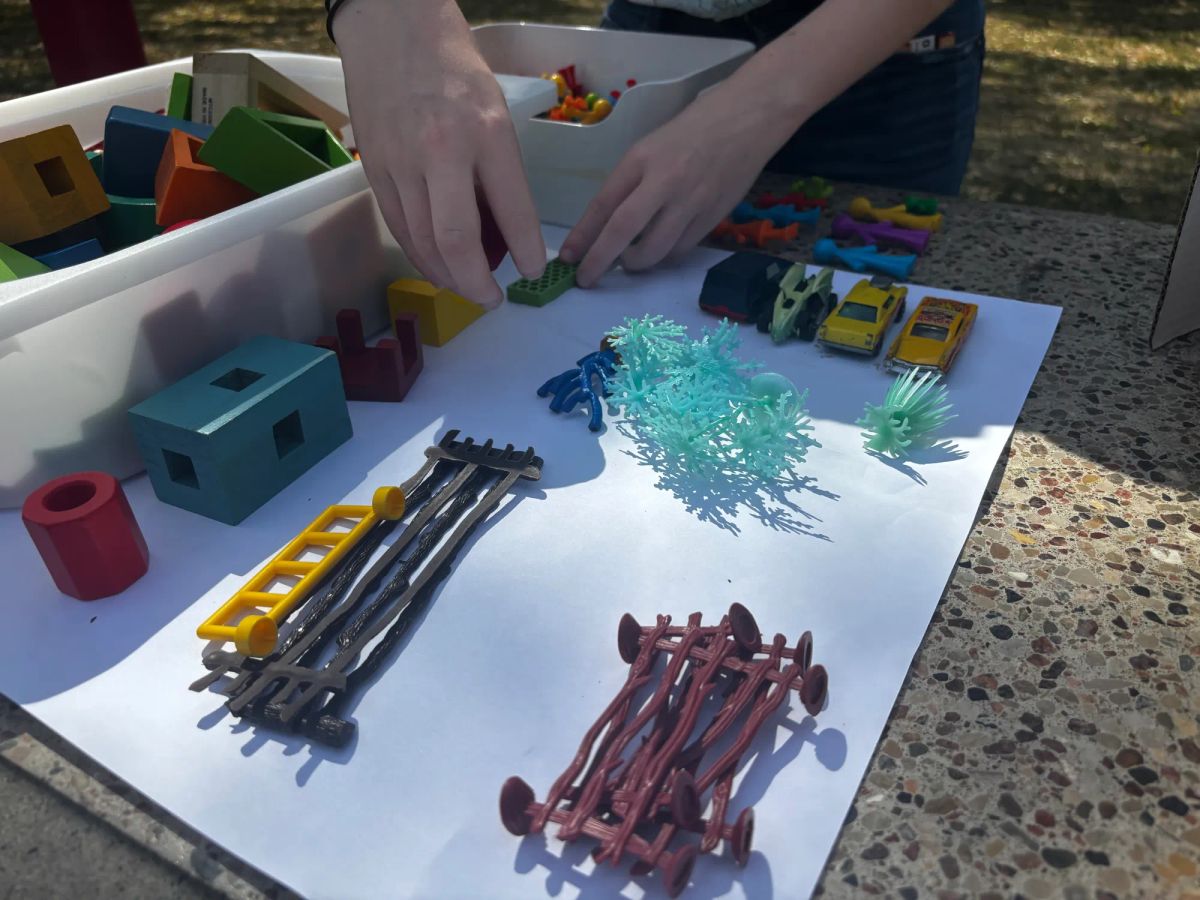
The whole team conducted a convivial make-method in Goodale park in order to better understand the needs of local Columbus communities. Participants were asked to sign a consent form, in which basic information about them was anonymously collected. Each participant was tasked to create a physical representation of their community within a sandbox using provided blocks, figurines, and toy cars. After being asked to write about their creation, they were then asked to modify their work to create an improved version of their community. These changes were captured on the bottom of the consent form, and each of the participant’s creations were photographed.
The team sent two members to conduct a sample count of people in the park at different hours. From 12:50-1:05: the count was 75 . From 2:20-2:45: the count was 43. From 3:15-3:30: the count was 57. The average age of these participants was 39 years, ranging from 26 to 59. The average time spent living in these communities was 11 years, ranging from four weeks to 29 years. The Columbus Communities listed include: Italian Village, Short North, Shepherd’s Community, West Broadstreet Near Galcoway, Grove City, Old Town East, Brewery District, and Victorian Village. A third of the participants did not make any changes to their creations. One person in particular said their community was “perfect,” but wished more people would see deeper into their neighborhood beyond the built environment and into the hearts and minds of youth. Most participants did not suggest changes to their communities until prompted by the Local Loops team. When given the opportunity to modify their creations to reflect an improved community, responses varied widely. One person expressed the need for their community to be more inclusive of others. Two people made separate comments about traffic related improvements. One person who resides in the Brewery district, made a comment about the importance of historic preservation in her community.
The sandbox make method did not reveal any clear trends about community representation or ways to improve these areas. This may be explained by the relatively low number of participants compared to the sample sizes at different hours. This may also be explained by the non-centralized nature of Goodale park; since people across the city visit this place, diverse communities will be represented in research.
Amish Country - Site visit
- September 18th, 2025
- Facilitators: Cheyann, Chip, Sophie
- Writer: Cheyann
The Amish are a group of Christians who follow a specific set of rules called the Ordnung. Basic principles include rejecting modern technology to live simply, wear modest homemade clothes, and emphasize community. This site visit took place between two locations within the central Ohio Amish community. The first was the Walnut Creek Farm, and the other was the Walnut Creek store. This site visit was initiated to explore a unique culture and the use of materiality and systems. Facilitators toured the farm’s animal drive through, the farm’s open land and giftshop, in addition to the offsite store with connected branding.
Farm
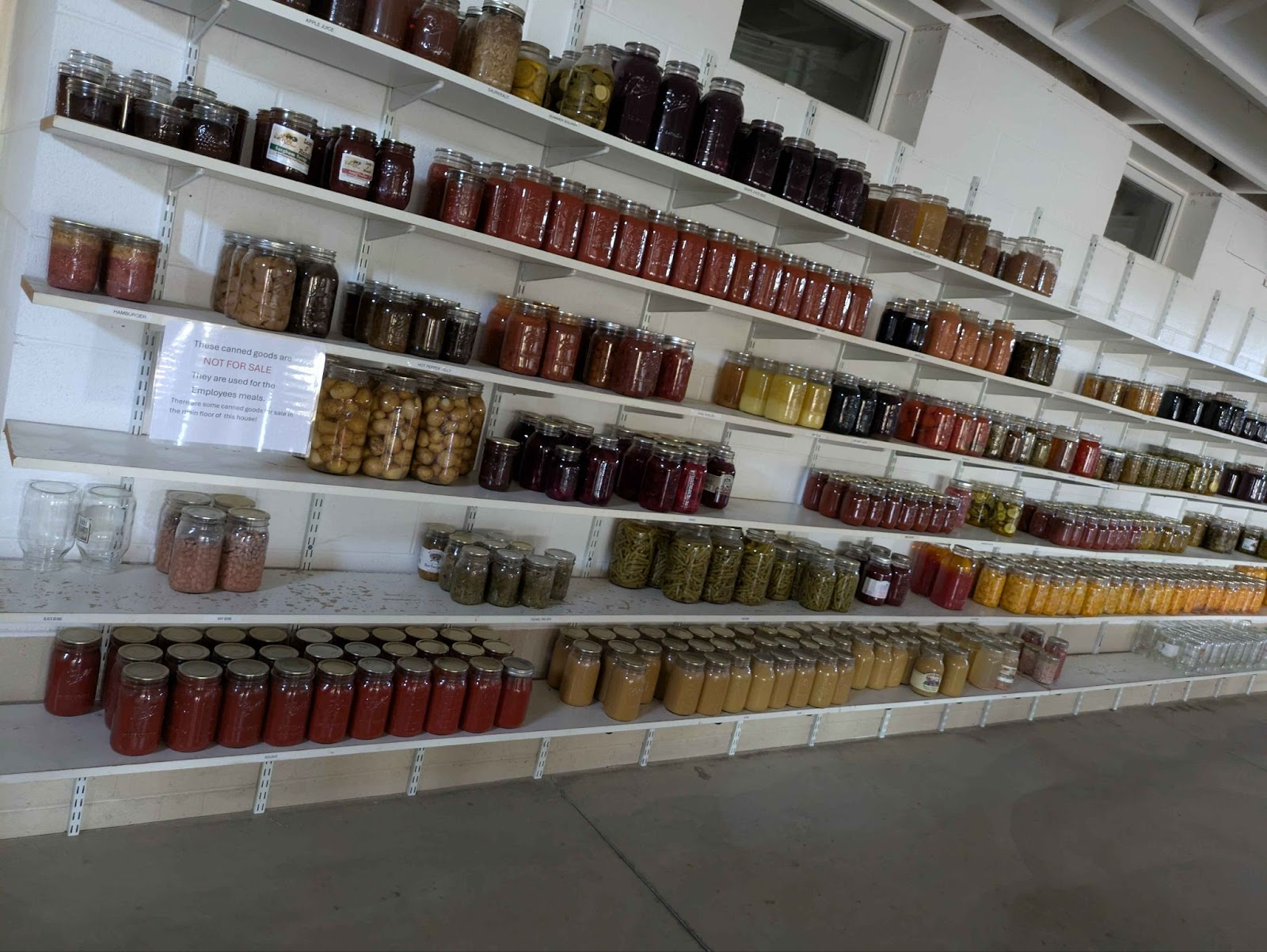
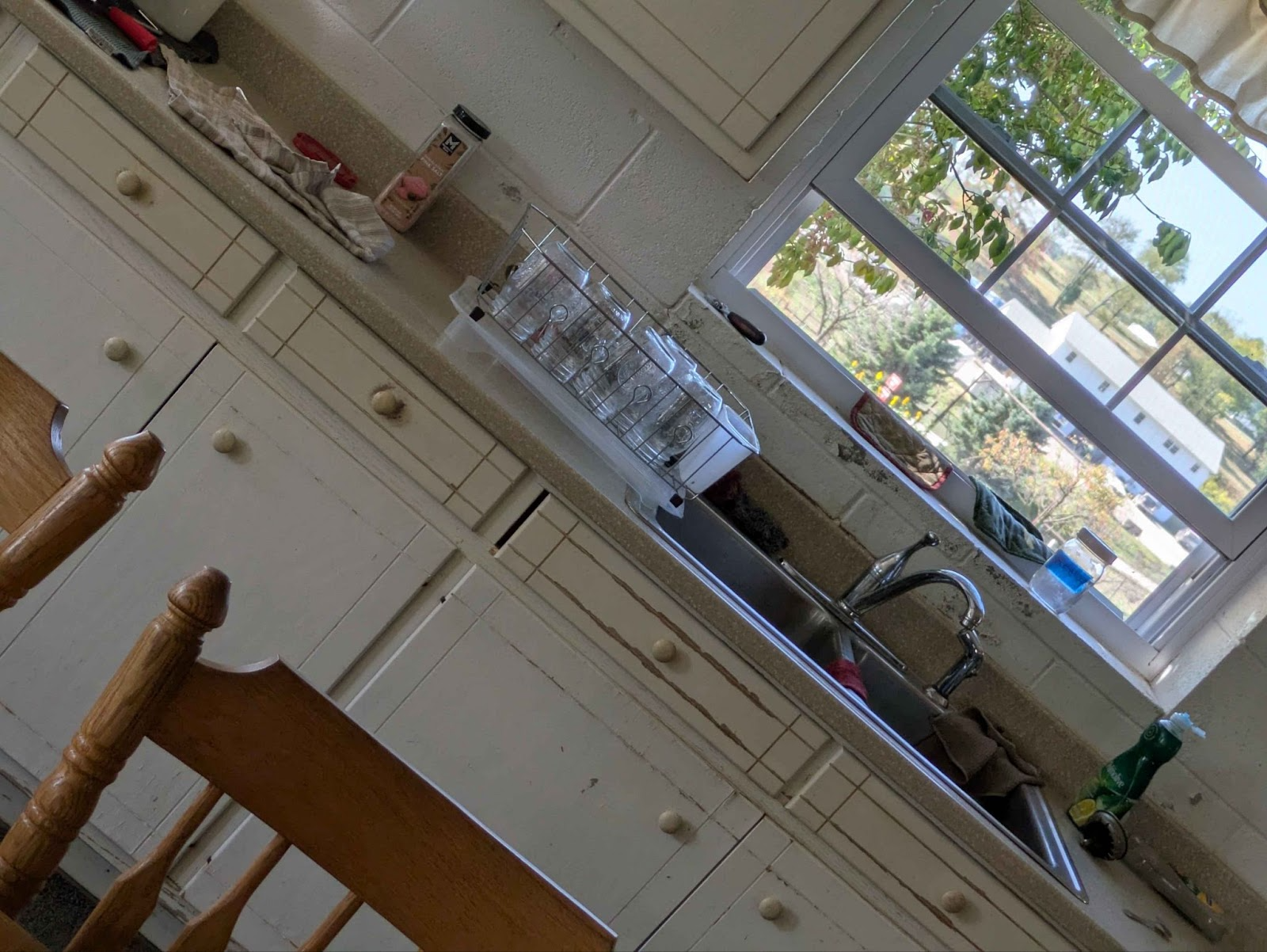
There were many animals and gardens on the farm property. Reusable plastic buckets and cardboard for storage/shipping could be seen in use on the fields. Some of the plants grown on the property include apple trees, grape vines, various gourds, and other small scale gardens with things like peppers. The farm makes fresh lunches for its employees with its stores of canned foods. Canning takes place on-site, often with fresh produce and there is an extensive range of options. The plants on-site are not entirely self-sufficient, and workers mentioned needing to get tomatoes, potatoes, and beans from other sources.
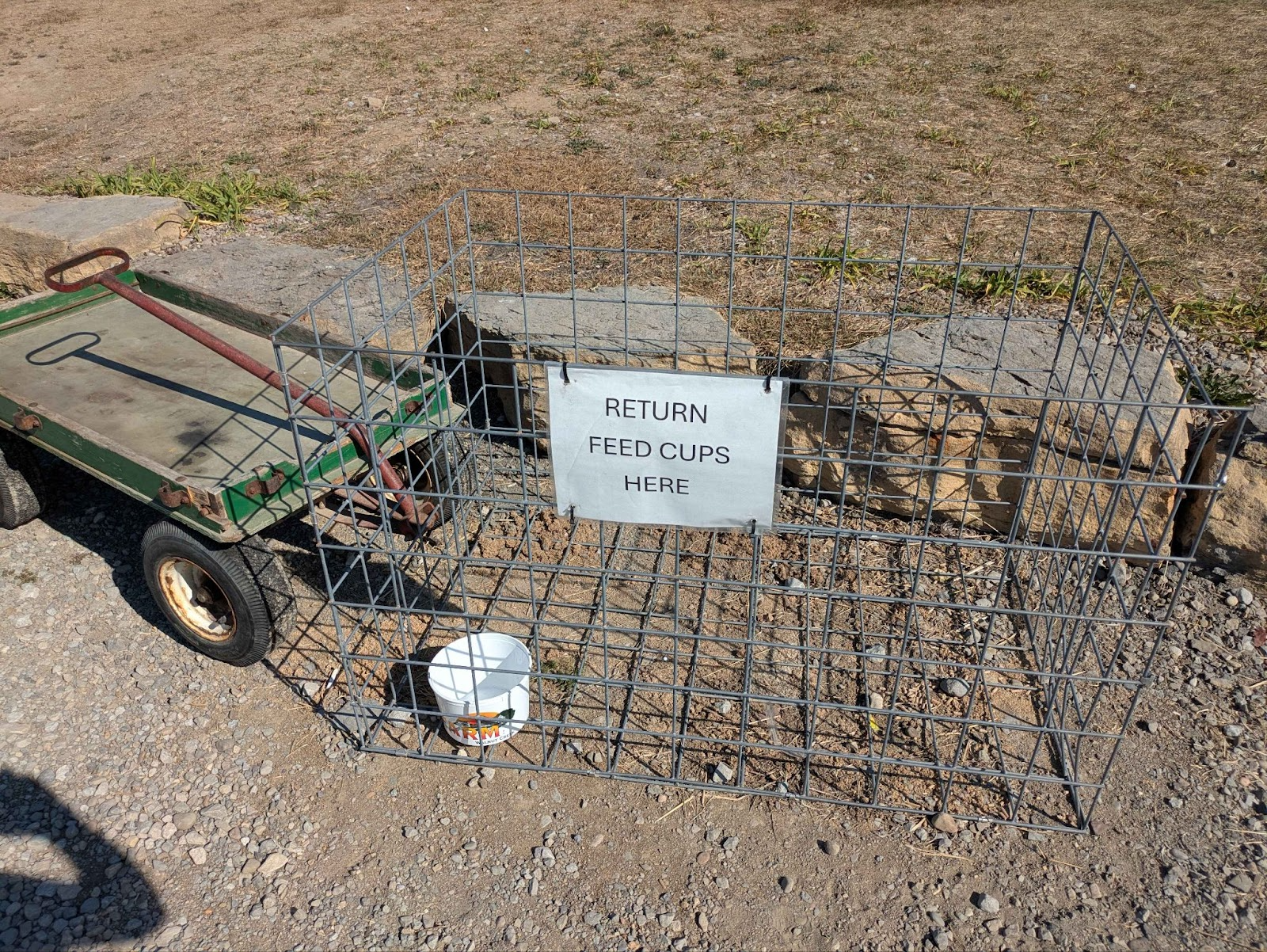
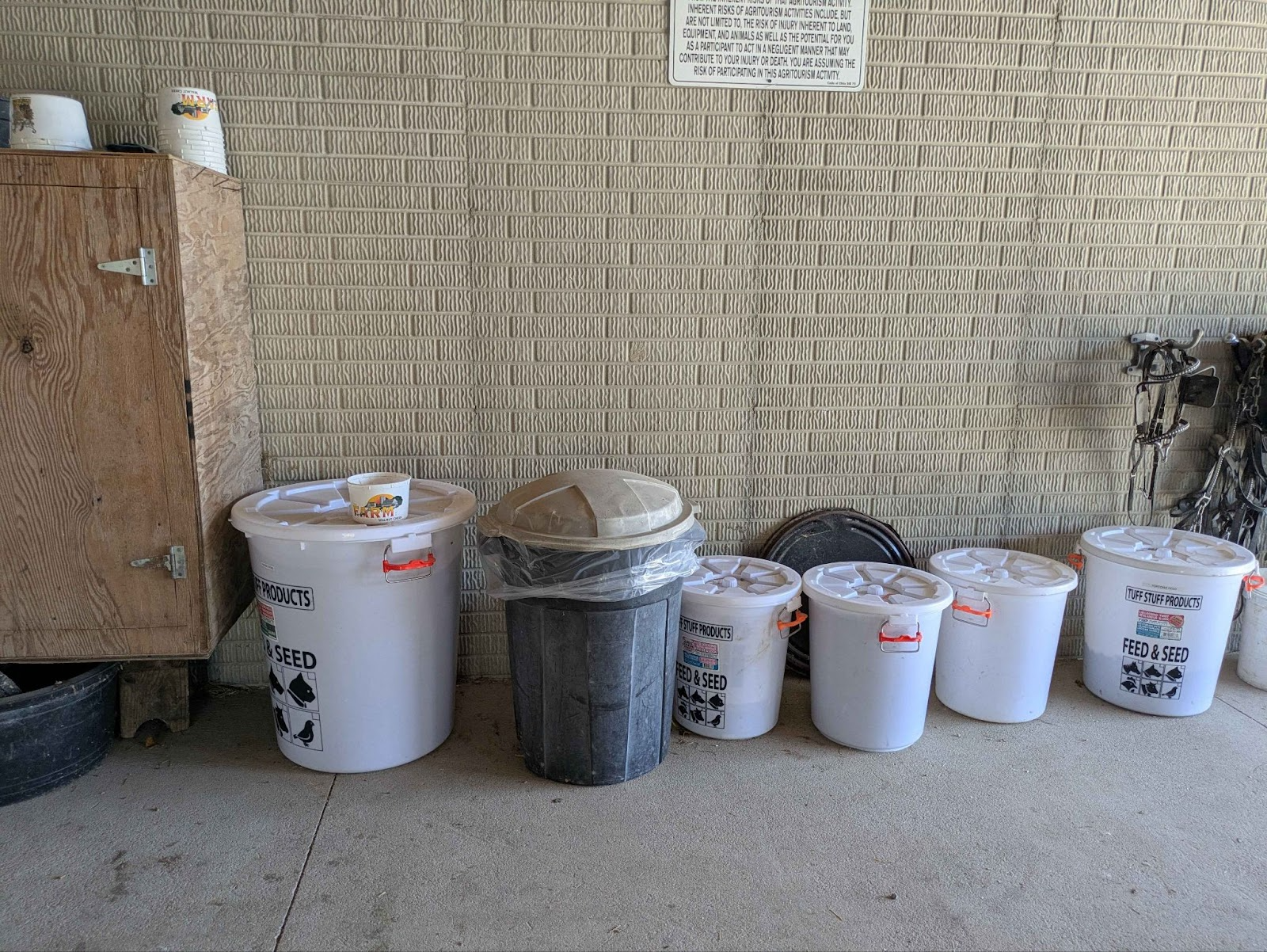
The animals on site range from classic farm staples like roaming cattle, to exotic birds and even giraffes and zebras. It is important to acknowledge that this farm is open to the public, and many things are in place as part of an experience to draw in guests. This being said, there are many animals on site that have functional purposes. For instance horses are used to pull carriages and perform labor. Chickens, cows, and goats are all serving classic farm roles producing eggs, milk, or meat. The stranger animals, like llamas and deer could contribute in similar roles, but giraffes and zebras are present for purely entertainment purposes. The role of the exotic animals tended to function more like a zoo than a farm in certain aspects. Notably, the feed containers that guests could buy to interact with the animals were reusable and collected at various drop-off points once empty to be refilled and redistributed to future guests.
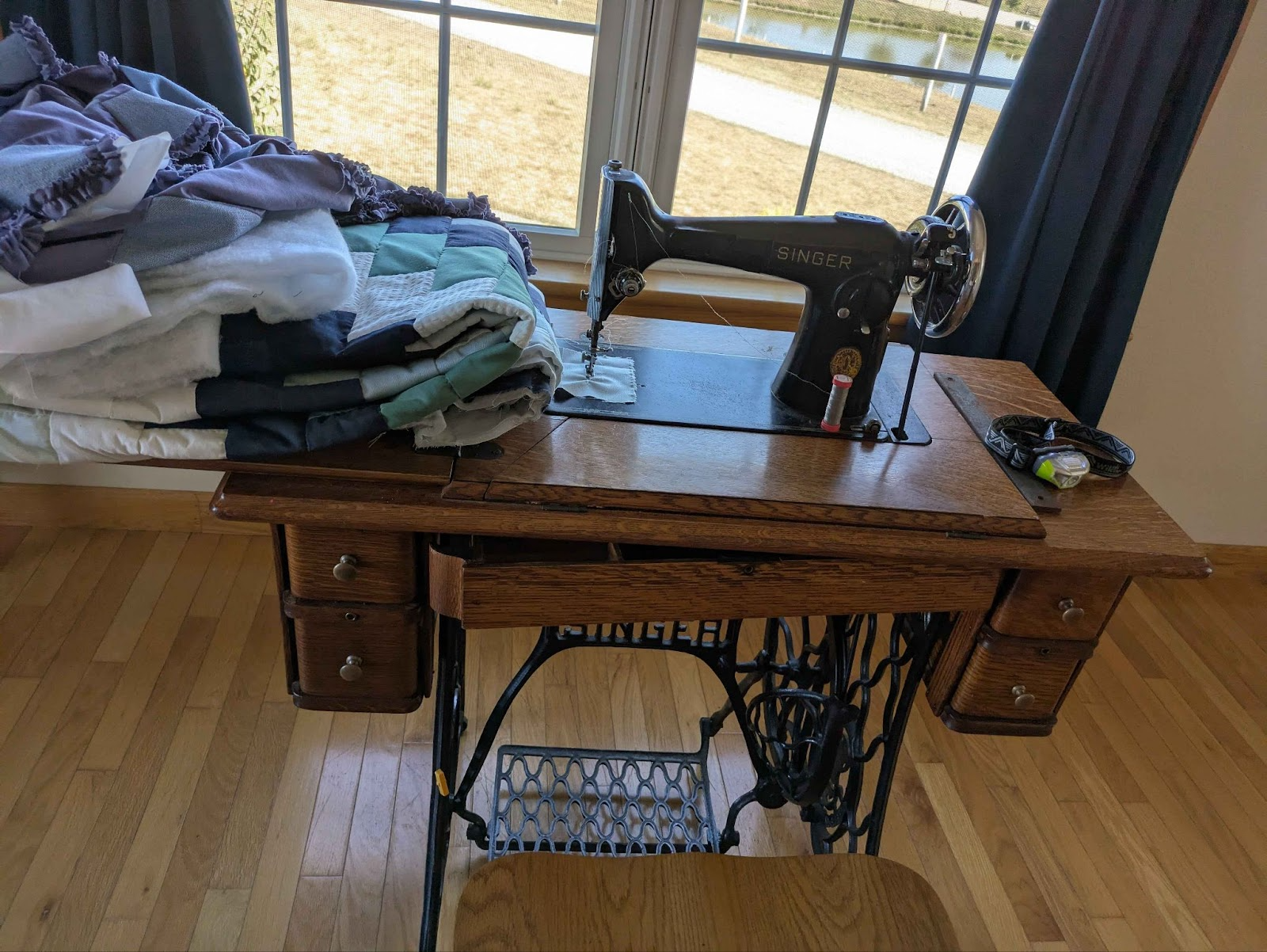
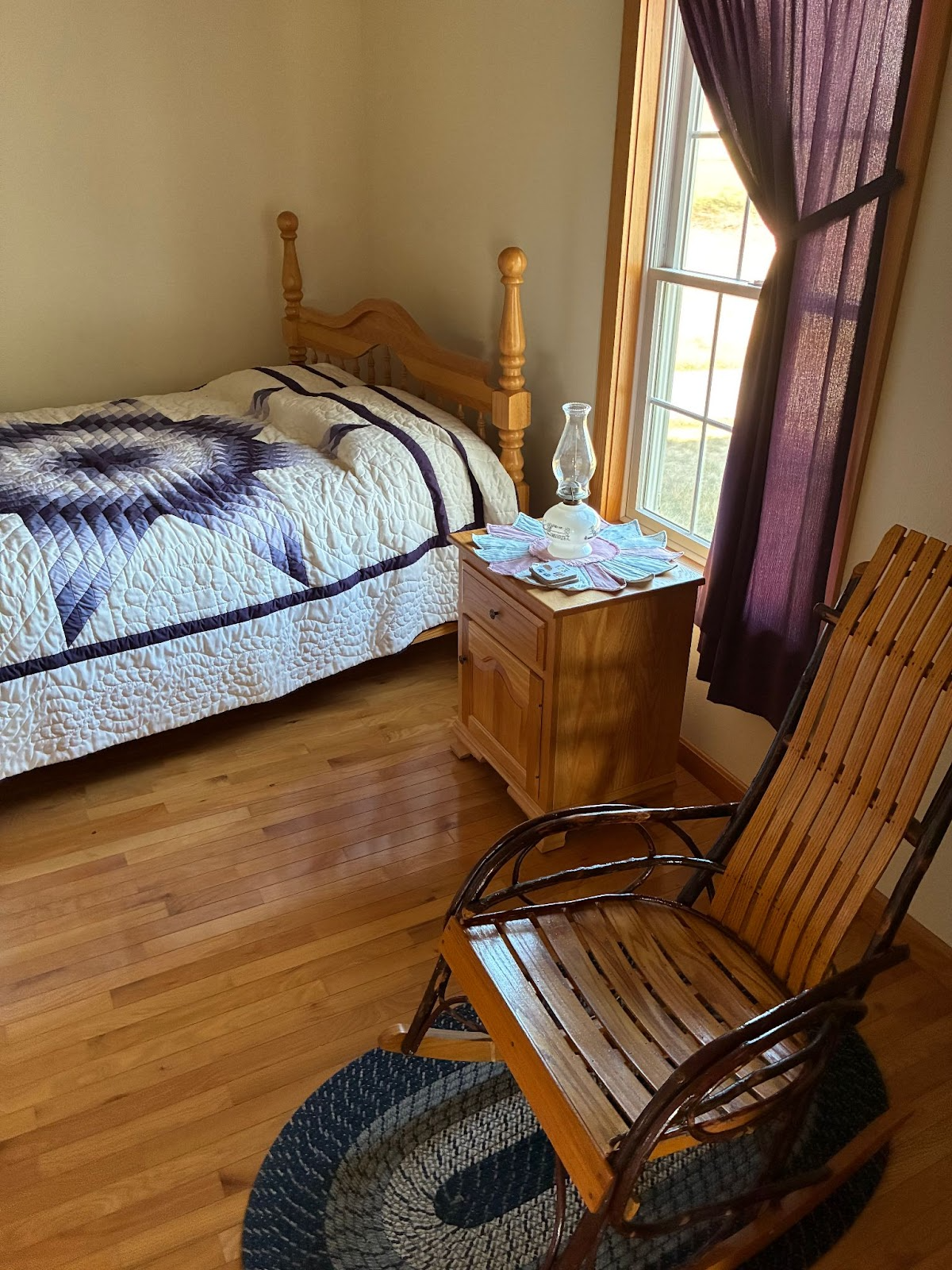
The house itself was open to be explored by guests. Certain aspects were functional for the workers, while some were in place like an exhibit for guests. Materially, all the furnishings were hand-crafted wood from tables to chairs and the quality of the craftsmanship was easy to see. Mock-bedrooms also had wood crafted bedframes, with quilted blankets. An original singer sewing machine was in the middle of a quilting project. Even the public bathrooms had tin stalls for separation, instead of the usual plastic walls. It was easy to see these timeless materials and practices everywhere you looked, even the wooden floors. There was some interesting creep of modernism when taking a closer look, namely the houses themselves. The patios, and stairways leading up to the house, and some railings were new and shiny white made of some sort of plastic material common in newer homes. They were hollow inside, and the material difference was noticeable.
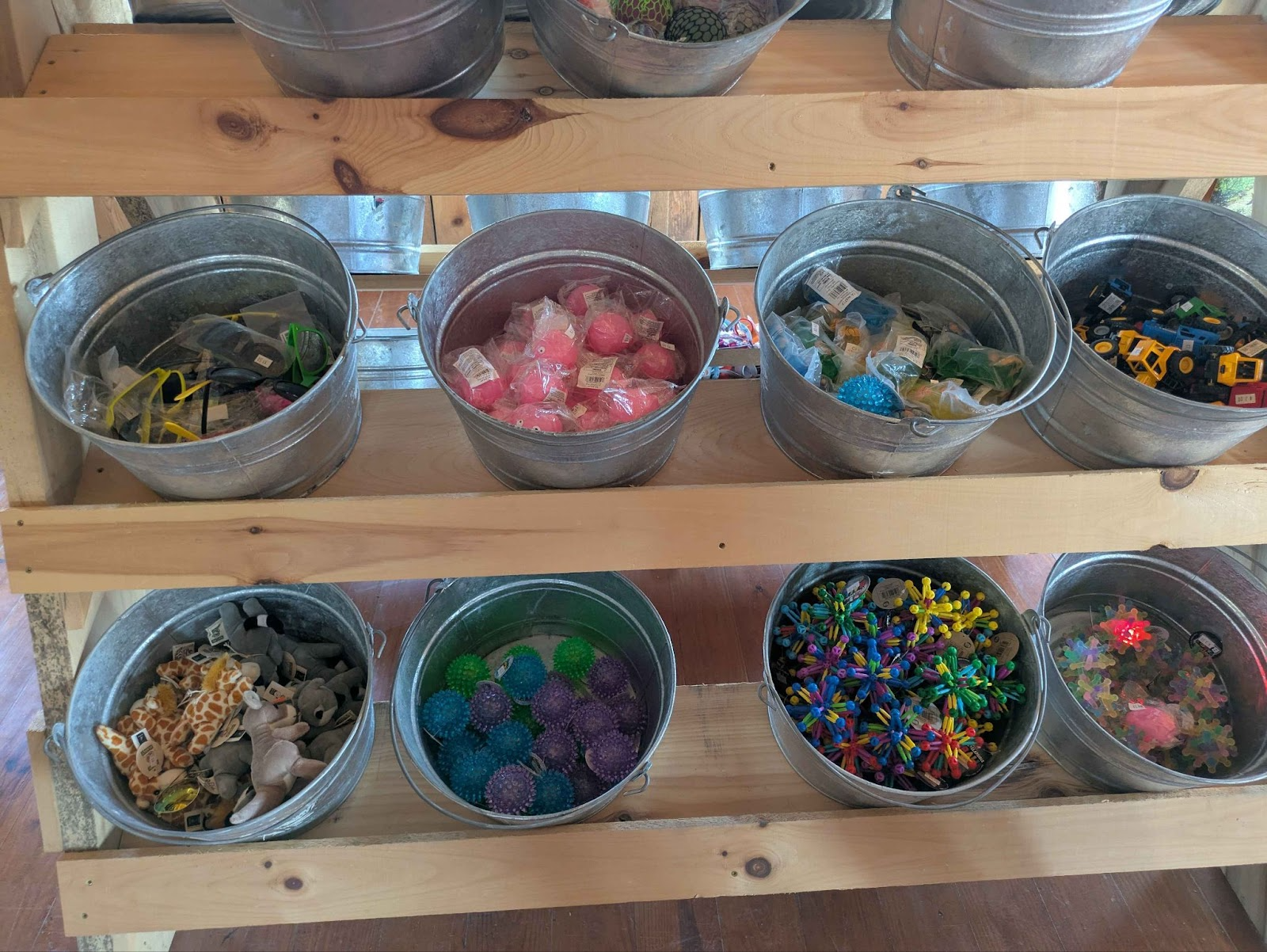
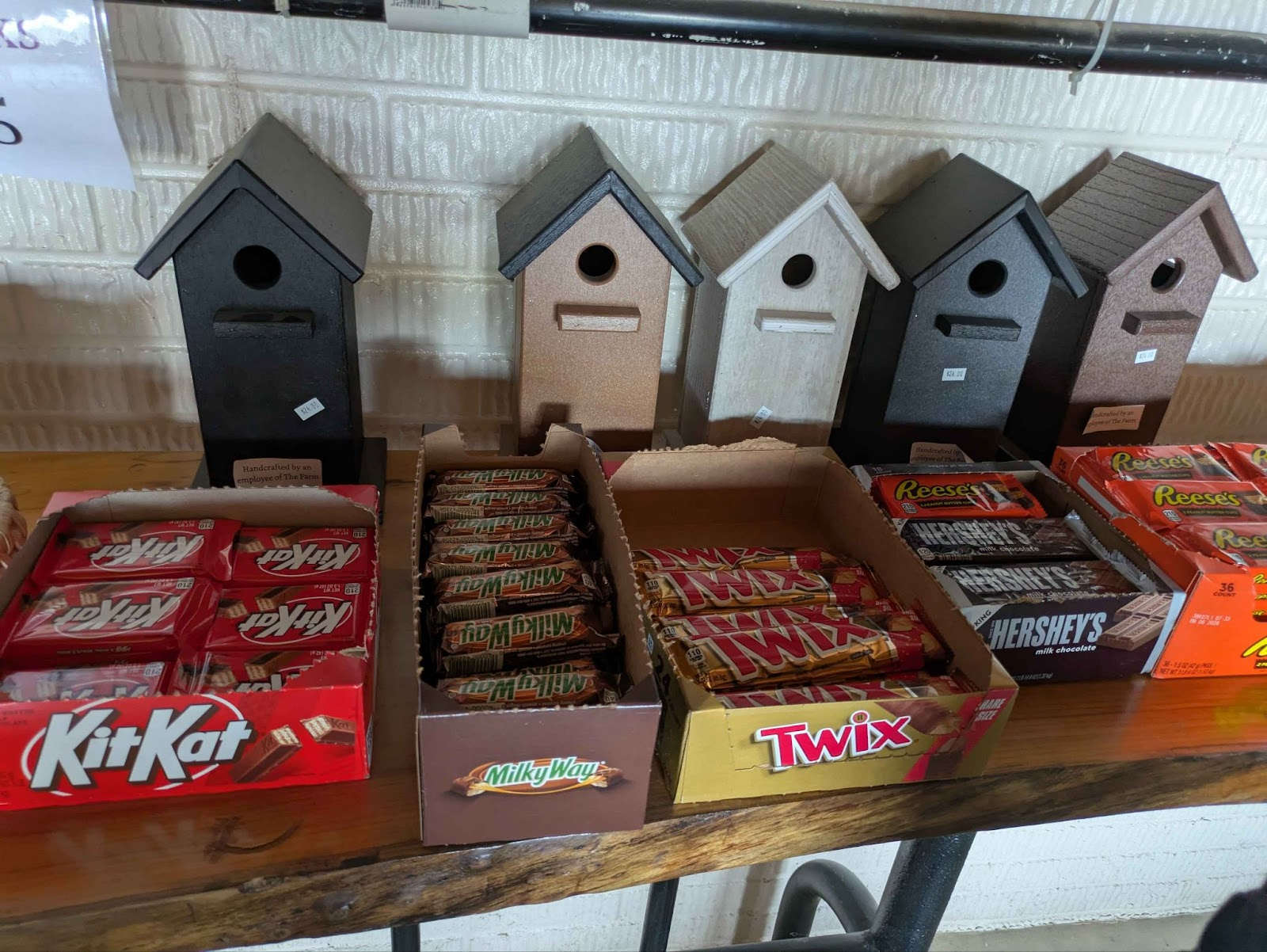
Something interesting is happening in the Farm gift store, where this shift of material and craft comes to a head. The products are being held on wooden shelves with metal buckets, which matches the other furnishings. Inside these buckets they are selling a lot of plastic things, some with disposable packaging, and other items that are homemade. It can be a whiplash to see artisan maple syrup with hand written tags next to the mass market Twix bars. The gift shop stands out because this is where the company is most trying to catch the interest of their non-Amish guests, and this can be seen in the products on sale.
Offsite Store
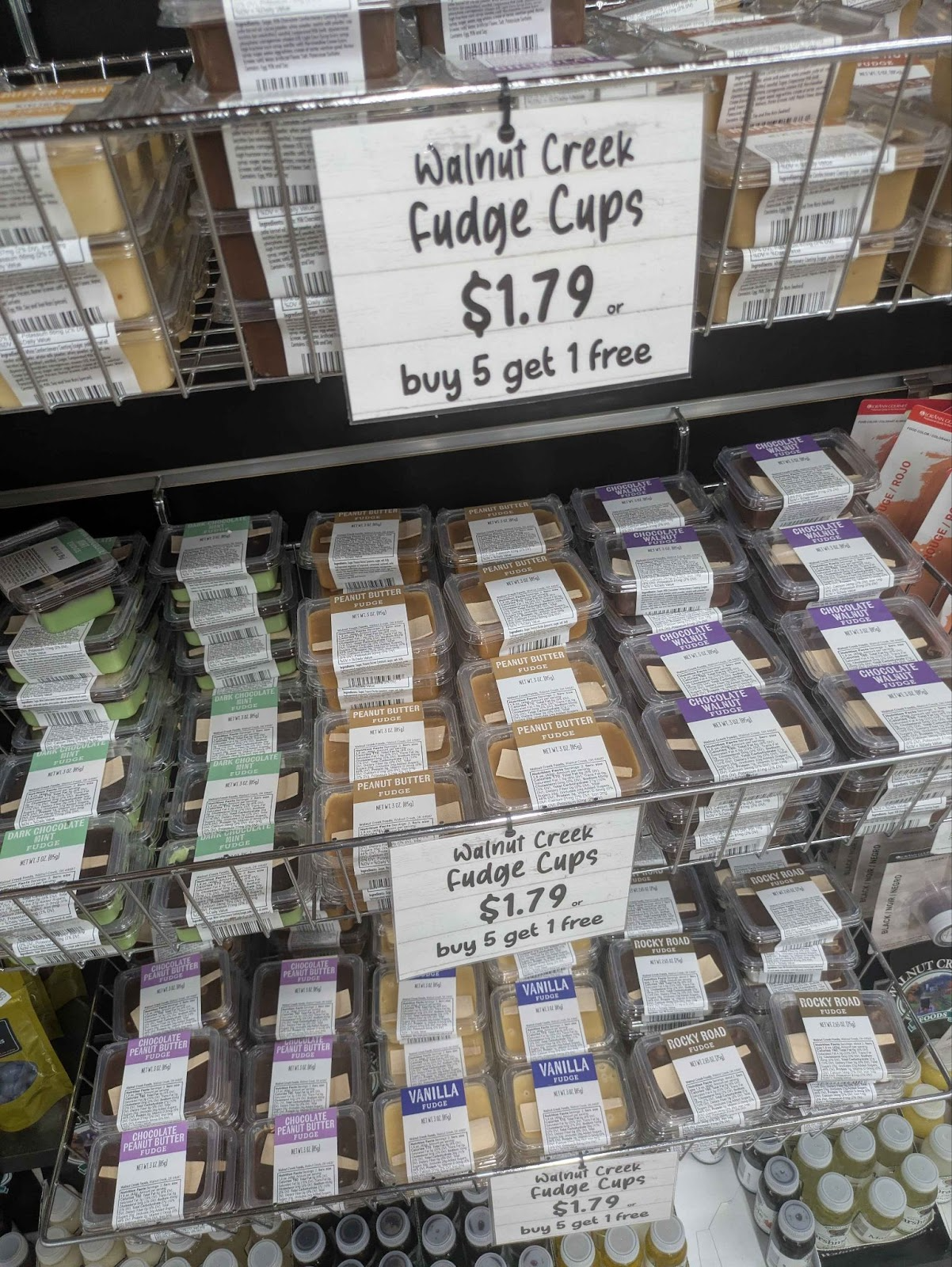
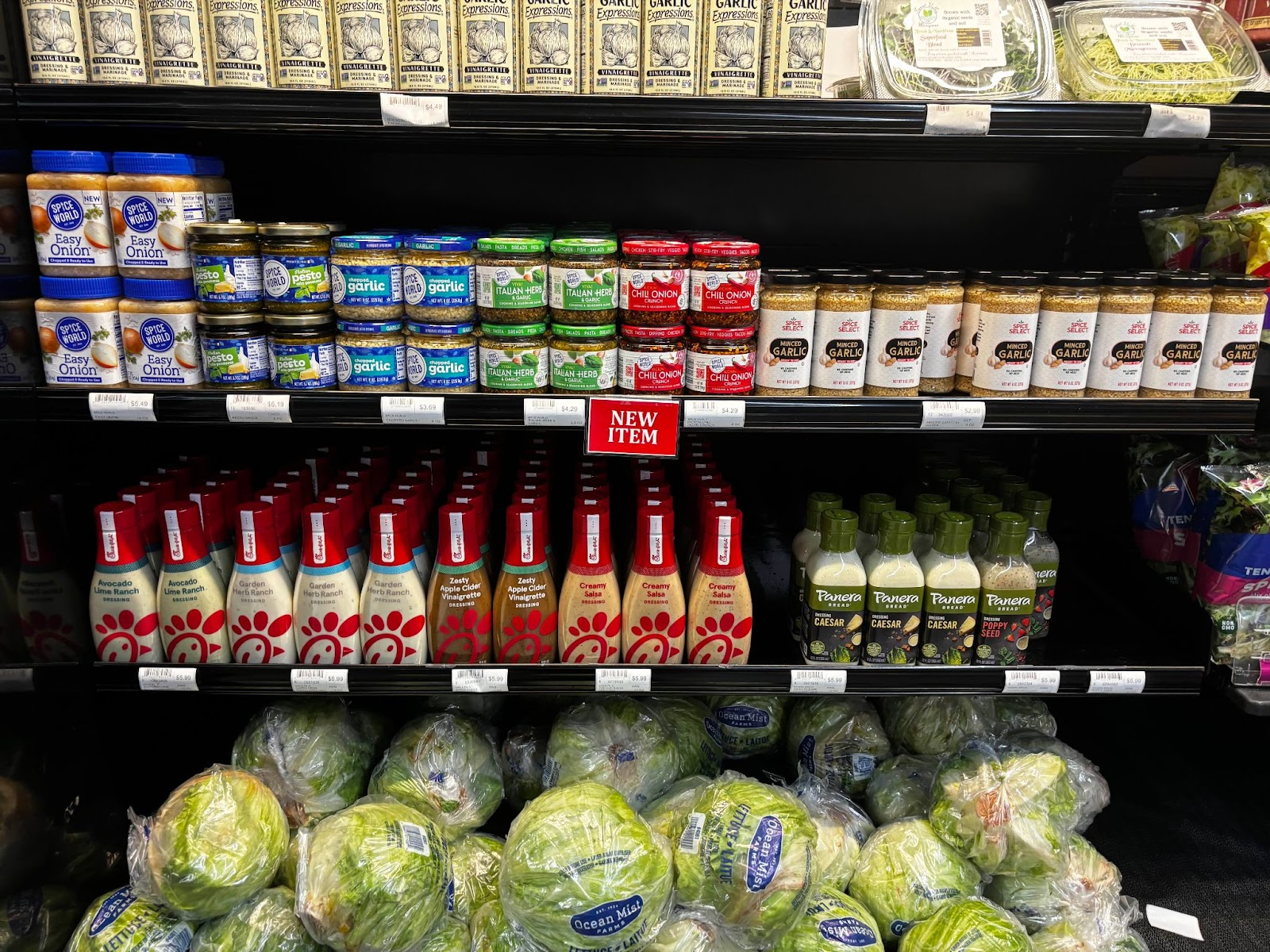
The second location is the Walnut Creek Cheese and Market. The offsite store employs and serves both the Amish and non-Amish residents around the area. Many of the products are from Amish makers, and many have Walnut Creek branding. But there are other products being sold from larger brand names. Groceries are packed in single-use plastic bags, and there was a lot of single-use packaging around the store. Even the Amish-made products use more plastic and boxes in their packaging. This is a big shift from the farm kitchen where glass jars were reused for storing the workers food. This mimics the normalized practices in grocery stores.
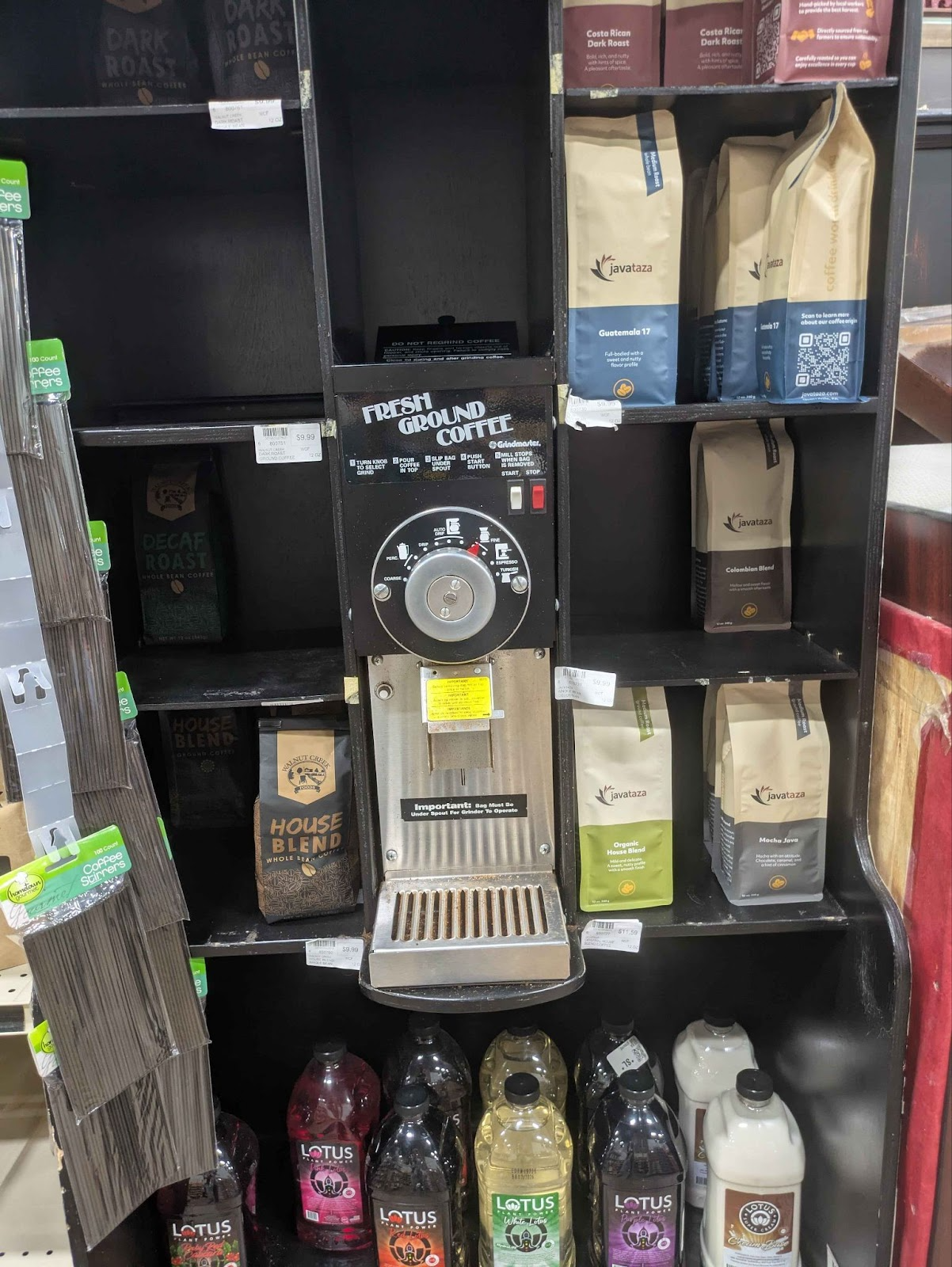
However, there were some interesting systems that broke out of the normalized grocery experience. One example is a coffee-grounds machine where customers can refill their own bags of fresh coffee.
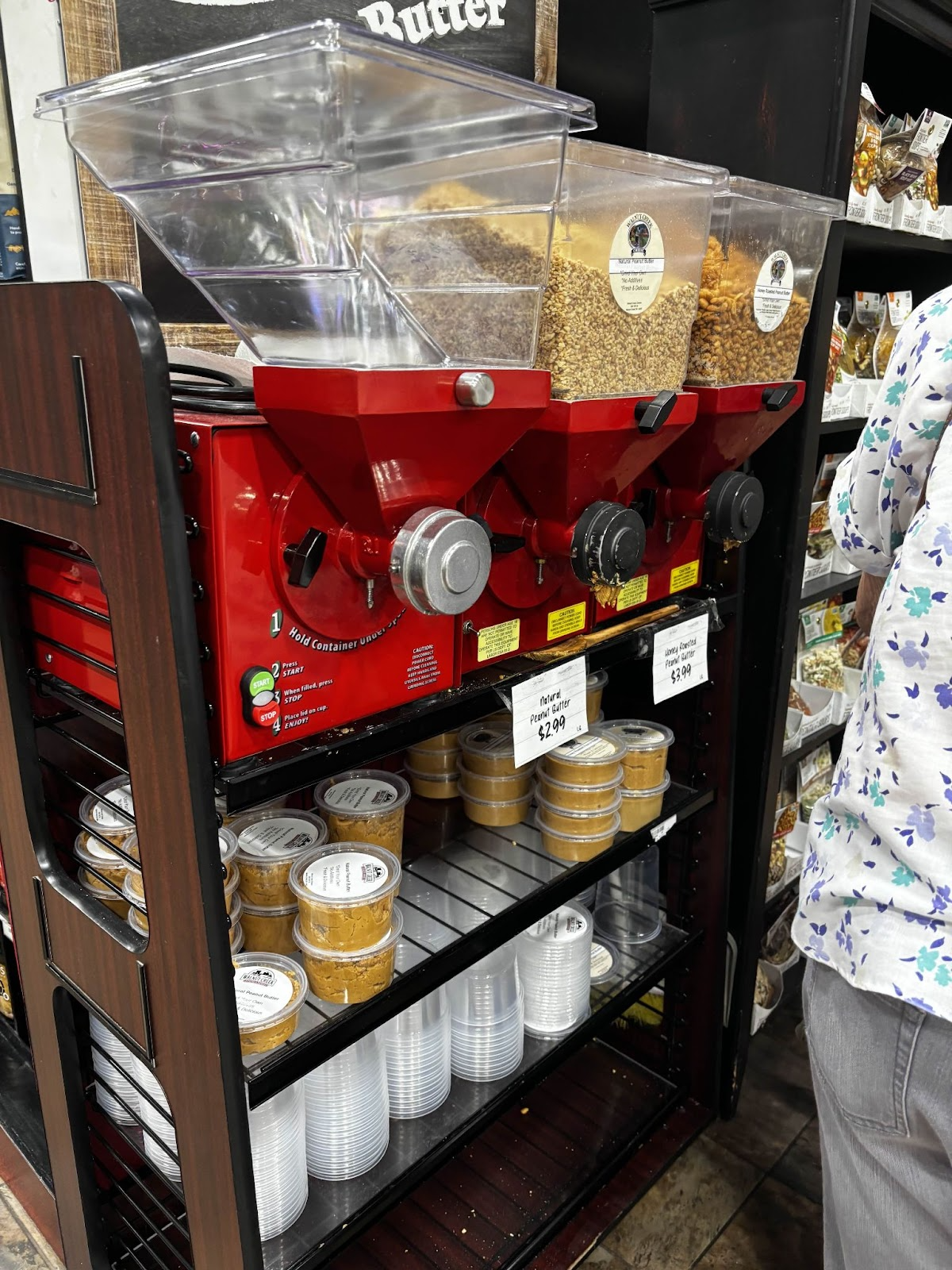
Similarly, fresh peanut butter and almond butter comes from these machines. Plastic containers come already filled, with the option for customers to refill it or bring their own containers. This is Walnut Creek branded peanut butter.
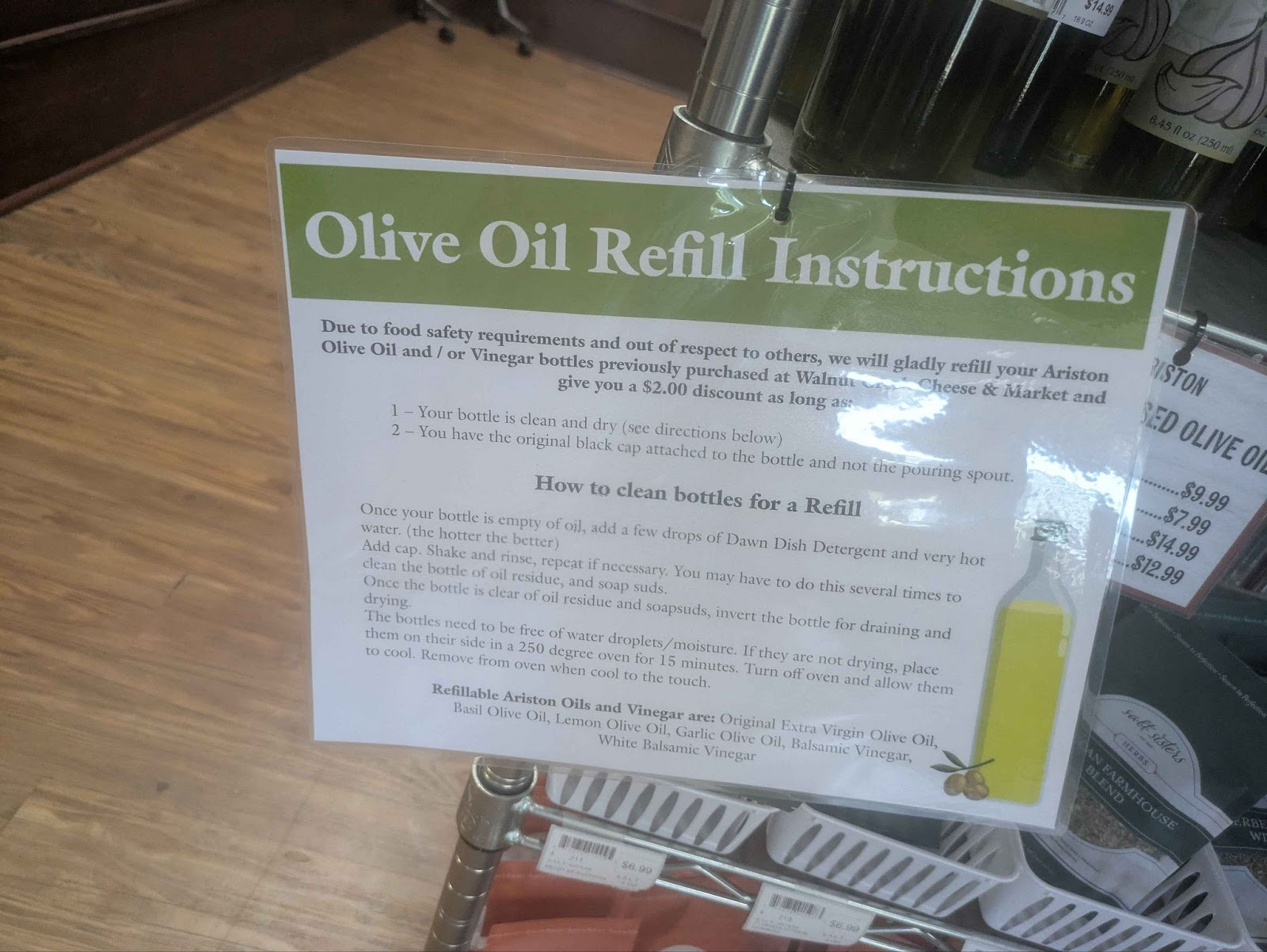
Finally, some of their artisan oils and vinegars offer refills with a two dollar discount if the customer brings back a clean bottle. This is especially interesting because the bottle must be from their product, making this very circular in nature.
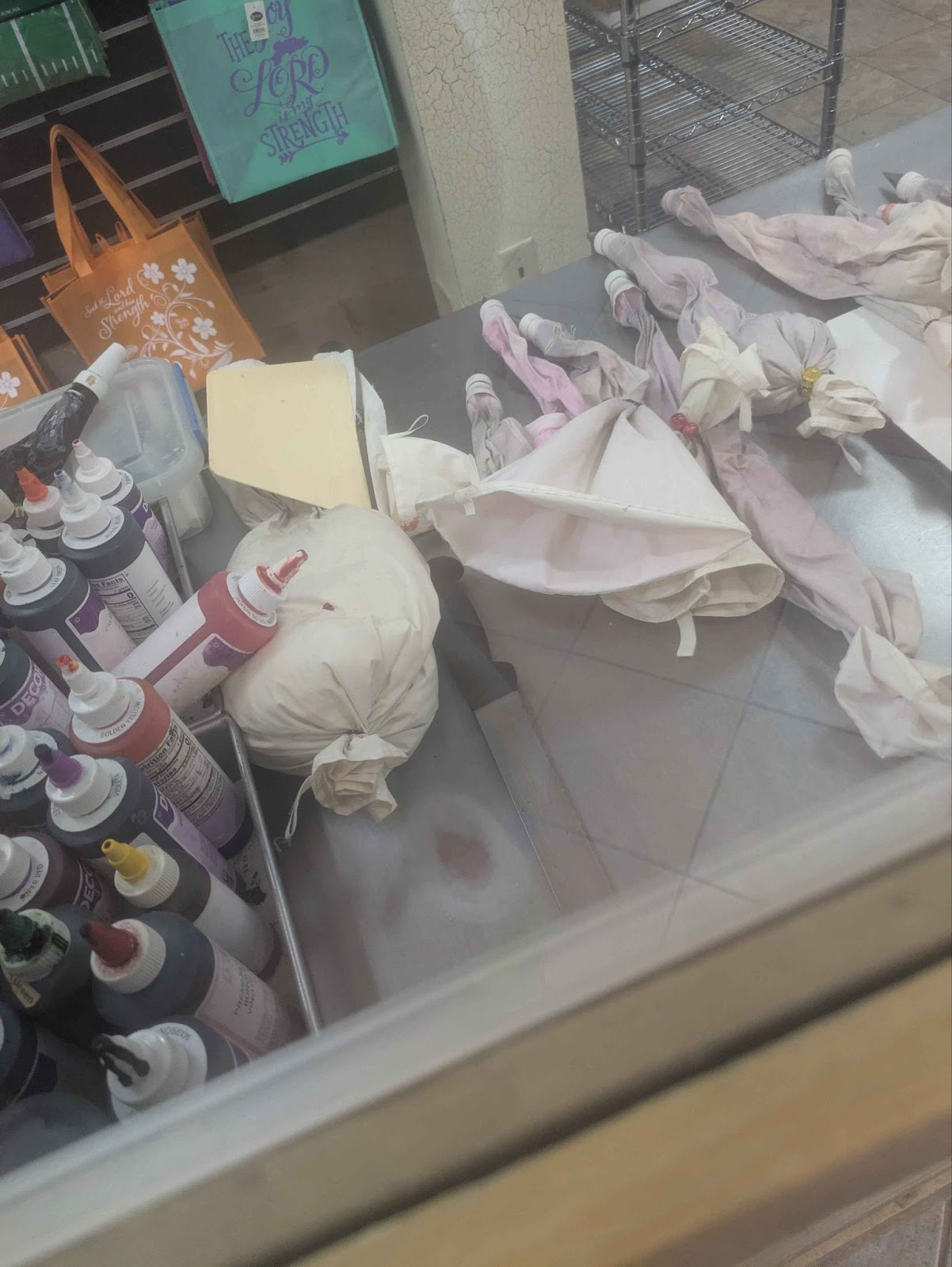
Some practices still have uniquely reusable materials. These piping bags being used to decorate icing onto cakes are made of reusable cloth. Once cleaned properly, they can be used again. This is very different compared to the usual one-use plastic bags that are discarded in large scale markets.
There is a shift from reusable goods living a circular lifespan, to single-use items the more the general public comes into the picture. Materiality follows this shift as well and goes from long term wood and metal to easily discarded plastics. The larger a circular economy needs to exist within the harder maintaining the process becomes, and more likely to rely on the current American systems of consumerism.
Central Ohio Reuse Coalition, Circular Coffee - Site visit/Informal Interview
- September 18th, 2025
- Facilitators: Jessica
- Writer: Jessica
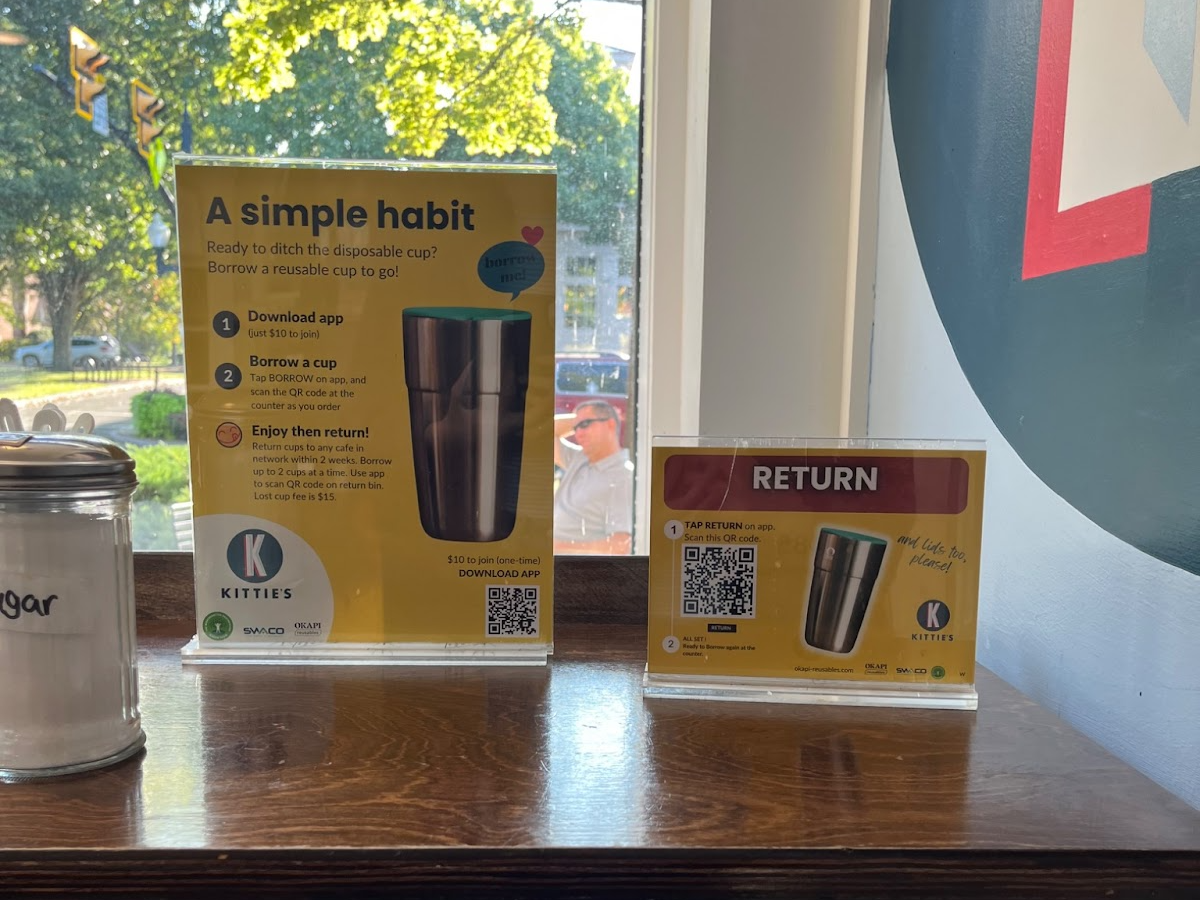
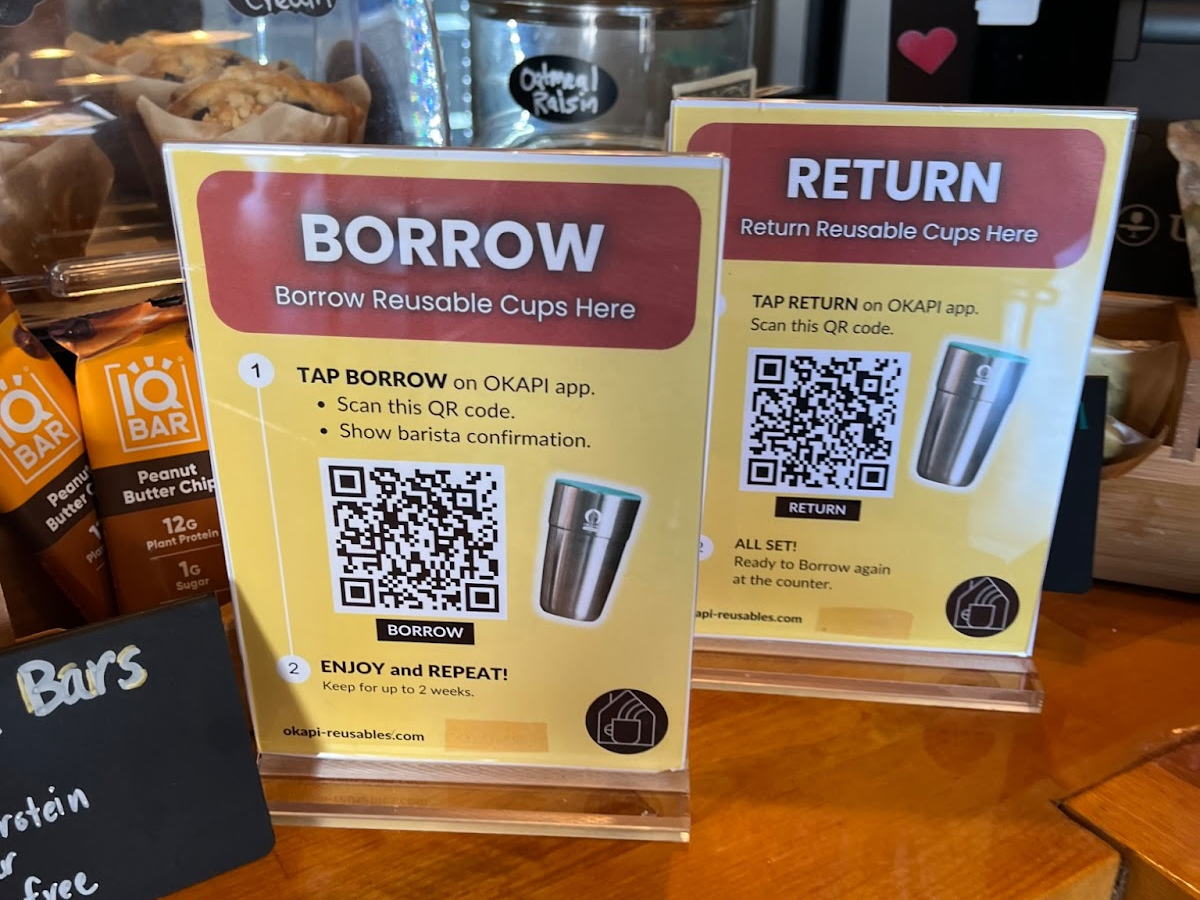
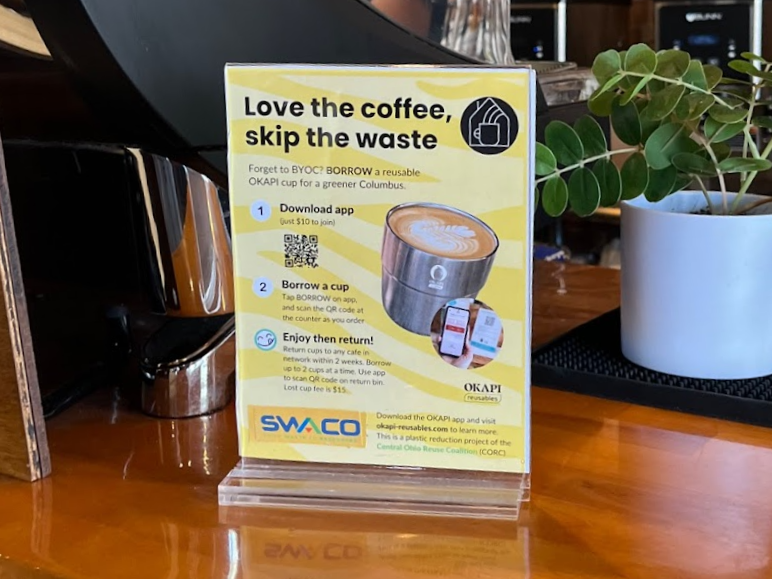
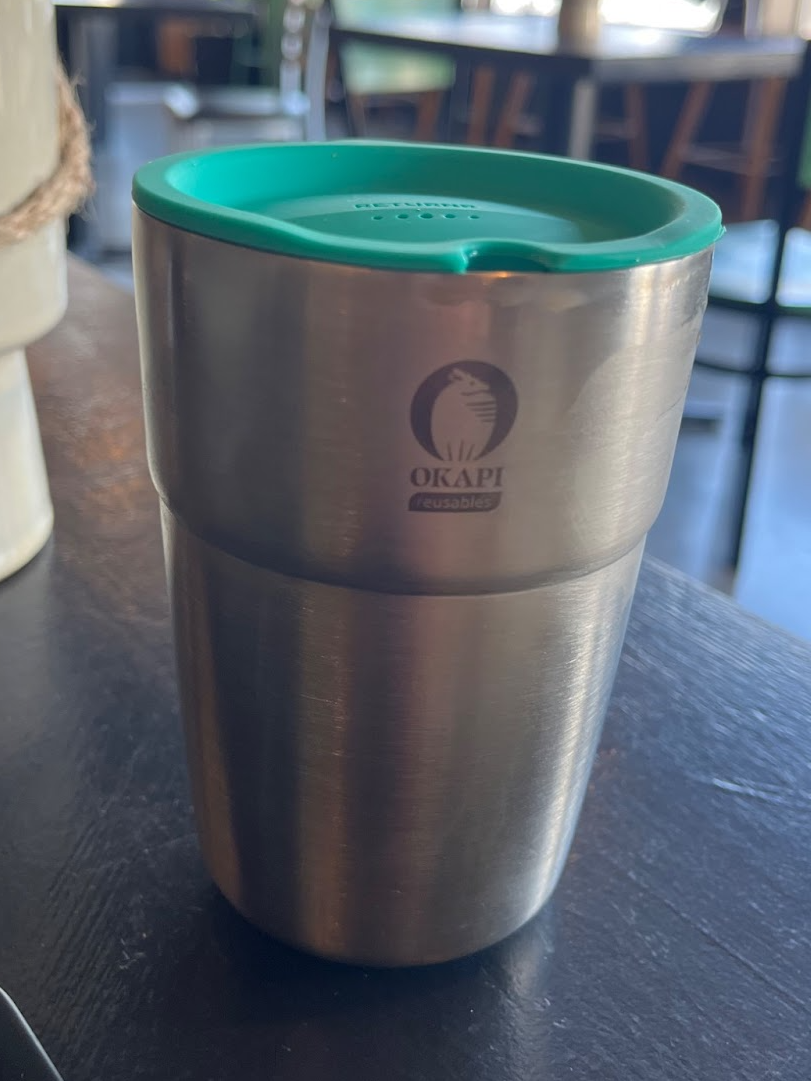
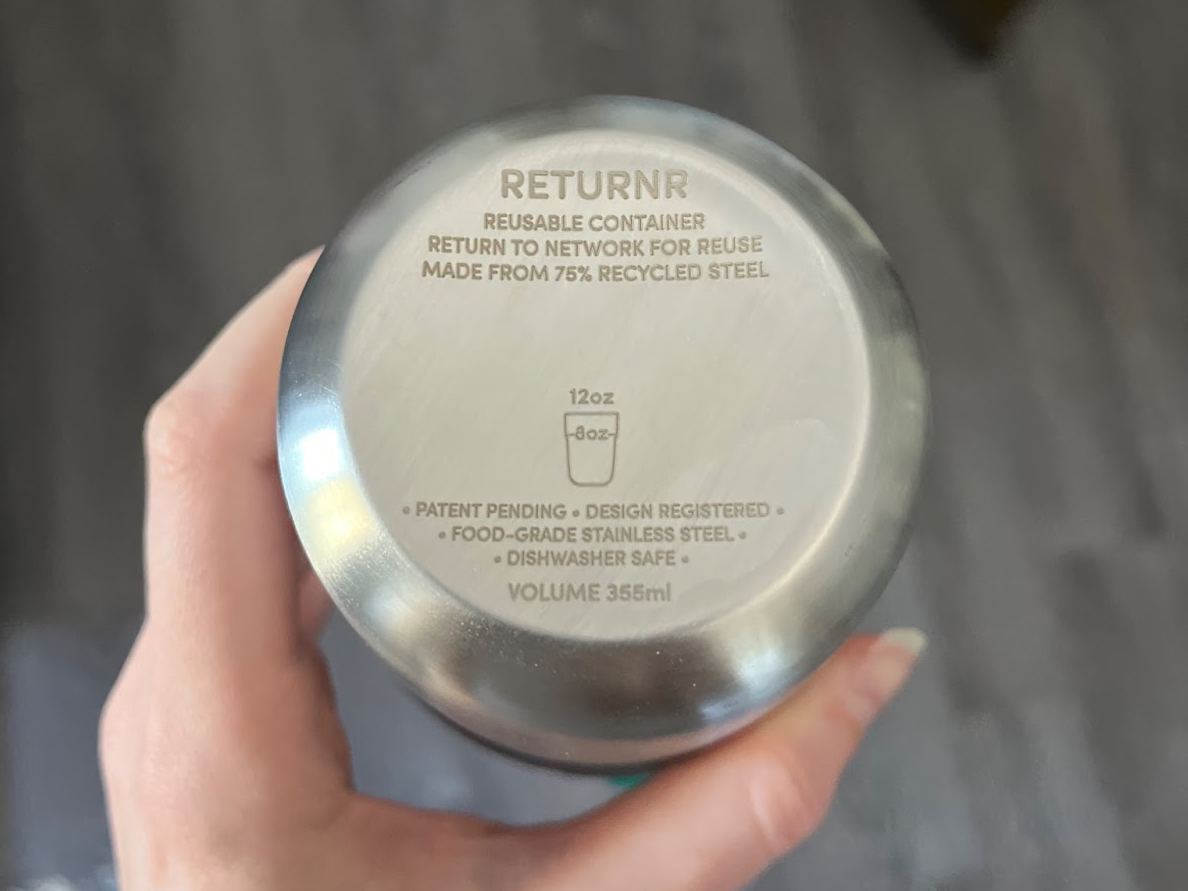
While researching current initiatives towards circularity locally, I found out that since this past January, Columbus is part of a pilot program to reduce the amount of single use coffee cups from cafes. In partnership with Okapi Reusables, currently 9 cafes across Columbus are testing out their program to encourage using metal tumblers instead of the single use cups coffee orders usually get placed in. Participants are asked to download the app, and then there is a one time $10 fee to get started using their cups. They base it off of a library borrowing system where you get two weeks to return the tumbler that you most recently used. By scanning a QR code at the time of ordering you are able to get up to two reusable tumblers at a time which makes it convenient if you already have one checked out and forgot to bring it back. Once your drink is in the cup, you are then asked to wash it initially before scanning the QR code to turn it back in at any of the participating cafes return bins. However the cafes then wash them on their end too before going back into circulation. I thought that this program would be an interesting way to do participant observation to fully get a grasp on how the process goes from start to finish while also informally engaging in a few casual interview questions.
I started my morning with Kitties café in Worthington, where the barista helped me through the process of downloading the app and then scanning the “borrow” QR code when ordering. The app is pretty straight forward which I think is intentional because asking someone to incorporate an extra step in their morning routine could be a deterrent from participating. After conversing with the barista she shared that they’d been participating for around 6 months and she has noticed that participation has slowly ramped up. The process hasn’t interrupted their work flow much because besides having to wash a few more items they just keep the stainless steel tumblers in a cabinet behind the counter. After I received my coffee I took a seat and observed for roughly 2.5 hours. I didn’t witness any people participating directly in the program itself with the 72 people I counted that came in that morning. However there were a handful of people that brought their own tumbler to be used which I thought was interesting.
In the afternoon, I looked on the app to see the list of participating cafes and went to The Light Meeting House to see how the return process would go. With a washed tumbler in hand to return, I had a nice conversation with the owners. They had only been part of the program for a week and hadn’t put up the signs or QR codes yet and brought it out from the back. They excitedly said that I was the first to come in and participate. My expectations were lower of seeing another participant since they were so new, and the café was slower with it being the afternoon. However, of the few patrons that came in while I was there for about an hour and a half there was a person who came in and had their drink put in their own tumbler. There seems to already be an unspoken level of circularity among some café goers, which helps towards the pilot program's goal of reducing the amount of disposable cups. How could this program reach more people, and is the paywall preventing more engagement when you could just bring your own tumbler?
Lucky’s Market - Site visit
- September 19th, 2025
- Facilitators: Cheyann
- Writer: Cheyann
Lucky’s Market is a store that specializes in organic products, health foods, and local finds. They have a unique selection of natural food. This site visit was initiated to understand trash management from a corporate perspective, to identify examples of circular economy if any appeared to be present, and identify gaps in circular economy locally.
Facilitators toured the store, made use of amenities, and spoke to various employees and customers.
Disposal methods
Lucky’s market deals with waste in a few different ways. Produce waste, for instance, goes back to farms to be composted. For the most part, the company does not have recycling methods in place due to the change of culture. When the company was owned out of California, recycling bins were easily accessible throughout the entire store for customers and workers. This is no longer the case now that they are local to Ohio. Although there is no glass or plastic recycling, there are still options for recycling cardboard.
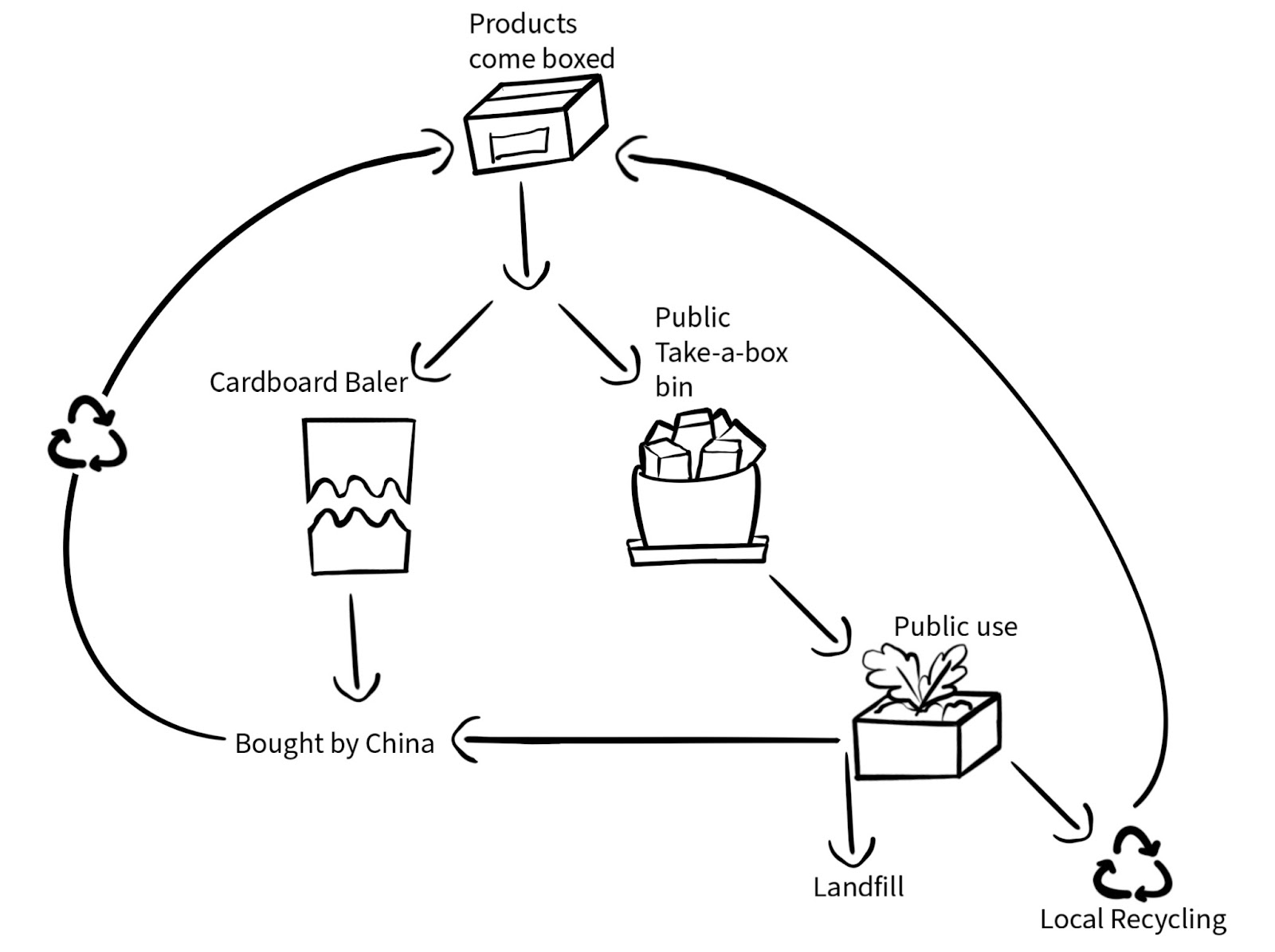
Boxes are generated from shipping in products, and these mostly go to the in-house cardboard baler. The condensed cardboard is bought by Chinese companies and eventually used to make boxes for American products. But there is another offshoot created by the unique take-a-box system where customers can take boxes, often for carrying groceries home, storing plant materials, moving, or anything else. The boxes from this branch have a wider reach, but presumably some are locally, or globally recycled, while many may end up in a landfill. Despite all the offshooting branches to this system, there is still a slight circularity emerging.
Finally, all other waste goes into their garbage transportation system which eventually goes to a landfill. Previously there was an outside dumpster for trash collection, but the system was recently updated into a trash shoot. This benefits employees who no longer have to go outside in the elements to dispose of trash. There are also less garbage pickups scheduled with this system which will save on CO2 emissions from garbage trucks.
Notable systems
There were many interesting systems in place at Lucky’s market that may shed some light on the current circulatory system of the local community and explore interesting aspects of materiality. For example, all bags for packing groceries are paper and completely biodegradable. Customers are socially encouraged to reuse these bags or bring their own reusable ones from home. The store also sells reusable bags, which are often made from cloth or recycled materials. One exception is that plastic bags are available in the produce section for loose fruits and vegetables.
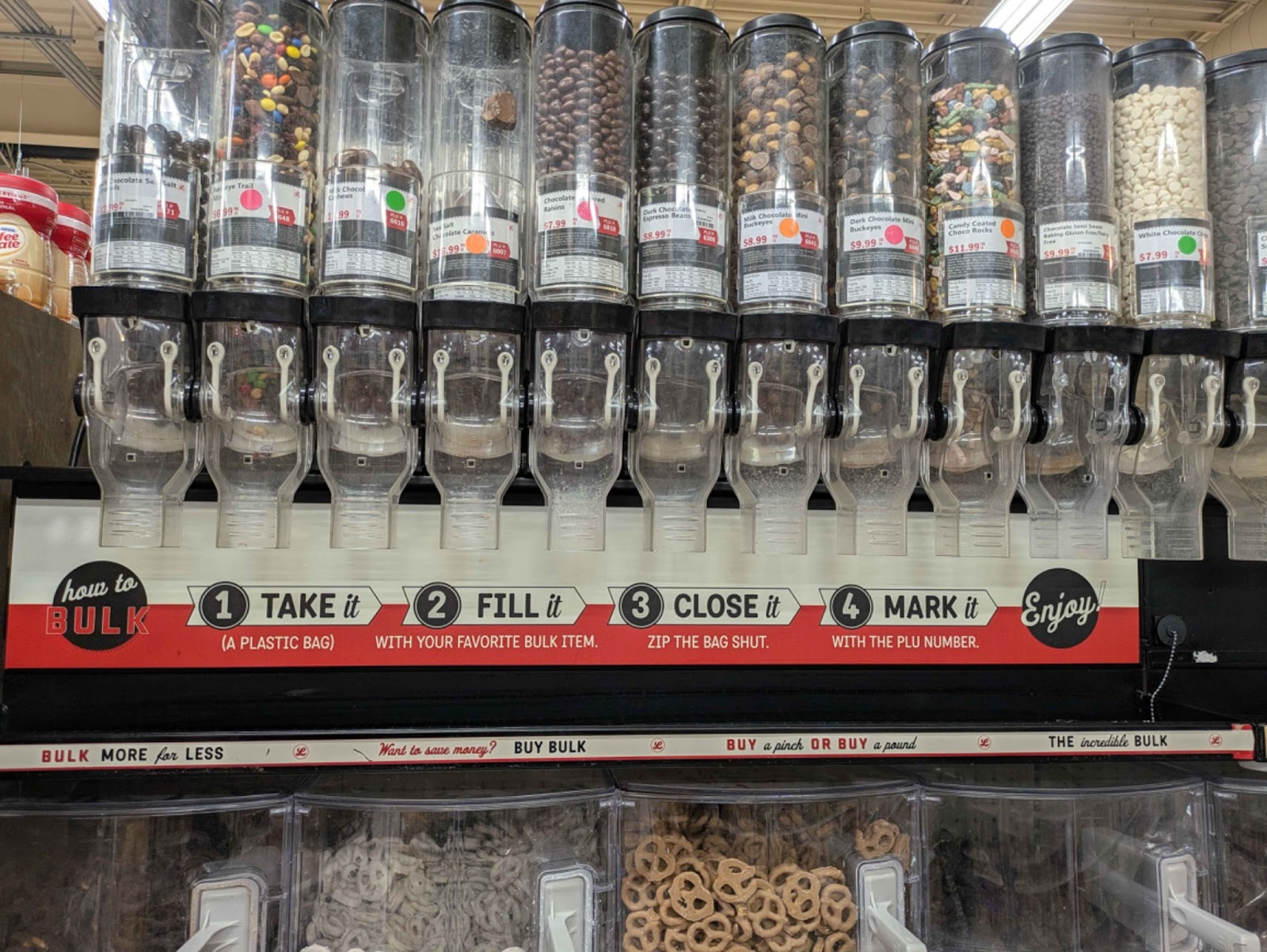
One very unique system is the Bulk Buy section. Loose products such as nuts, dried fruits, rice, spices, and more are available for customers to fill their own desired amount. This helps to cut down on excess plastic used in most product packaging, but it can be confusing for new customers to figure out.
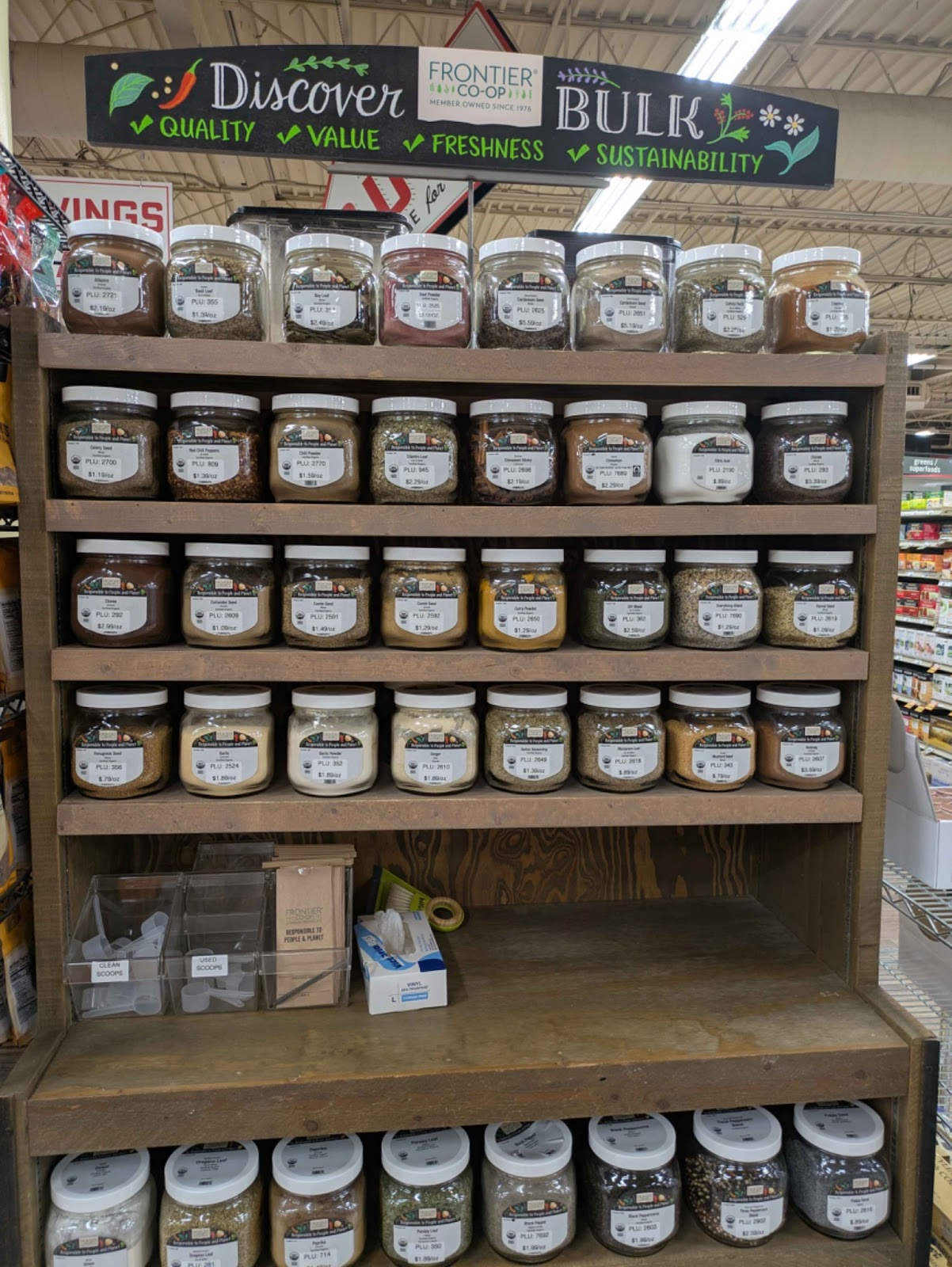
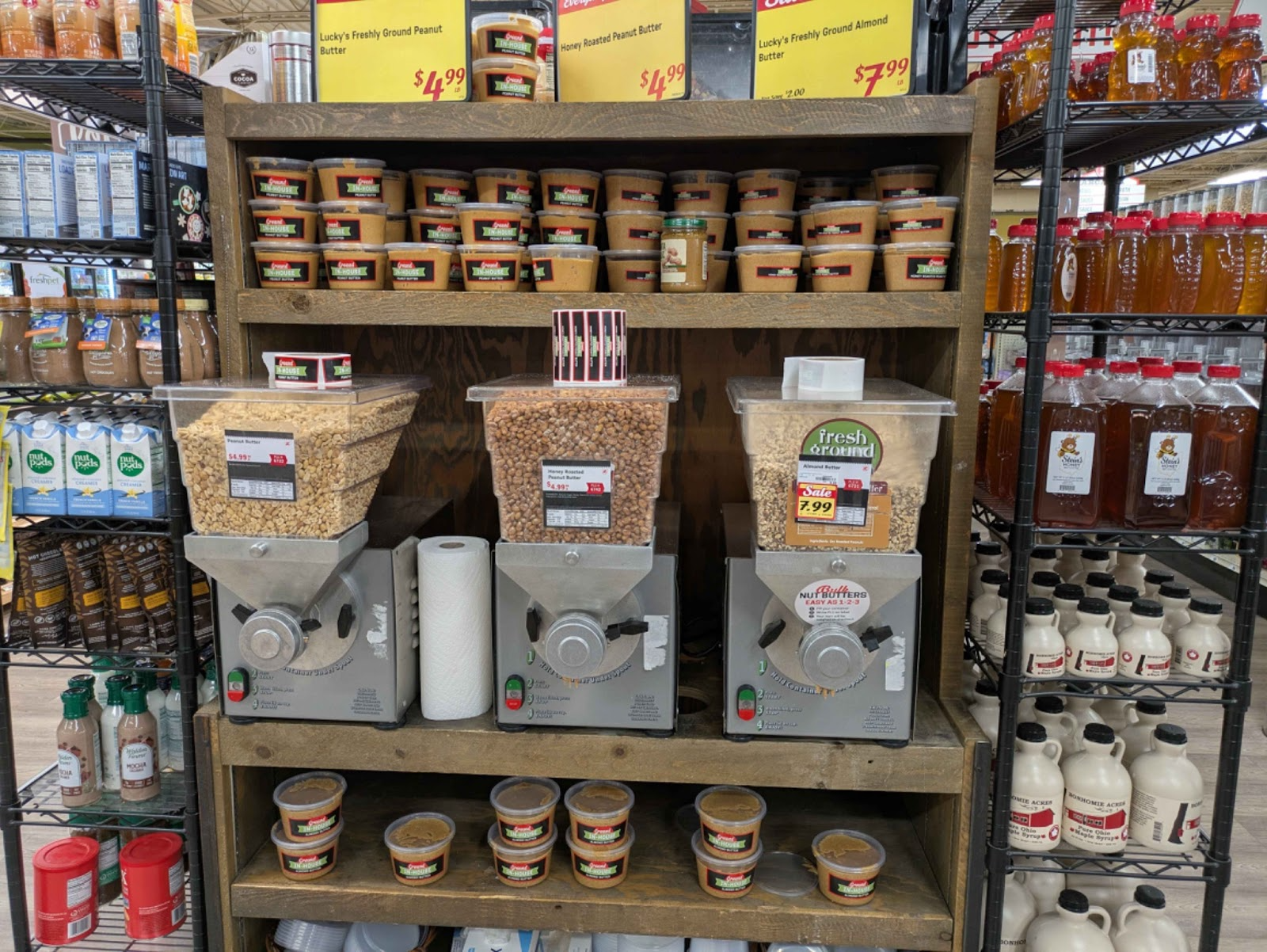
There is also freshly made in-house peanut butter and almond butter. The machines are available for customers to fill and refill old containers. They are stocked with peanuts and almonds. This drastically cuts back on the single use jars that peanut butter is usually sold in.
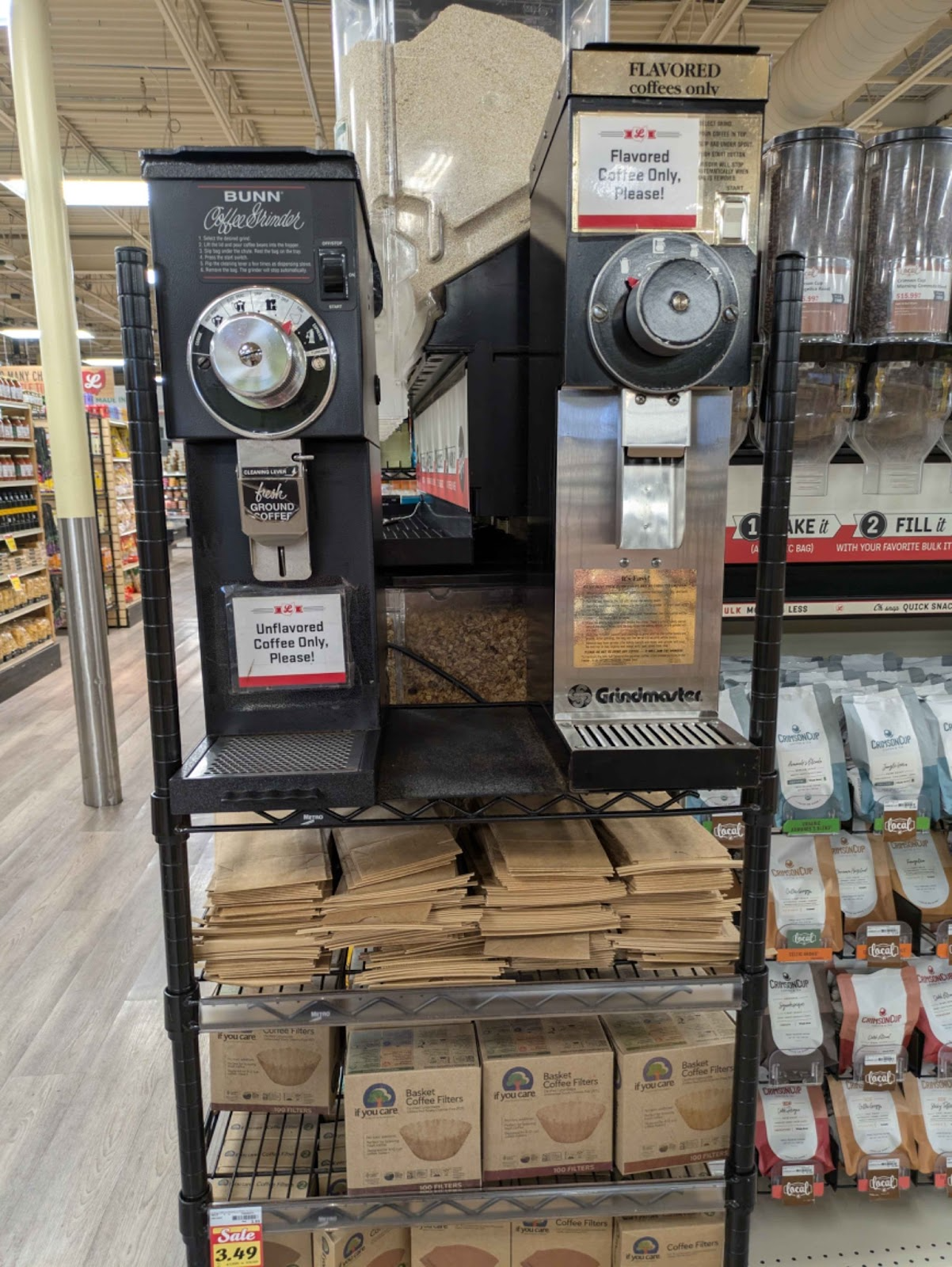
Similarly, there is a machine that makes fresh coffee grounds for customers to use. For storage there are provided paper bags, and customers can bring in their own.
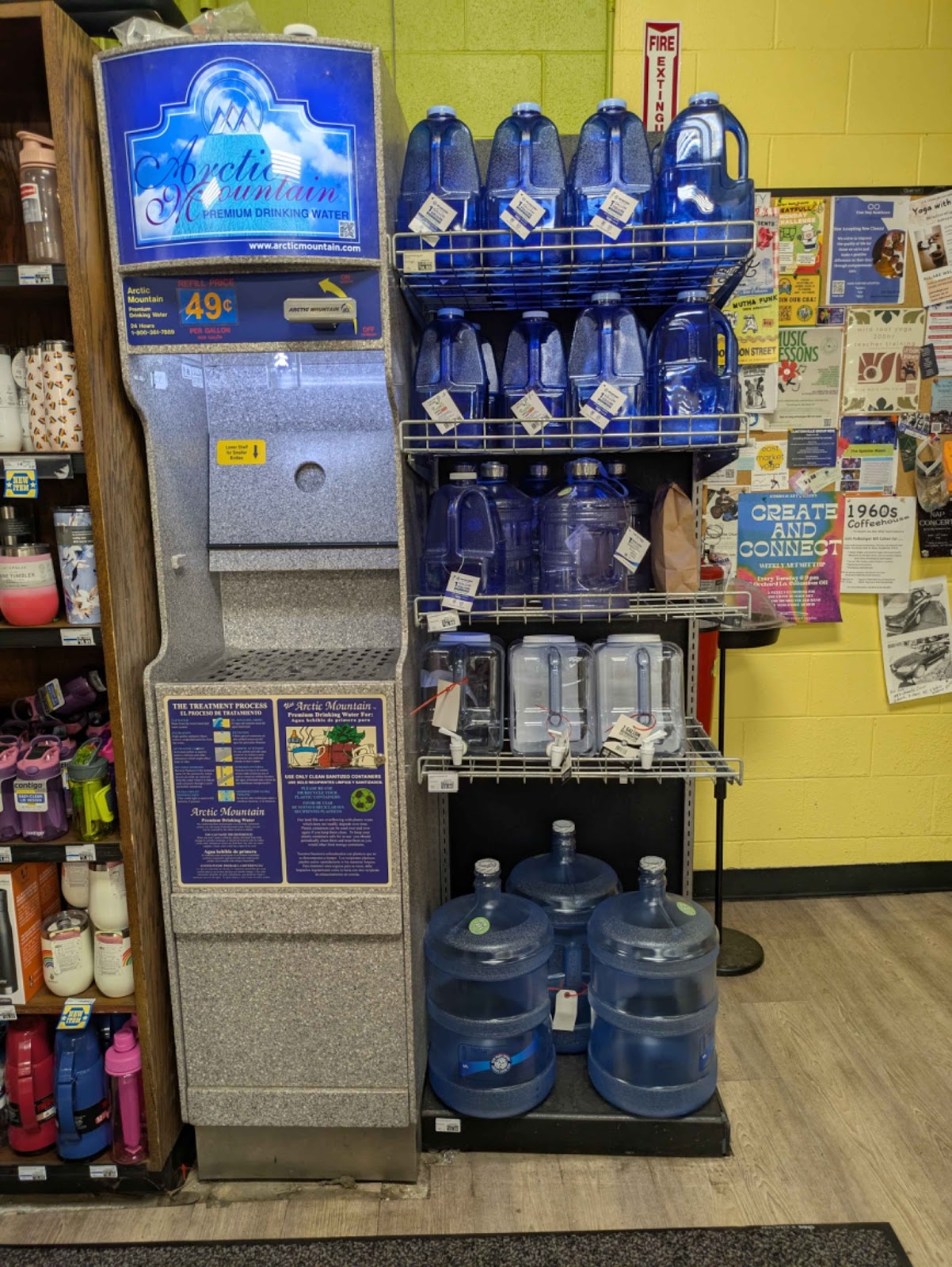
Water refill amenities provide fresh and filtered drinking water. There are reusable containers for sale right next to the water dispenser. This is a great alternative to individual water bottles in a package.
All of these systems allow customers to bring their own containers, which reduces the use of plastic. Additionally, customers choose the amount of product they want to buy. This can help limit food waste, as people are not forced into buying more than they can finish.
Lastly, there is a unique process being done between Lucky’s, their customers, and a milk company called Harzler that is an example of a circular economy. Milk is sold in reusable milk bottles. Customers buy this milk with an additional deposit charge. After finishing the milk, they clean the containers and return them to Lucky’s to be repaid the deposit. Lucky gets the containers back to Hartzler who refills them with milk to be sold again. Notably this is only done with the large bottle sizes, and they do not accept the caps back.
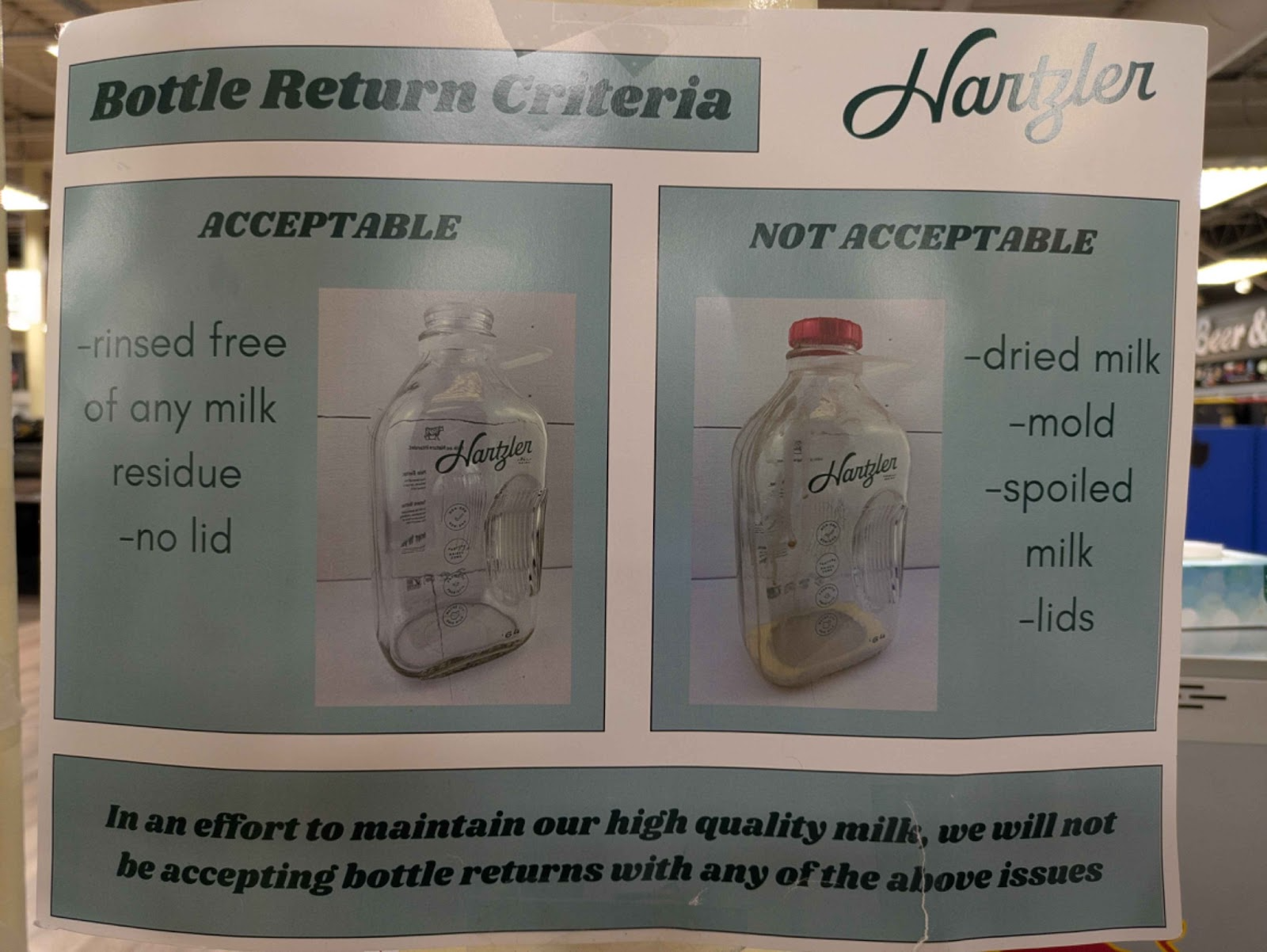
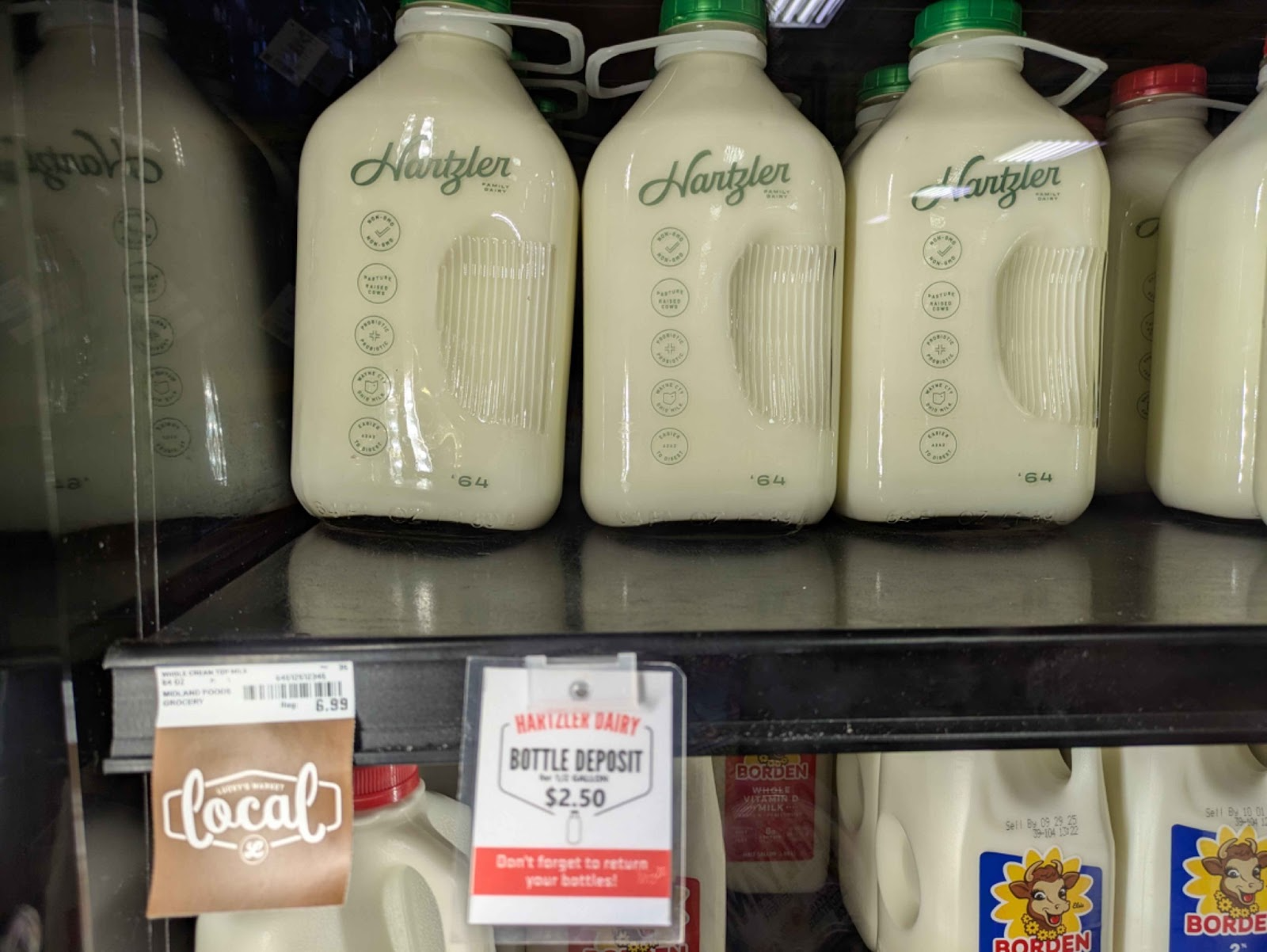
These systems were popular with those spoken to on location, but there appears to be a lack of education about what is available and how to use them to the fullest. While these systems of sale are doing a lot for food waste and plastic waste issues, employees stressed that nothing is done without it benefitting the bottom line of the company. The store is still subjected to the larger company policies in practice that make it difficult to reduce single use plastics, and many products with excess packaging are still sold there. Still, many unique material alternatives are in use here and there may be something to learn from the current systems that appear to be working on this small community level.
Trader Joe’s - Site visit
- September 20th, 2025
- Facilitators: Sophie
- Writer: Sophie
I was dragged by my roommates to go to Trader Joe’s. Little did I know it ended up being a site visit. I very rarely go to Trader Joe’s but when I walked in, I started to take note of their sustainability practices.
Display
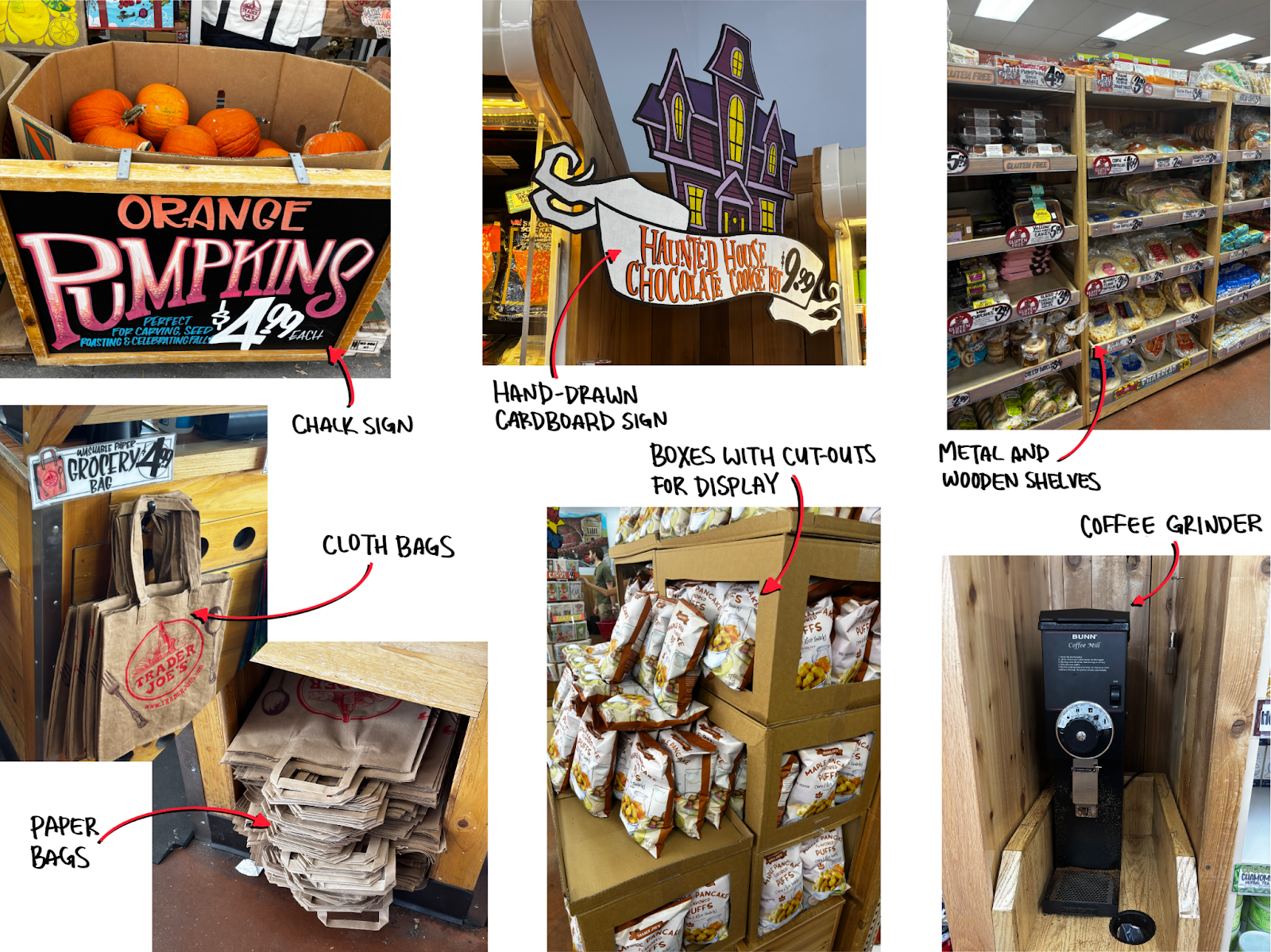
One apparent thing I noticed was the absence of plastic in their display shelves. All of their “furniture” is made of wood or metal. The store aisles are created using metal shelves that have wood facades glued onto them. Furthermore, employees reuse the cardboard boxes the products come in and turn them into stackable display cases by cutting out squares on three sides. This allows customers to see what is inside while preventing the need to buy more shelves. I know that Trader Joe’s is not the only store that does this. Aldi and Costco also repurpose the big cardboard boxes as shelves.
Signage
When it came to signs, I was also surprised to see the lack of plastic. Other than the price markers that have a clear plastic sleeve, all other signs are hand-drawn on recycled cardboard or written on chalk. Not only does this completely cut out printing costs, but it also reuses material, and employs artists. The eye-catching signs go well with Trader Joe’s unique branding and chunky vibe. This is completely different from other big store chains like Kroger or Target. I think the visually engaging products and signs are a reason why Trader Joe’s is so popular among young people.
Bags
The lack of plastic bags is far from unique in Trader Joe’s. Some states have extra fees or partial bans on single-use plastic bags. There are countries around the world that have gotten rid of them altogether. However, it is rare to see a store in the US that doesn't carry them completely. Again, Aldi and Costco are a few other examples that come to mind. But given that Trader Joe’s and Aldi are related companies both from Germany, maybe their shared background makes it less surprising that they stand out as exceptions among American grocery stores. Trader Joe’s only carries its signature, brown paper bag. I was very interested to see a washable, cloth-like bag that is almost indistinguishable from its paper counterpart when viewed from afar.
Trader Joe’s also offers an on-site coffee grinder. Although when I was there, I didn’t see anyone using it. From what I understand, customers grab the type of coffee they want from prepackaged paper bags or larger canisters on the shelves and then pour the beans into the machine. They place the now empty bag/canister at the bottom to catch the ground coffee. I think this system could be more sustainable if they just did away with the prepackaged bags. Let people scoop however many beans they want and encourage them to provide their own containers.
Notable Conclusions
I think Trader Joe’s does a good job of reusing the items they receive as well as limiting plastic bags, but there is more that they could do. A lot of the products still come in clear, plastic packaging. They could sell refills or have bulk storage for things like coffee beans. They could also choose to source from other packaging manufacturers that create sustainable alternatives.
That being said, I also believe that Trader Joe’s is a great case study on how grocery stores - or other kinds of stores - can foster a sense of community. It almost has a cult following. There is a brand loyalty and other stores don’t really see. This can all be attributed to the cozy charm, atmosphere, hand-drawn signs, unique packaging, instagrammable products, paper bags, and more.
How can we learn from these different ways of building community and encourage people to be sustainable? Can we create a type of business model whose purpose is to engage their customers into the circular economy?
Microplastics - Interview
- Point of Contact: Prof. Lenhard & Megan Jamison
- September 23rd, 2025
- Facilitators: Everyone
- Writer: Jessica & Sophie
What did we learn?
When thinking of the effects that plastic has on an area, our team was interested to learn more about the micro and nano level of the waste stream. Meeting with Professor Lenhart and PhD candidate Megan Jamison cast some light on the topic for us. Their research mainly covers the presence of microplastics within water treatment facilities, specifically near Lake Erie. Current water treatment facilities don’t treat the presence of micro plastics due to the equipment, time, and cost barriers. Megan shared that the current process is labor intensive with samples needing four days in the centrifuge. We learned that you could identify what type of plastic the particle came from but you couldn’t tell how old it is. Megan also spoke about how the shape of the particle can change over time especially between fibers, so a polyester fiber could be differentiated initially in a sample from particles from bottles, but over time who's to say that it doesn't break down to be similar shapes as other micro plastics. When talking about nano plastics, that topic seemed a little more concerning due to the ability to permeate cells. Those are the plastics that have been found in brains, but they can also affect crops through the soil and translocate into the fruit of the plant.
Big Questions
When asked about the big picture of microplastics, Prof. Lenhart and Megan emphasized the need for more research. There are still so many things about plastic that we don’t know. What is the rate of particle shedding? What are the long-term health effects? How do we stop nanoplastics from getting inside our cells? Is it possible for a full-breakdown and complete mineralization into the ecosystem? And much more.
What is the first step, though? Waste management. And then? Knowing when to use plastic. Multiple things must be done concurrently to effectively be sustainable and change our culture of consumption. We should reduce what we send to the landfill, take the plastic already here and prevent it from entering the environment, and research other alternatives. They said that bioplastics are not one. They are still plastic - just made from renewable sources. Shedding, microplastic, and water contamination will also occur.