Recent advances and challenges in recycling and reusing biomedical materials
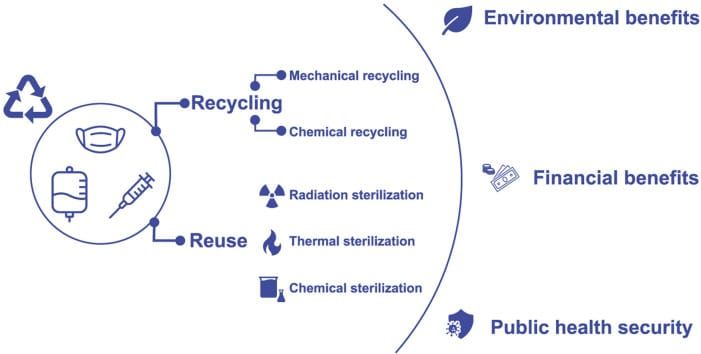
Medical waste is not my immediate thought when brainstorming materials in certain industries towards circularity. There are many elements of a medical facility that are not recyclable due to the nature of the jobs and the biohazards the item might posses. Nevertheless, there are many ways to reuse or sanitize equipment to limit waste. From our capstones team visit to Marble Plastic, Joseph Klatt the founder, touched on how recycling is not the solution. Reducing and reusing are where more materials will be saved, and this article covers some of those instances along with some issues with sanitizing plastic over time.
Medical waste is divided into two categories: (i) hazardous waste, involving biological, chemical, radioactive, and/or physical footprints, and (ii) non-hazardous waste, constituting about 85% of waste generated from healthcare activities that are similar to domestic waste [3] (Kheirabadi, S., & Sheikhi, A, 2022).
Sterilization can be divided into three categories: (i) thermal, (ii) radiation, and (iii) chemical sterilization [17]. Steam sterilization (autoclaving, limited to moisture-resistant materials) and dry heat sterilization are among the thermal treatments that are used for heat-resistant materials [16]. Autoclaving can cause corrosion in surgical alloys or rust in instruments [17]. Moreover, it has been reported that the repeated autoclaving of polyvinyl chloride (PVC), used in blood bags, causes plasticizer loss, molecular weight reduction, and increase in tensile modulus and yield strength [18] (Kheirabadi, S., & Sheikhi, A, 2022).
In low-temperature sterilization methods, medical devices are radiated at varying wavelengths and penetration power. Electron beam, gamma, and X-ray radiations are used for low, medium to high, and high penetration needs, respectively [16]. Typically, plastics used in medical devices are susceptible to structural changes, including degradation, discoloration, and crosslinking during radiation sterilization [16,18]. This includes the gamma irradiation of PVC/polystyrene blends [19], polypropylene (PP) [20], polymethyl methacrylate [21], and polyethylene terephthalate fibers [22], as well as the electron beam sterilization of polylactic acid [23] (Kheirabadi, S., & Sheikhi, A, 2022).
Several programs have been developed worldwide for plastic-based medical waste recycling. A recycling pilot was developed in the UK to downcycle PVC-based materials such as anesthesia masks, oxygen masks, and tubing into horticultural items [36]. Another PVC recycling program in hospitals is conducted by the Vinyl Council of Australia to remanufacture valuable items, including industrial hoses, from recycled PVC medical waste, such as oxygen masks and tubing, intravenous fluid bags, and suction tubing [37] (Kheirabadi, S., & Sheikhi, A, 2022).
Seeing steps taken towards tackling those hard to recycle items, especially after sterilization techniques degrade the item over time seems like a design opportunity to introduce another alternative that would be sterile, flexible, and long lasting.
Most hospital wastes are not infectious, rendering them suitable for recycling programs [58]. However, unstandardized medical waste sorting has led to the erroneous disposal of items as infectious waste [59], imposing unnecessary costs associated with infectious waste treatment [4]. This challenge might be addressed using machine learning algorithms, as they have been utilized to sort and classify wastes for different industrial applications, such as plastic waste, bottle, and municipal solid waste recycling, with >90% accuracy [60]... In addition, economically feasible processes should be developed for plastic recycling, and the design of plastic-based materials should satisfy the feasibility of efficient recycling by following healthy design practices [27∗]. Using bio-based plastics in medical applications is another alternative that may lower environmental impacts [63] and, with further exploration, might lessen recycling costs associated with the petroleum-based counterparts [64] (Kheirabadi, S., & Sheikhi, A, 2022).
Introducing a more circular mind set when it comes to non hazardous plastics in the medical field seems like a source for untapped potential. Even in my search online there wasn't much information on any companies locally practicing. I did see some sources that would take the consumer side of medical devices like wheelchairs, but not much in plastics. The article mentions the use of bio-plastics as seeming like a better alternative, but our groups interview with the microplastic researchers mentioned how bio plastics still share properties of regular plastics and will shed just the same. I wonder how those would preform under the sanitization processes that are currently in place?
Reference.
Kheirabadi, S., & Sheikhi, A. (2022, December). Recent advances and challenges in recycling and reusing biomedical materials. Current opinion in green and sustainable chemistry. https://pmc.ncbi.nlm.nih.gov/articles/PMC9568467/