
Sand, focus, and sweeping it all away
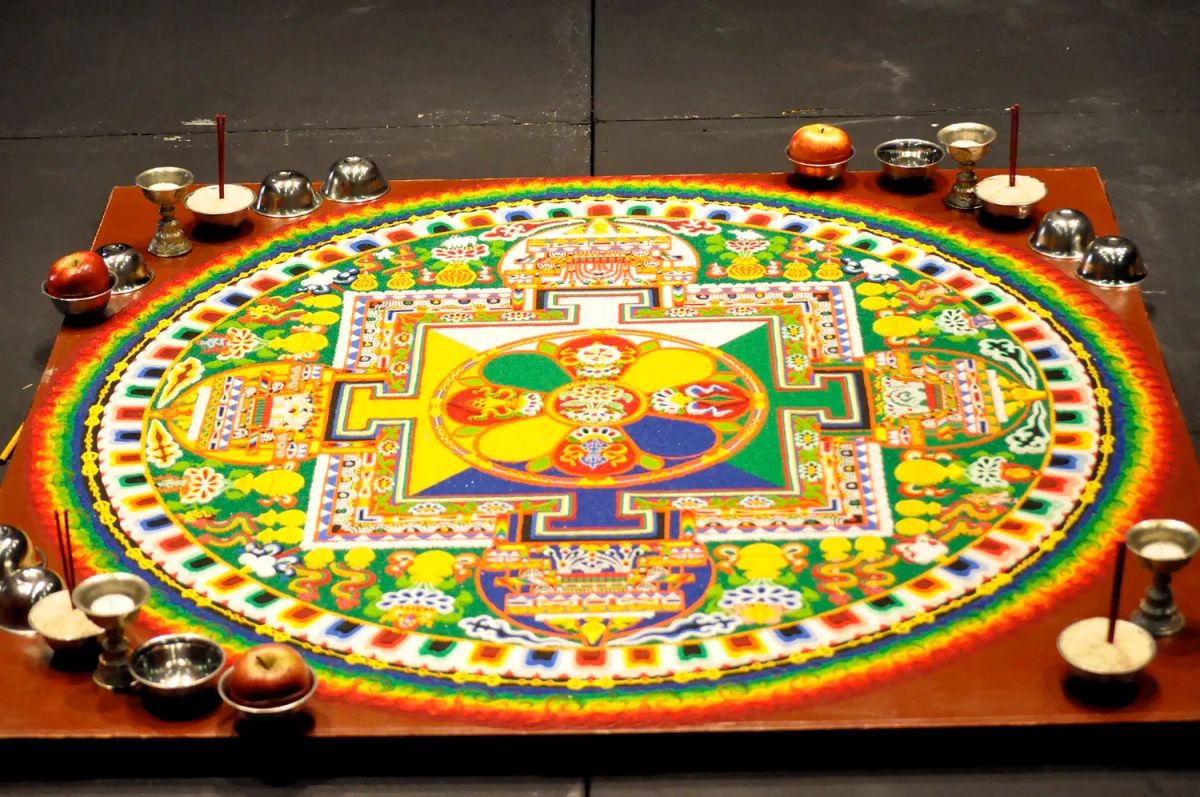
When you think of meditation, images of monks focusing in silence or a room filled with rhythmic humming may come to mind. However, the Jangchub Choeling Nunnery recently displayed a much more visual form of mediation at the Minneapolis Institute of Art.
In celebration of the opening of the “Tibetan Buddhist Shrine Room: The Alice S. Kandell Collection” on September 14, 2024, Tibetan Nuns from the Jangchub Choeling Nunnery assembled a sand mandala the week of September 9, 2024, at Mia (Minneapolis Institute of Art). Mia encouraged visitors to observe the nuns as they created this intricate work. After a week on view, on the morning of Saturday, September 21, 2024, the nuns dismantled the Green Tara Sand Mandala and dispersed it into the Mississippi River.
Some Buddhists believe that Shakyamuni (Buddha) taught the art of sand mandala construction in India in the fifth or sixth century BCE. In this tradition, it also states that the knowledge has been passed down, unbroken, for more than 2,500 years. Through the centuries, it has been incorporated into many Eastern religions, including Hinduism, Buddhism, Jainism, and Shinto.
Sand mandalas were documented in Tibet as early as the 11th century, and the Tibetan term dul tson kyil khor means “made of powdered colors.” The geometric designs are first drawn by a qualified lama, after which purification rites are conducted to bless the monks or nuns who will undertake the mandala’s creation. Starting at the center, they work their way to the outer edge over several days. The sand is applied using a thin funnel-like tube. Rubbing a metal rod along the ridged exterior of the tube causes a gentle vibration that helps keep the sand running smoothly.
This sacred art form is not only a visual representation of specific qualities and energies but also serves as a tool for meditation, focusing the mind and fostering spiritual reflection. It’s a symbolic offering of the entire universe.
The preservation of past works of art is highly valued, especially with parents and their children's artwork. The iconic trope of a childhood drawing fastened with a magnet to the kitchen fridge is a testament to this. However, what value could a form of art meant to fade away give to a child? The impermanence of the completed piece could help to teach ways to accept loss or things not going your way. Additionally, the intense focus needed to complete these elaborate works teaches discipline.
The use of sand in children's entertainment is already popular such as with sandpits and sandcastles. It wouldn't be too far fetched for a sand toy to emerge that focuses on drawing instead of sculpture. However, would the average child have enough focus to create something so easy to mess up over several hours or days? Regardless, these sand mandalas help to expand the meaning of meditation even within the religious traditions from which mediation emerged.
References
Bedeaux, Rob. 2025. Minneapolis Institute of Art. "The Tibetan Sand Mandala: A Short History". https://new.artsmia.org/hub/programming-events/tibetan-sand-mandala-history
Barlow, Lisette. 2017. World History Encyclopedia. https://www.worldhistory.org/image/6518/tibetan-sand-mandala/
All original works in this article were done without the assistance of AI tools.