Sink it to Save it
After a visit to a local bait store, I noticed that live bait was only sold in single-use plastic containers. While I was able to bring my own container for crickets, no such option was available for wax worms or red worms. There were also no signs encouraging anglers to bring reusable containers. Later, while visiting a dam site popular for shoreline fishing, I observed bait cans scattered across the shoreline and floating in the water at intervals of about every six to ten feet. Similarly, while tracing roughly half a mile of shoreline at an Indiana lake, the only angler waste I encountered was discarded bait cans.
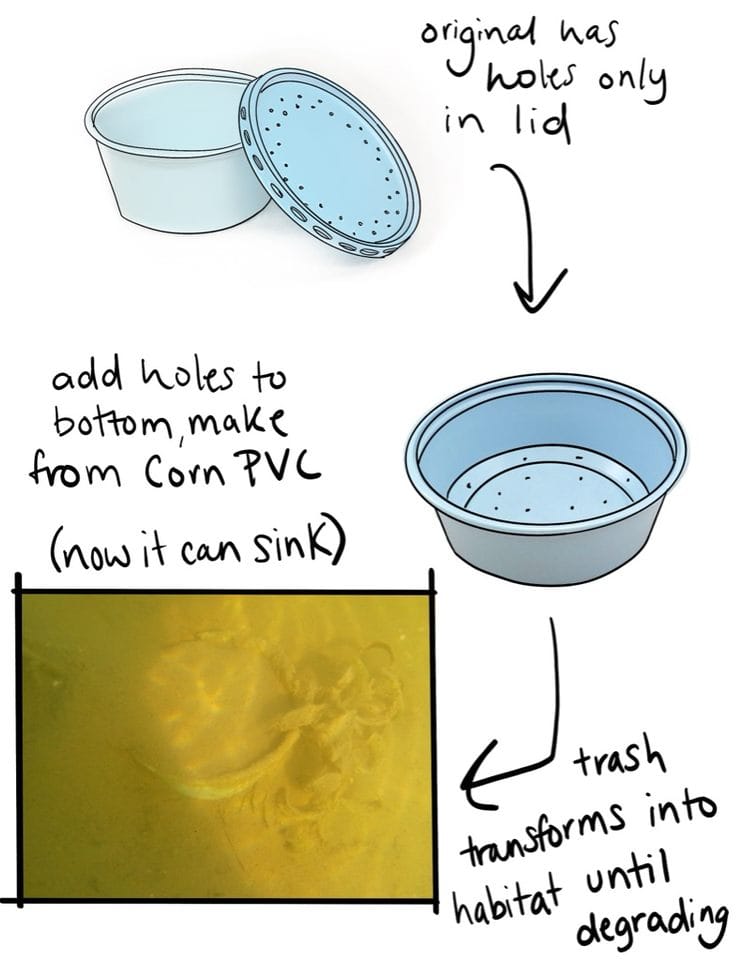
This led me to consider whether bait containers themselves could be reimagined. Specifically, I propose designing bait cans from biodegradable corn-based plastics (West, 2020). These containers, rather than persisting as litter, could function as temporary artificial fish habitats when they sink to the bottom of waterways. Adding ventilation holes to the bottom of cans would encourage the cans to settle underwater rather than wash ashore. Research shows that artificial structures already benefit fish by creating shelter and breeding sites (Baxter, 2025). However, this idea raises concerns: the higher production cost of corn PLA, limited research on habitat sizing, and uncertainties about environmental impacts of degradation.
References.
Baxter, S. (2025, September 22). How Fish Benefit From Artificial Structures - FishSens Magazine. FishSens Magazine. https://www.fishsens.com/how-fish-benefit-from-artificial-structures/
West, L. (2020, December 7). Are Corn-Based Better than Petroleum-Based Plastics? Treehugger. https://www.treehugger.com/pros-cons-corn-based-plastic-pla-1203953
This conjecture is based on original material from Baxter’s How Fish Benefit From Artificial Structures (~25%) and West’s Are Corn-Based Better than Petroleum-Based Plastics? (~25%), my own contributions (~30%) in observing bait container waste, conducting site visits, and proposing biodegradable corn-based PLA bait cans as dual-purpose habitat structures, and AI assistance (~20%) in synthesizing sources, refining language, and structuring the narrative. All interpretations remain the responsibility of the author.