
The People Behind the Earthworks: Hopewell Culture
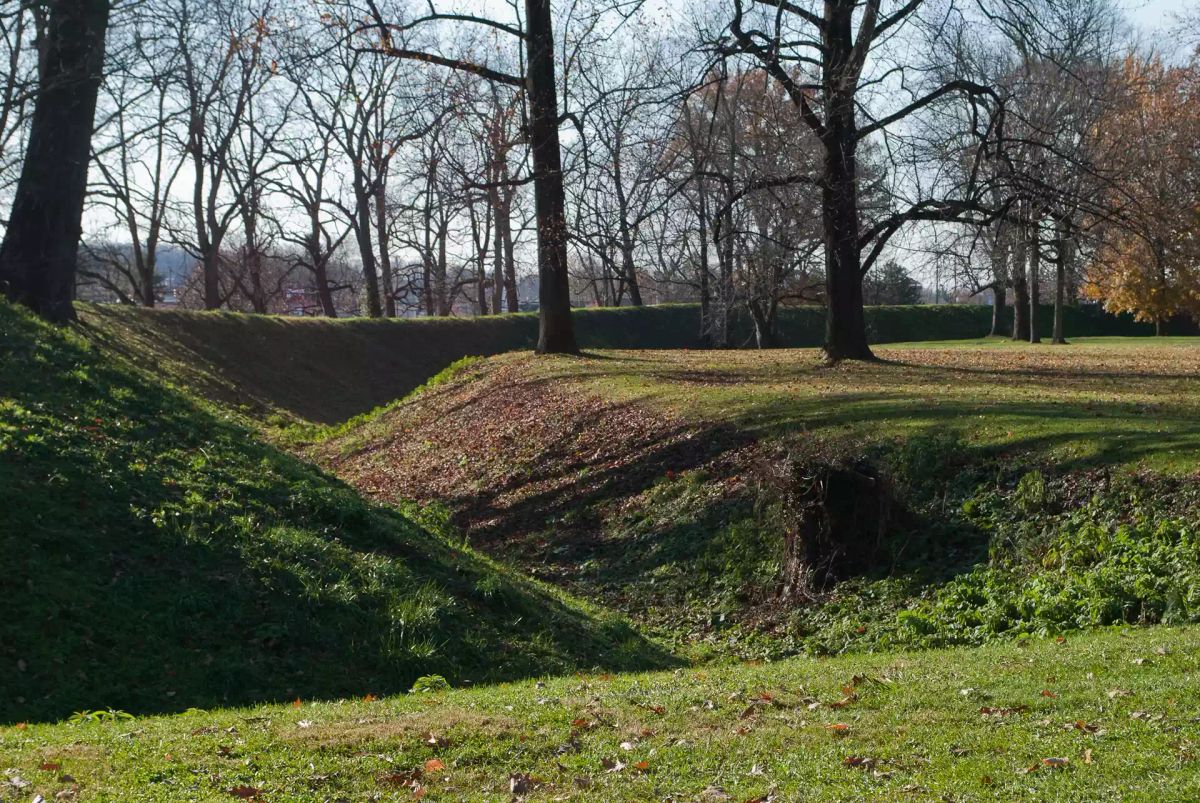
This article from the Hopewell Ceremonial Earthworks webpage describes how Hopewell culture developed throughout history, highlighting the impact that widespread social interaction across North America had on the construction of the earthworks. This post goes hand in hand with my primary research on the same topic.
"By year 1 CE, the Middle Woodland period had ushered in the increasingly elaborate Hopewell culture which dominated the Miami, Muskingum, and Scioto watersheds, and influenced many regions beyond. People began to assemble here over many generations, creating the elaborate earthwork complexes as places of assembly, ceremony, and burial" (Hopewell Ceremonial Earthworks, 2023).
"While Adena (pre-Hopewell culture) circular earthworks had been more like community 'churches' serving a local congregation, Hopewell earthworks were monumental 'cathedrals' serving a much larger and far-reaching community. The sacred rituals took place in often huge and elaborate timber shrine buildings, later dismantled and covered with the carefully mounded layers of earth visible today. Within their earthwork sites, and among the remains of these buildings, they left elaborate burials, altars, and beautifully crafted objects" (Hopewell Ceremonial Earthworks, 2023).
"The Hopewell culture was not a single group of people, but instead a spiritual movement that linked many distinct communities, likely with differing languages, scattered across much of eastern North America. Although the Hopewell heartland was in southern Ohio, evidence of their sphere of influence extends not only to these diverse Eastern Woodland groups, but also to much more distant places" (Hopewell Ceremonial Earthworks, 2023).
"Long-distance expeditions and pilgrimages are evident from the spectacular artifacts found at these sites, made from mica, copper, obsidian, and seashells brought from what is now North Carolina, Michigan, Wyoming, and the coast of Florida, respectively. These materials accumulated at the Ohio ceremonial centers, apparently without corresponding trade goods returning to their places of origin. This may suggest pilgrimages to the Hopewell heartland by devotees from afar, and long-distance quests by sojourners from Ohio returning with tokens of spiritual power and prestige" (Hopewell Ceremonial Earthworks, 2023).
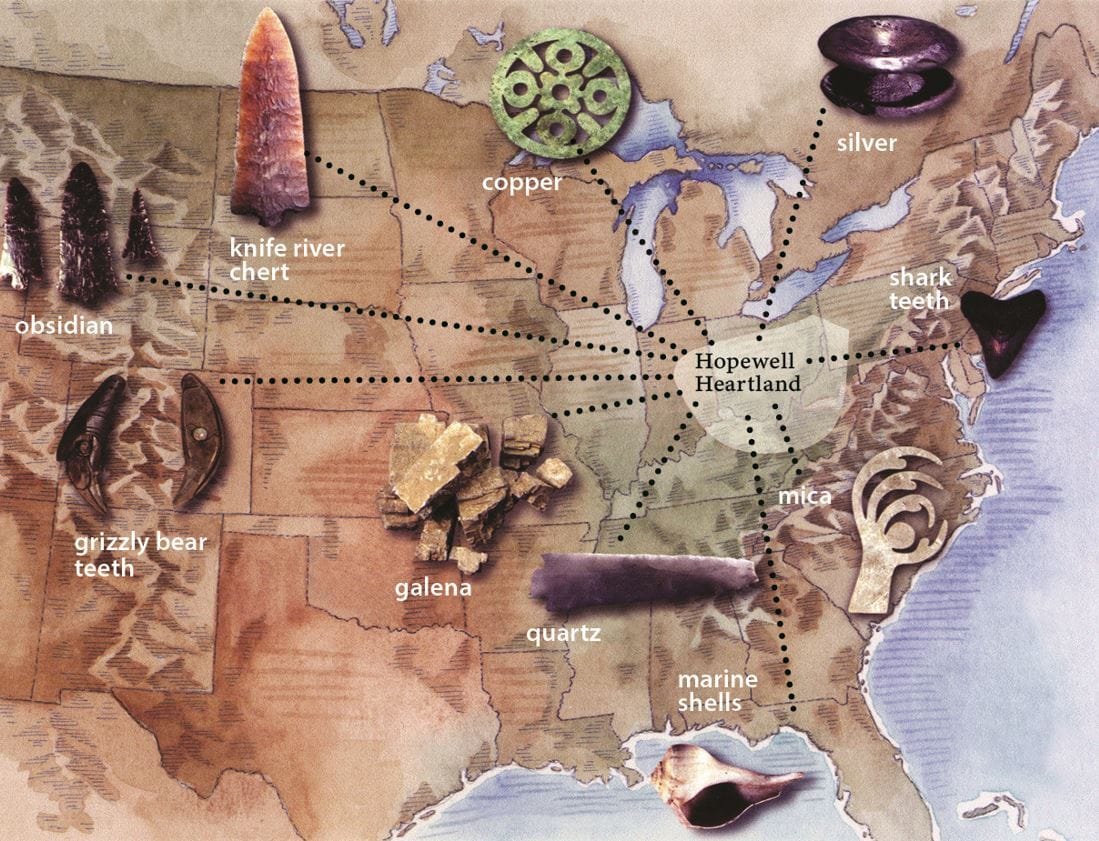
"Widespread Hopewell interactions are also evident from cultural practices as far away as Illinois, the Lower Mississippi Valley, and the southern Appalachian summits. These areas are beyond the range of linguistic unity, yet identical forms were present: designs for log-lined tombs, and motifs on locally made pottery as specific as spoon-billed birds. Perhaps most striking is the use of characteristically Hopewell bi-cymbal earspools. Making these complicated objects required shared, specialized knowledge, as well as copper from far-away Lake Superior. Their distinctive use in burials (held in the hands, as well as on the ears) demonstrates shared meanings and beliefs about the uses of visual symbols and regalia" (Hopewell Ceremonial Earthworks, 2023).
"Daily life occurred in small settlements of just a few households, organized by kinship into local communities. Built within each one were several functionally distinct ceremonial grounds marked by mounds and earthworks. Hopewell social organization is thus very different from the centralized, hierarchical, and hereditary chiefs who later ruled Cahokia and other Mississippian towns and cities. There were no large settlements, and no large dwelling houses or 'palaces'. Studies show that everyone, even people buried with much honorific regalia, ate the same foods and worked just as hard as everyone else. Finally, there is no systematic evidence for children having been buried as 'chiefs', indicating that there was no tradition of inherited leadership status" (Hopewell Ceremonial Earthworks, 2023).
Review
This webpage on the Hopewell Ceremonial Earthworks site describes Hopewell culture as being heavily based on community and greatly influenced by social interactions between indigenous peoples across North America during the Middle Woodland period. Before conducting my own research on Ohio's state parks, I had never heard of the earthworks and soon became fascinated by these mounds that go far beyond the purposes of burial that I had been familiar with. Using this post to provide background information on Hopewell culture that I also document in my primary research findings, I have gained more insight into how Hopewell culture is defined, not by a strictly local community of indigenous peoples in Ohio, but by a network of indigenous groups from all over North America that share common beliefs and practices. I hope this perspective will inform my project scope, implementing aspects of the culture and how the earthworks serve as invaluable spiritual sites of gathering within a community.
References
Hopewell Ceremonial Earthworks. (2023, September 12). Culture. https://hopewellearthworks.org/culture/