The Authority of Words
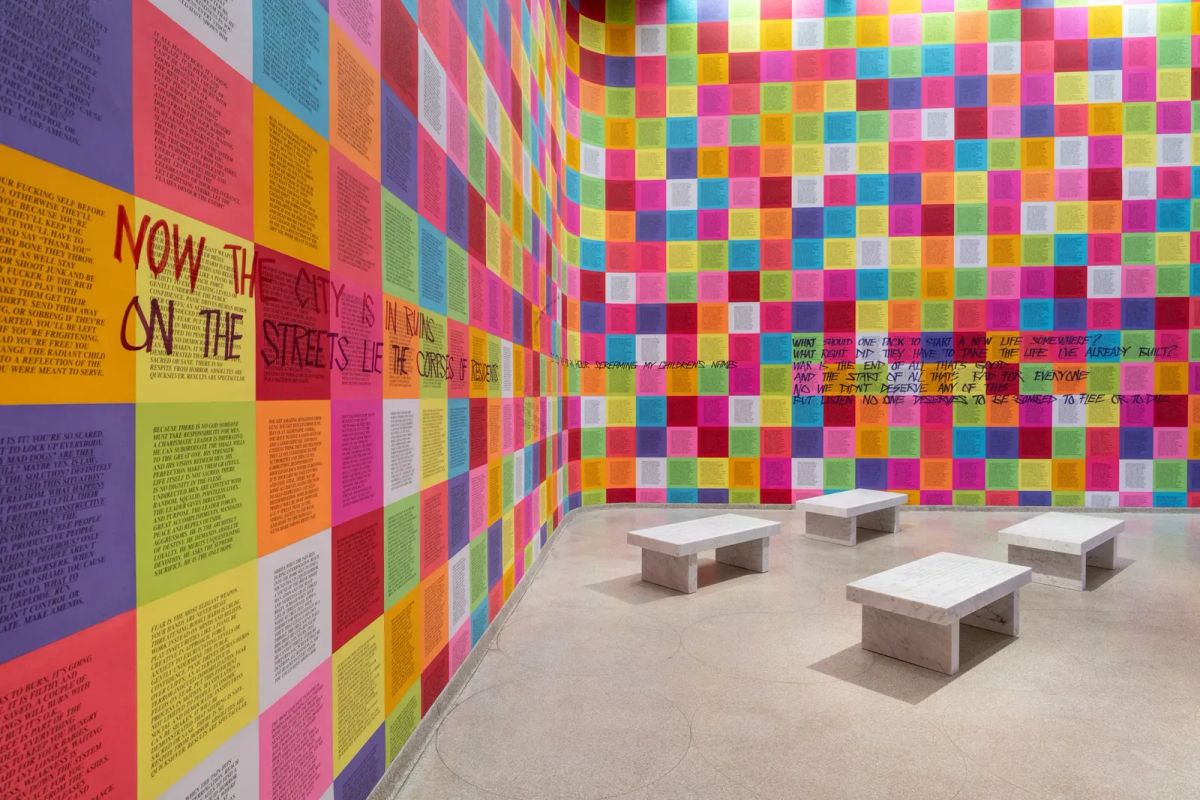
Holzer’s seamless integration of blunt remarks about power into public environments reaches new vertiginous heights at the Guggenheim Museum’s ‘Light Line.’ The centerpiece, an installation of LED lights climbing up the full ramp of the museum, features a stock ticker–like flow of aphorisms addressing power dynamics, warfare, surveillance, and existential anxieties. In this expanded restaging of a 1989 installation, some are recycled from Holzer’s ‘Truisms’ (1978–87) and ‘Inflammatory Essays’ (1979–82), others are newly generated with artificial intelligence. Regardless, the authorship of the phrases is left intentionally ambiguous—a throughline for Holzer, whose artistic practice was initially centered around anonymity. Such a momentous restaging of one of Holzer’s most ambitious projects reminds us of her continued relevance: ‘Light Line’ immerses the viewer in a vertigo-inducing spectacle. As Holzer’s reputation has expanded, so too have the scale and complexity of her work. Holzer’s groundbreaking use of language as an artistic medium blurred the contours between art and everyday communication.
Whether she engaged with advertising aesthetics or replicated the authoritative typeface, design, and tone of political messaging, her intent was to interrogate and provoke rather than imitate. Instead, she employed cryptic, free-floating language—equally convincing, and beguiling, in its anonymous authority—to maintain an ambiguity of meaning and destabilize conventional linguistic systems. Recognizing the potential of LED signs to create immersive and site-specific experiences, she continued to use them to lend her words a sense of impartial authority. (Artsy Editorial, 2019).
This article from Clara Maria Apostolatos offers a valuable insight into how important framing a message can be for the perception of a product. This article does provide an interesting view of how online banking apps can frame certain information and experiences to shift the trust perception and decision-making of the users. In this article, we see how Holzer’s art is able to transform language based on the way that it is presented. This is closely related to the way that banking apps are able to frame information for the saving goals, ways users get alerts about their spending, and financial advice through the language that they use and the visual cues they add. What we are able to learn from this is how art can influence language and construct a way for financial user experiences and interfaces to be a more honest and helpful experience about money and financial security.
References:
Artsy Editorial. (2019, March 18). Why Jenny Holzer’s text art still matters. Artsy. https://www.artsy.net/article/artsy-editorial-jenny-holzers-text-art-matters
Ai was not used in this article