The Automobile and Gender: An Historical Perspective
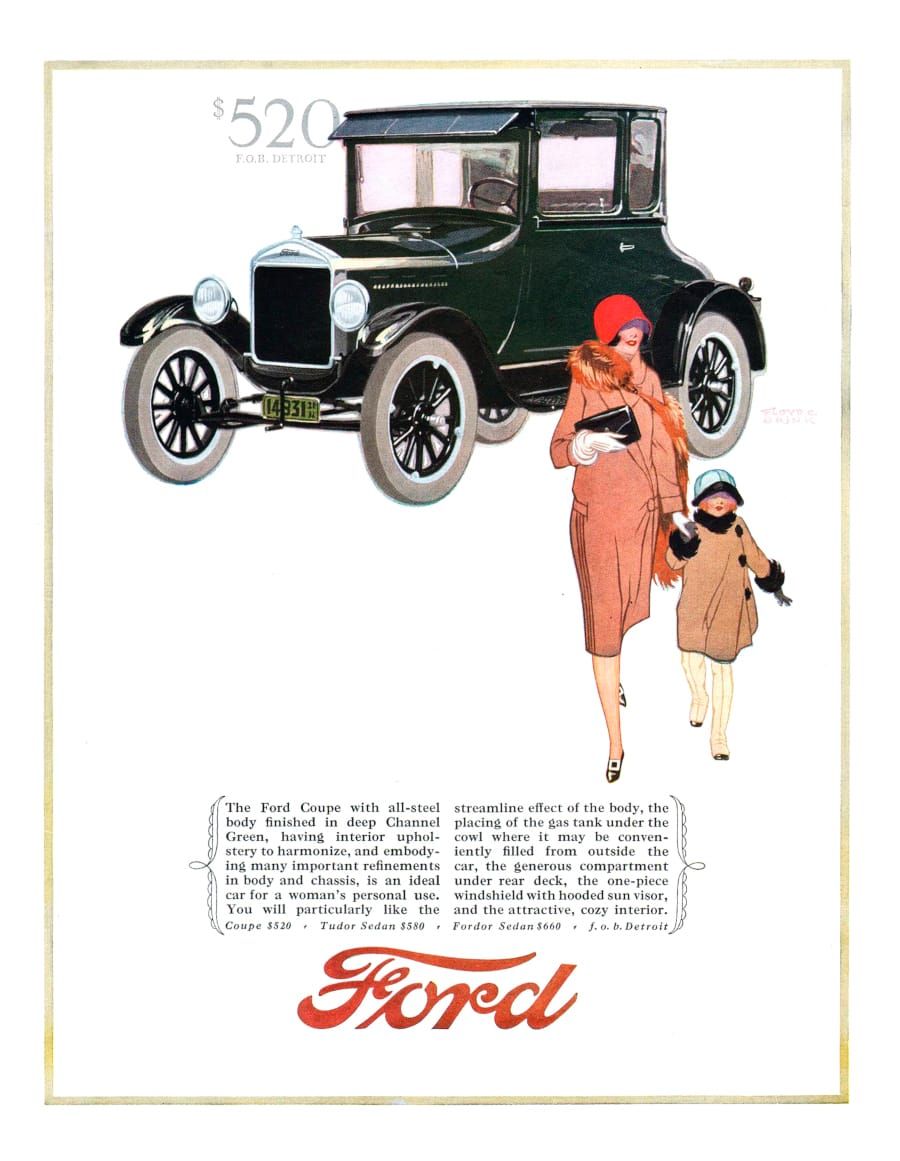
I was interested in looking into automobiles through a different lens. I wanted to better understand the ways the automobile industry has played a role in gender roles. The article showcases the ways in which automobiles created freedom and challenges for gender roles in society during the 1920s.
"The automobile could play a central role in the nurturing of family, and it was increasingly presented as an opportunity to do a better job of child rearing and as a way to bring family members closer together.
a General Motors advertisement of the 1920s, typical of hundreds of ads placed in magazines and newspapers, shows a middle class woman picking flowers with her children; their car is in the background. The text reads:
Today the members of a family must make a real effort to keep united. I thought a great deal about this as my children began to grow up. I decided that the most important thing I could possibly do would be to plan ways in which they and I could have good times together. My husband agreed, and for that reason we bought a second automobile, since he had to use his car in getting back and forth to business. I can’t begin to tell you of the happiness it has given us—picnics together, expeditions for wildflowers in the spring, and exploration parties to spots of historic interest. It’s our very best investment. It has helped the children and me to keep on being pals. Every year thousands of families decide that a second car is a saver of time, a great contribution to family happiness and health.
The power of the auto was by the twenties equally available to men and women, who could use it to explore new horizons and who could use it to escape from traditional roles. Conservative social movements—those who wanted to preserve and protect traditional gender roles—naturally found themselves rather aggressively countering the threat of the automobile by reasserting the centrality of traditional roles and integrating the automobile into the nurturing and child rearing activities that were traditionally associated with women. Members of the clergy often wrote about and prepared sermons about the dangerous social consequences of the automobile, which included opportunities for young women to escape supervision in ways that would certainly lead to moral decline.
Women were presumed to be interested only in the color, styling, and upholstery of cars, while men were presumed to be interested only in technical capabilities of autos. An article in the trade journal, Automobile Topics, for example, stated that when shopping for a new car: “One of the first things a woman thinks of...is whether the color of the upholstering will harmonize with her personality, coloring, and clothes.”
Berger points out that the stereotype of the “woman driver” was intended to keep women in their place—i.e. to limit their freedom, and to protect them from corrupting influences in society and in themselves. Over time, through repetition and based on little or no verifiable evidence, women drivers were increasingly portrayed as less proficient, decisive, less aggressive, more flighty, and more unpredictable than men drivers (Wach, 1998)."
The article described the social impact cars had on society, specifically in promoting/challenging gender norms. Cars were equally available to women as they were to men, creating a new sense of freedom for women to explore and break free from traditional ideals. Although this was the case, advertisements and specific social groups worked to keep the traditional ideas in the media and limit freedoms. Car advertisements were focused on women running errands, or another way to tend to children as an activity. Automobiles were also assumed to only have interest in the interiors and aesthetic of the car, while men were concerned with the mechanics and the idea of travel. I found these advertisements and assumptions to be really upsetting, considering they were put in place to continue to limit women in society. I thought these concepts were important for me to explore because I wanted to understand the deeper history of automobiles and how they were advertised to people in the past. It was interesting that children have always been seen as a part of automotive history, but portrayed as a way to promote health for kids and ensure gender roles in the family.
Reference:
Wachs, M. (1998). The automobile and gender: An historical perspective. U.S. Federal Highway Administration. Retrieved September 22, 2025, from https://www.fhwa.dot.gov/ohim/womens/chap6.pdf
This reflection draws (~40%) from Wachs, M. “he automobile and gender: An historical perspective. U.S. Federal Highway Administration. (1998), (~40%) from the author’s own framing of the capstone context and design intentions, and (~20%) from AI assistance (summarizing article content, editing for clarity, and creating citation format). All interpretations and final perspectives remain the responsibility of the author.