The Future of Work: AI “Digital Employees” in Banking
The article Digital Workers Have Arrived in Banking explains how Bank of New York Mellon (BNY) is bringing AI “digital employees” into its teams. These autonomous agents handle specialized tasks like coding and validating payments, with their own logins and managers, working side by side with human staff.
“Bank of New York Mellon said it now employs dozens of artificial intelligence-powered ‘digital employees’ that have company logins and work alongside its human staff." (Bousquette, 2025).
"Similar to human employees, these digital workers have direct managers they report to and work autonomously in areas like coding and payment instruction validation, said Chief Information Officer Leigh-Ann Russell. Soon they’ll have access to their own email accounts and may even be able to communicate with colleagues in other ways like through Microsoft Teams, she said." (Bousquette, 2025).
“This is the next level,” Russell said. While it’s still early for the technology, Russell said, “I’m sure in six months’ time it will become very, very prevalent.” (Bousquette, 2025).
"What the bank, also known as BNY, calls “digital workers,” other banks may refer to as “AI agents.” And while the industry lacks a clear consensus on exact terminology, it’s clear that the technology has a growing presence in financial services." (Bousquette, 2025).
"BNY said it took three months for its AI Hub to spin up two digital employee personas: one designed to clean up vulnerabilities in code and one designed to validate payment instructions. Each persona can exist in a few dozen instances, and each instance is assigned to work narrowly within a particular team, Russell said. That way no digital employee has broad access to information across the company, she added." (Bousquette, 2025).
"Because they have their own logins and can directly access the same apps as human employees, they can work autonomously, said Russell. For example, a digital engineer can log into company systems and see there’s a vulnerability that needs to be patched, write the new code to patch it, and then pass it on to a human manager for approval in the system.” (Bousquette, 2025).
BNY’s approach demonstrates how thoughtfully design can guide AI integration in banking. These digital workers don’t have unlimited access as they’re tied to specific teams and report to human managers, which ensures security and control. From a banking perspective, this setup is exciting because it speeds up critical processes, reduces errors, and lets human employees focus on higher-level work. Beyond efficiency, it’s fascinating to see how this changes the way work is structured. Humans and AI now collaborate in a seamless and a intentional way. Introducing technology successfully isn’t just about the tech itself, it’s about creating systems that feel intuitive, trustworthy, and aligned with business goals. Looking ahead, digital workers could reshape banking operations, redefine roles, and help banks innovate while staying secure.
References.
Bousquette, I. (2025, June 30). Digital workers have arrived in banking . The Wall Street Journal . https://www.securitiesdocket.com/2025/06/30/digital-workers-have-arrived-in-banking-wsj/
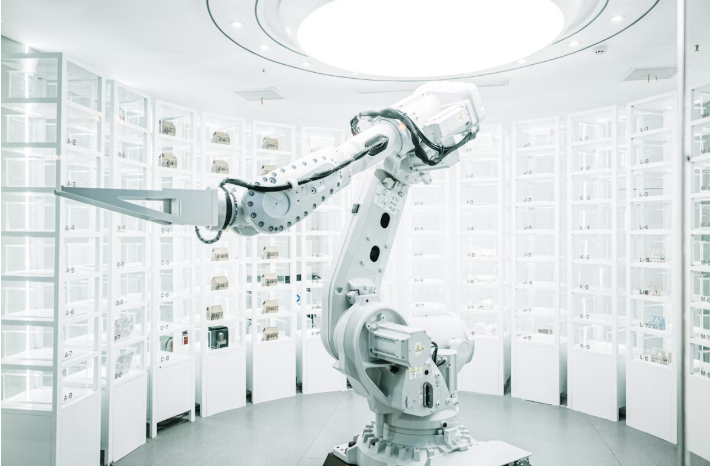
Luo, Z. (2022). A Room With Many Machines [Photography]. Unsplash. https://unsplash.com/photos/a-room-with-many-machines-kE0JmtbvXxM
Based on Digital Workers Have Arrived in Banking (~30%), combined with my own reflections on design, banking, and AI integration (~40%), and text synthesized, structured, and edited with the assistance of AI (~30%). All interpretations remain the responsibility of the author.