The Significance of our Senses on our Well-being

Reading this article reinforced just how much our senses influence comfort and emotional well-being. It emphasized that even the smallest shifts, like adjusting the quality of light, temperature of the seats, or improving airflow can deeply affect how safe, calm, and engaged we feel in a space.
Indoor environmental quality has been found to impact employees’ productivity in the long run, yet it is unclear its meeting level impact in the short term. We studied the relationship between sensorial pleasantness of a meeting’s room and the meeting’s productivity. By administering a 28-item questionnaire to 363 online participants, we indeed found that three factors captured 62% of people’s experience of meetings: (a) productivity; (b) psychological safety; and (c) room pleasantness. To measure room pleasantness, we developed and deployed ComFeel, an indoor environmental sensing infrastructure, which captures light, temperature, and gas resistance readings through miniaturized and unobtrusive devices we built and named ‘Geckos’. Across 29 real-world meetings, using ComFeel, we collected 1373 minutes of readings. For each of these meetings, we also collected whether each participant felt the meeting to have been productive, the setting to be psychologically safe, and the meeting room to be pleasant. As one expects, we found that, on average, the probability of a meeting being productive increased by 35% for each standard deviation increase in the psychological safety participants experienced. Importantly, that probability increased by as much as 25% for each increase in room pleasantness, confirming the significant short-term impact of the indoor environment on meetings’ productivity.
Traditionally, companies and organizations have resorted to sensors through which the environmental conditions could be sensed [3, 28, 78, 79], and even adapted accordingly [11, 29] to meet recommended standards1 , thus increasing their employees’ productivity and well-being. Sensing devices are often being deployed in spaces to sense indoor environmental quality (IEQ). To circumvent shortcomings of commercial devices such as costs or flexibility of platforms in terms of data acquisition, IEQ devices based on open-source electronic designs were made available [37]. For example, Ali et al. [4] proposed Elemental, an open-source device that combines IEQ readings with energy usage and HVAC operation sensors. A recent review of studies on indoor comfort [72] identified the application of machine learning to IEQ factors other than thermal comfort as one of the research gaps. Our work partly fills this gap. Additionally, as we shall see in §2, while previous studies highlighted the impact of the environmental conditions on people’s productivity in the long run, it is unclear to which extent that impact translates in the short term at a meeting-level.
To explore the short term impact of indoor environmental quality, we looked at one of the most common daily activities at work: meetings. More specifically, we studied the relationship between the sensorial pleasantness of a meeting’s room and the meeting’s productivity. In so doing, we made four main contributions:
We operationalized the concept of ‘sensorial pleasantness’ and ‘productivity’ by developing an online 28-item questionnaire, grounded on literature in the fields of Management and Organizational Science, and administering it to 363 participants (§3). Based on factor analysis, we indeed found that three factors captured 62% of people’s experience of meetings: (a) productivity (i.e., whether a meeting has been productive); (b) psychological safety (i.e., whether participants felt listened to); and (c) room pleasantness (i.e., whether the room was felt to be pleasing to the senses).
We developed an indoor environmental sensing infrastructure, called ComFeel, which captures light, temperature, and gas resistance readings through miniaturized and unobtrusive devices that we built and named ‘Geckos’(§4).
To measure room pleasantness, we deployed ComFeel across 29 real-world meetings held at a corporate setting, and collected 1373 minutes of environmental readings (§5). For each of these meeting, we also collected whether each participant felt the meeting to have been productive, the setting to be psychologically safe, and the meeting room to be pleasant.
Using the collected data, we studied the interplay between the sensorial pleasantness and productivity (§6, §7). We found that, on average, the probability of a meeting being productive increased by 35% for each standard deviation increase in the psychological safety participants experienced. Importantly, the very same probability increased by as much as 25% for each standard deviation increase in room pleasantness. These results suggest that indoor environmental conditions do matter not only in the long run (as previous work found), but also in the short term so much so that significant differences in productivity were observed even within the constrained temporal space of individual meetings. (Constantinides, 2021)
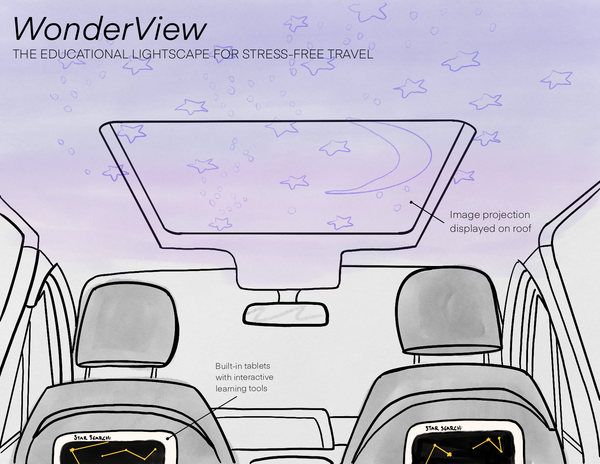
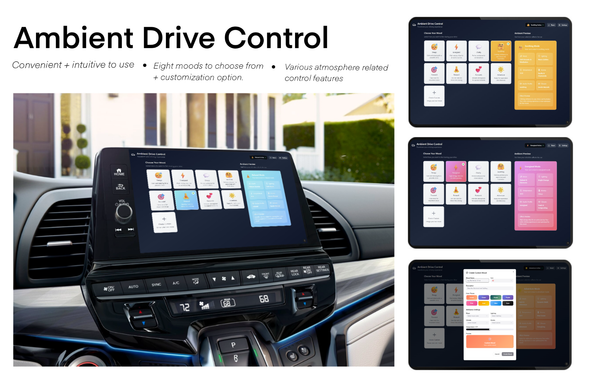
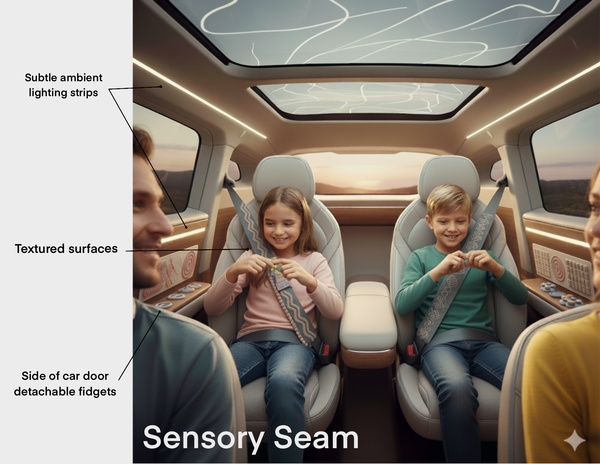
The study’s focus on “room pleasantness” as something measurable was very significant, as it was reframing ambiance as a deliberate design choice rather than a passive background element. What stood out most to me was how this research highlighted ambiance as something we can shape with intention. It made me think about designing for small but powerful sensory moments; a shift in lighting that softens tension, a texture that feels comforting to the touch, or airflow that feels refreshing instead of stagnant. For parents, these same design details could create a sense of safety and control, allowing the car to feel less like a rushed in-between space and more like a pause.
References.
Constantinides, M., Šćepanović, S., Quercia, D., Li, H., Sassi, U., & Eggleston, M. (2021, September 13). ComFeel: Productivity is a matter of the senses too. arXiv.org. https://arxiv.org/abs/2109.05930
Grammarly. (n.d.). https://app.grammarly.com/