The world needs less plastic: the role of psychological distance and self-efficacy in environmental messages
This article highlights the role of psychological framing and self-efficacy in promoting pro-environmental behaviors, which is particularly relevant to my capstone work on circular economies. I found it compelling that making plastic pollution feel personally immediate—reducing psychological distance—can increase engagement and motivate action. For me, this raises both insight and frustration: it is important to understand human behavior and why people often fail to recycle or care about the environment, but it is disheartening that individuals often only act when the consequences hit close to home.
Quotes taken from Cooper et al. 2025:
"Every year, the average American produces 218 pounds of plastic waste, all of which takes up to 1,000 years to fully degrade. Plastic is toxic to humans and animals and is not biodegradable. Despite the environmental problems created by plastic use, people have become increasingly dependent on the material for everyday life (Al-Salem et al., 2009), and plastic use in the United States has quadrupled since 1980 and continues to grow" (Cooper et al., 2025).
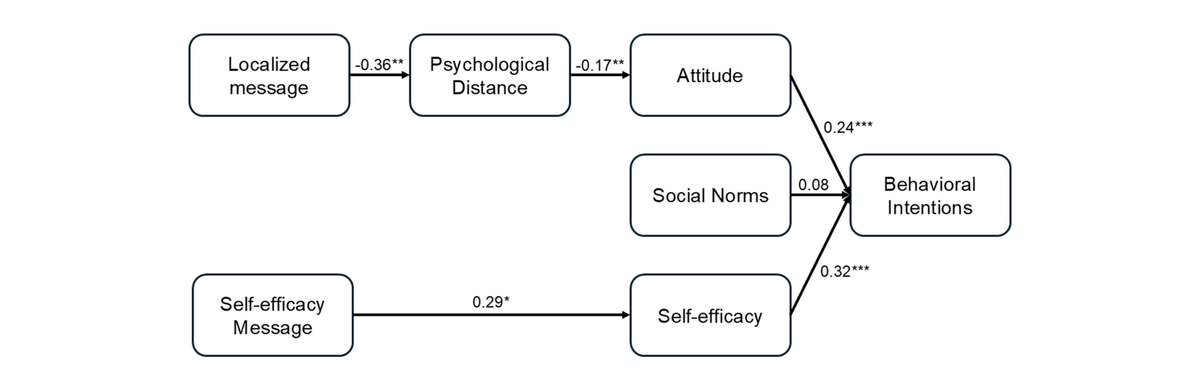
"Reduced psychological distance leads individuals to think about an issue like plastic waste in a more concrete way, which is associated with higher cognitive and emotional engagement with the issue compared to the abstract construals that are associated with greater psychological distance. Messages designed to manipulate perceived psychological distance may impact people differently based on individual differences, such as political orientation, and message framing" (Cooper et al., 2025).
"Another strategy to promote plastic waste reduction is increasing self-efficacy, which is an individual’s belief about their own ability to successfully perform relevant behaviors. In the context of PEBs, self-efficacy is positively correlated with an individual’s willingness to perform pro-environmental behaviors and the amount of effort they put towards doing so. Previous research has shown that efficacy framing increases climate change mitigation PEBs at close spatial distances" (Cooper et al., 2025).
"Within the context of plastic pollution, the current study tests how localized messages and the inclusion of self-efficacy information can influence behavioral intentions after viewing a short social media video" (Cooper et al., 2025).
"In addition, this study demonstrated that short media messages that provide information about how to engage in PEBs can increase an individual’s belief in their own ability to perform them. As predicted, higher self-efficacy was associated with increased behavioral intentions to reduce plastic waste, which is consistent with the Theory of Planned Behavior (TPB). This study demonstrates that the inclusion of simple, straightforward self-efficacy messages can promote PEBs" (Cooper et al., 2025).
"This suggests that science communicators should develop localized messages that reduce psychological distance by demonstrating how environmental problems impact an individual’s own community" (Cooper et al., 2025).
The emphasis on self-efficacy also resonates with my project, as it points to the importance of empowering people to feel capable of contributing to change. Yet the study’s reliance on behavior-change techniques underscores the limitations of focusing solely on individuals without addressing systemic drivers of plastic consumption. At the base of it all, I see empathy as a crucial factor—sustainable action requires people to care not just about themselves, but about communities, ecosystems, and future generations. This article reminds me that promoting sustainability involves both understanding human psychology and fostering a broader ethical and emotional connection to environmental problems.
This commentary draws on excerpts from Cooper, Brinkerhoff, and Landreville (2025) and related studies on plastic waste and pro-environmental behaviors (~40%), the author’s reflections on human psychology, empathy, and capstone research (~40%), and AI-assisted synthesis, organization, and editing (~20%). All interpretations remain the responsibility of the author.
References
Cooper, K. E., Brinkerhoff, L., & Landreville, K. D. (2025). The world needs less plastic: The role of psychological distance and self-efficacy in environmental messages. Frontiers in Communication, 10. https://doi.org/10.3389/fcomm.2025.1579912