These surprising materials are the future of furniture design
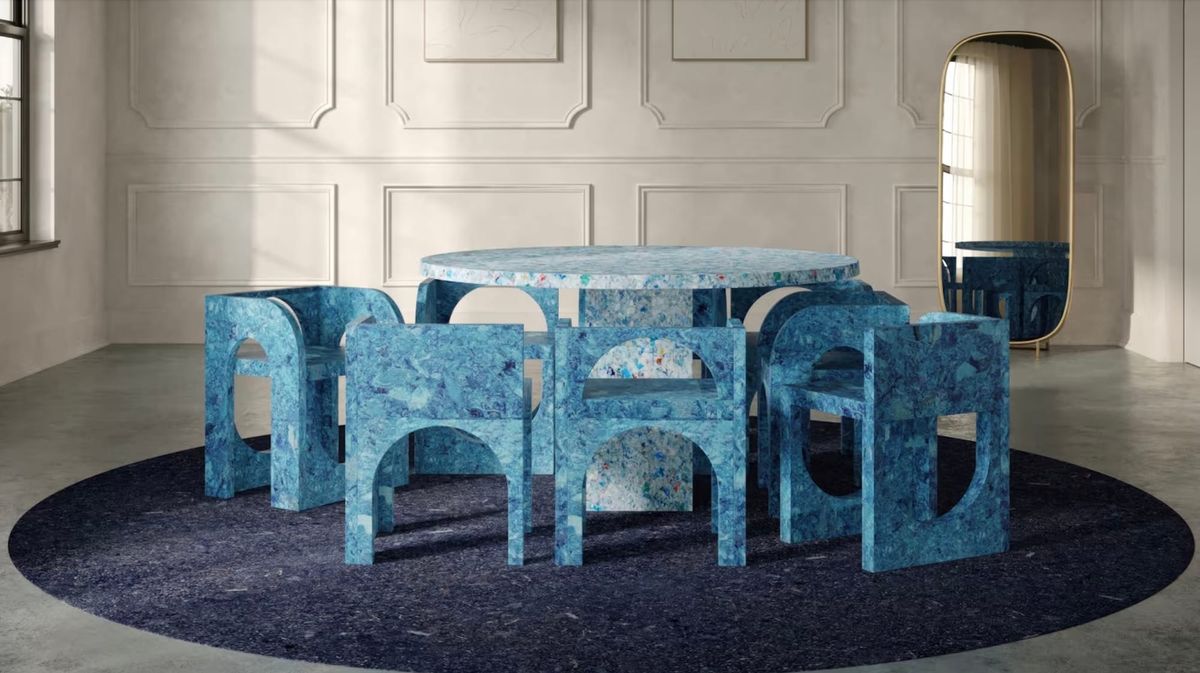
When I saw the thumbnail for this article, I was immediately reminded of our interview with Joseph from Marble Plastics. When we toured their facility, we saw how they turned colorful bread tags and white refrigerator linings into giant sheets of what can only be described as birthday cake ice cream. He showed us chairs, pens, and sculptural art made of this recycled plastic. And now I’m wondering to myself, how can this impact the future of furniture design?
From Marianna Cerini at CNN:
"With the industry under pressure to become more sustainable, designers and manufacturers have turned to out-of-the-box alternatives to make products that have a circular lifespan (ie. furniture or other household items that can be re-used, composted and ultimately do not become garbage)" (Cerini, 2025).
"'Rubbers, plastics, footwear waste and recycled textiles hold vastly untapped potential. They are extremely versatile materials, which leaves space for a lot of different creative possibilities,' Rawlings said. 'Krissy and I are exploring how to extend their lifecycle — and doing it through homeware people genuinely want to live with'" (Cerini, 2025).
“'Instead of exporting textile surplus to countries in Africa or South America — as is often the case — we can repurpose it into something meaningful and lasting'" (Cerini, 2025).
"'I’m not interested in designing just another pretty lamp,' he said. 'Designers today need to challenge systems, rethink materials, and offer scalable, real-world solutions to issues like waste'" (Cerini, 2025).
“'New materials are opening up different ways of what it means to design today,' said the curator Juan Torres. 'They reflect a mindset that sees design as a tool for responsibility — especially for the next generation'" (Cerini, 2025).
In an everlasting effort to be sustainable, I really love how these designers aren’t just recycling. As Joseph said to us, “recycling isn’t the answer.” Reusing materials is great and all, but it can only get us so far. At the heart of it, we have to stop creating plastic goods and also to stop relying on them. I like how this article touches on the designers who are focused on reimagining existing materials that are made of biodegradable components that can be meant as alternatives to wood and plastic. I believe that if we want a future that isn’t reliant on plastic or nonrenewable resources, we need to be a little more creative with what is already here.
One thing I’m wondering about is the longevity of biodegradable/recycled materials. A lot of them don’t function well when wet or exposed to sunlight unless there is some sort of toxic coating. Of course, this depends on the type of plastic but all chemical bonds degrade with each time it is melted and reused. But on the question of longevity, we have to ask ourselves why it is so important for something to last forever. Isn’t that the beauty of nature? Things are ephemeral and that’s what makes life precious.
No generative artificial intelligence (AI) was used in the writing of this work.
References
Cerini, M. (2025, August 19). These surprising materials are the future of Furniture Design. CNN. https://www.cnn.com/2025/08/19/style/surprising-materials-future-of-furniture-design