This Underwater Sculpture Garden Protects Italian Fishing Grounds
Have you ever seen Seaspiracy? It's a documentary on Netflix that details how overfishing is destroying marine ecosystems and how fishing industries contribute to plastic pollution. As someone who was born on an island and loves the ocean, when I saw this article, I immediately wanted to learn more about how art is protecting marine life.
From Ruth Sherlock and Christine Arrasmith at NPR:
"Imagine cruising the blue waters of Italy's Tuscan coast and looking down to see a mermaid looking back. You'd have found yourself at the sunken sculpture garden created by one Italian fisherman to protect marine life" (Sherlock & Arrasmith, 2025).
"The sculptures serve as deterrents to the heavy nets used in trawling. That's a common fishing method that scrapes many miles wide of the sea floor. The practice often traps far more marine life than reaches our tables" (Sherlock & Arrasmith, 2025).
"Paolo Fanciulli takes us out on his boat from Talamone, the fishing village he's lived in all his life. The sea is different these days. As a child, he remembers these waters full of life. We've destroyed our marine ecosystems, he says. Industrial-scale fishing and bottom trawling are compromising the delicate balance of these marine environments and causing fish populations to decline" (Sherlock & Arrasmith, 2025).
"It's here, under this gentle water, that there are statues made by artists and sunk to the bottom of this part of the Mediterranean to protect it" (Sherlock & Arrasmith, 2025).
"The project has stopped fishing trawling in this area, Fanciulli says" (Sherlock & Arrasmith, 2025).
"The statues, along with some 900 concrete blocks, break the trawlers' nets, tearing huge gashes in the webbing. And they attract attention to the fishing practice. Divers and snorkelers now come to see this underwater museum. In this area, ring-fenced by statues and blocks, fish are returning. Seagull hovers as Fanciuli fishes a more traditional way to show us how he thinks it should be done sustainably" (Sherlock & Arrasmith, 2025).
"Experts say Fanciulli and his colleagues in the project have brought new life to the sea. Carbon capturing plants cover the statues and the concrete blocks have also become valuable habitats for fish. Fanciulli is preparing to expand this project further along the Italian coast. But now he's also fighting against another problem" (Sherlock & Arrasmith, 2025).
"By law, he explains, ships can lay up to 1,250 traps for these sea creatures. But here, he says, some ships are placing up to 10,000 traps each" (Sherlock & Arrasmith, 2025).
"Octopus nest in them only to be yanked out of the sea. For years, Fanciulli has worked with activist organizations and the Italian Coast Guard to try to stop the illegal practice. And now he's starting Casa de Polpi, home of octopuses" (Sherlock & Arrasmith, 2025).
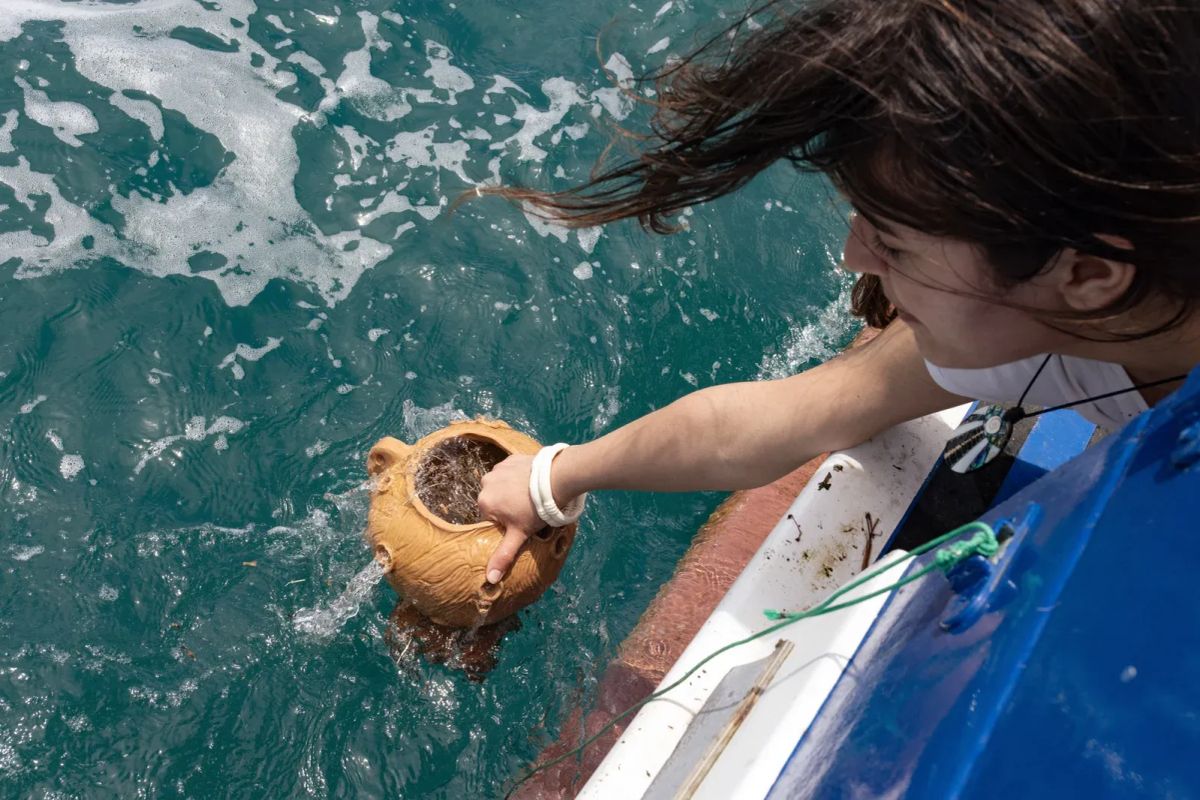
"Set out on fold-out tables are their works, rows and rows of amphoras that will now become new homes for octopuses. Students have made these imaginative terracotta pots" (Sherlock & Arrasmith, 2025).
"Nineteen-year-old Michelle Zordali says she finds it beautiful that her art won't just be kept in her school or in someone's home, but will actually have a practical use. Like with the marble statues, these amphoras will be placed under water. The intention is to provide a better space for these creatures than the plastic traps, thereby luring them to safety" (Sherlock & Arrasmith, 2025).
Fancuilli is one of the great examples of how our individual actions are able to stand up to giant corporations. We don't have to accept the way they are destroying our ecosystems for more profit. There are methods - oftentimes known to locals and indigenous peoples - that are sustainable and ethical.
This article reminds me a lot of our capstone. There are many parallels between the fishing industry and the plastic industry. Many people feel hopeless against the massive, billion-dollar companies that get away with pollution and destructive practices. But Fancuilli shows us that there are ways to fight back. And sometimes it's not about the most cutting edge technology or fancy equipment. Sometimes it's as little as mermaid statues and terracotta pots.
References
Sherlock, R., & Arrasmith, C. (2025, July 29). This underwater sculpture garden protects Italian fishing grounds. NPR. https://www.npr.org/2025/07/29/1256371479/this-underwater-sculpture-garden-protects-italian-fishing-grounds
Seaspiracy . SEASPIRACY. (n.d.). https://www.seaspiracy.org/