Village Community Banks
Shared Interest by Priyanka Sippy (2024) discusses Village Community Banks, a microfinance model in which the money is owned and managed by its members.
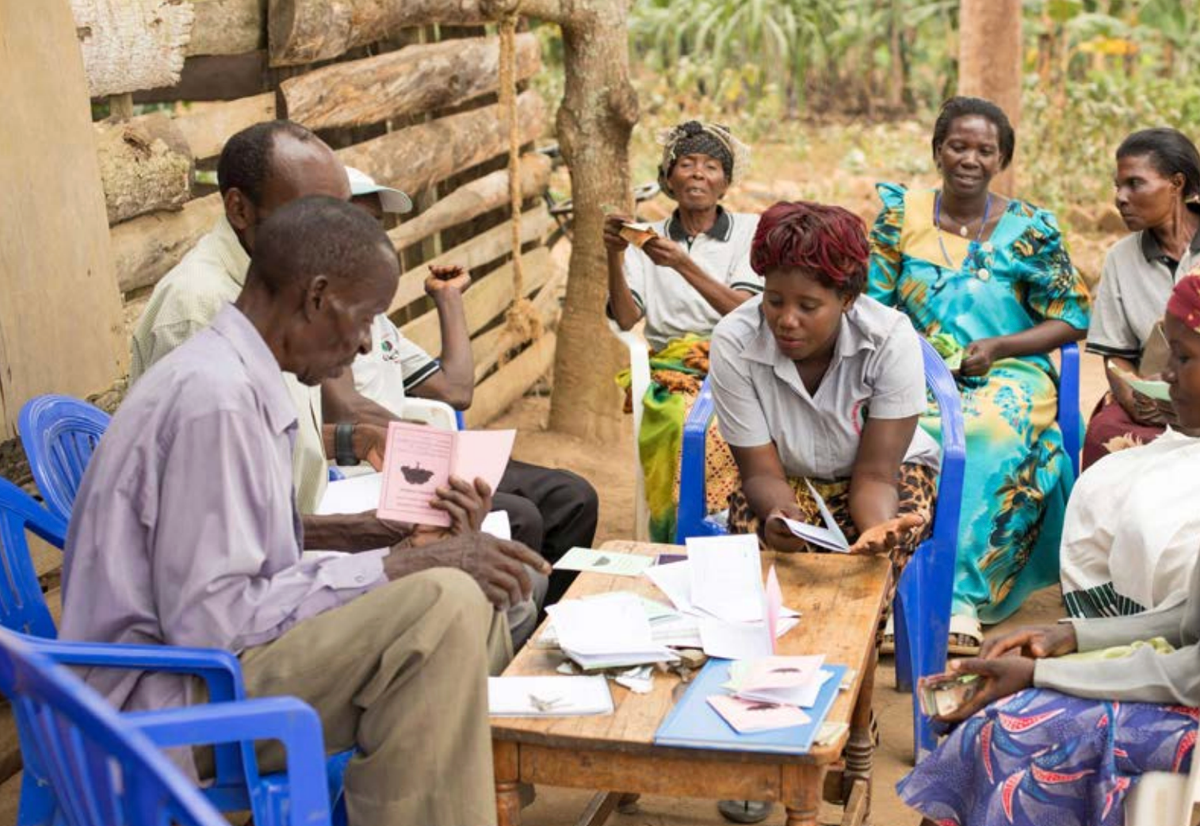
At a small cafe in a leafy suburb in Dar es Salaam, Tanzania’s financial capital, a table of 13 women rings with noise, laughter and chatter. Amid the chai, chapati and mandazi (a type of popular sweet fried bread) are spreadsheets and bank statements. Almost two years ago, these women came together to form a Vicoba (Village Community Bank), a popular microfinance model across subSaharan Africa whereby a savings group is owned and managed by its own members. The women have gathered for their monthly meeting to discuss group finances…
Susanne Aroko, part of the 13-member Vicoba in Dar es Salaam, recently used the group to take out a loan to pay a family member’s school fees. She says being able to access emergency funds quickly has relieved her of financial stress. “Applying for a bank loan is a complicated process. I used to rely on my sister for money,” she says. “But now I can get emergency funds when I need it – and you get it immediately.” The Vicoba is also helping her savings to grow. “I thought of it as an opportunity for financial stability. It creates discipline, as you must contribute each month. From the interest paid on the loans we also benefit from the dividends at the end of the year.” (Sippy, 2024)
The community banking models discussed here are built upon trust and communication. The groups gather and contribute together. The model also holds members accountable, since they must contribute monthly, benefiting them in the long term.
And the model goes beyond finance – it builds community. Mumu Bakari, a mother of three who lives in Kinondoni, a district in Dar es Salaam, says being part of a Vicoba has also provided her with moral support. She joined the group two years ago, along with 25 other members. “Mental health has been a big problem. But when we meet monthly, it’s a relief. We are mothers, we are wives, so we have similar experiences, and we support each other through that.”
Perhaps unsurprisingly, a unique bond is formed between members of community banks, who rely on each other to save, help each other through loans and build wealth together through dividends. By learning about each other’s financial goals, Bakari adds, they become involved in each other’s lives beyond money. (Sippy, 2024)
Community banking builds community. Sharing financial goals with others creates a safe space where people can encourage each other and grow together. The group doubles as a community bank and a support system. Building relationships with community members is extremely important, and can be applied to more traditional banking models.
Recently, community banks have begun transitioning to digital platforms.
Kwara, a Kenyan fintech company, is one such digital platform…The platform allows members digital access to financial services that previously would have required in-person interaction. Members are now able to view and download their financial statements, apply for instant loans, and make repayments through their phone or the web…
Ruth Lawrence, a 32-year old from Tanzania who has been part of several Vicobas, believes digital platforms have improved community banking. She is part of a 20-member Vicoba in Dar es Salaam. They use M-KOBA, a digital platform started by Tanzania Commercial Bank and M-Pesa, a mobile money service. “When we didn’t use a digital platform, we had a cash box and cash books,” she says. “The difference with using the platform is that transactions are seen by every member, we all see the loans taken out and the repayments made, so it makes everything more transparent and accountable.”...
“Without trust, it can be catastrophic. It happens. But when it works well, it creates relationships,” says Lawrence. Going forward, the challenge may be how community banks can continue to build those relationships while moving towards a digital future. (Sippy, 2024)
Community banks have a clear positive impact on communities. Digital community banks have simplified the community banking process, as loans, payments, and money can all be seen by everyone. This makes the model more practical.
Features of the digital community banking model can be applied to Huntington’s existing business model. Knowing that trust is one of the most important factors in community banking systems, creating a sense of trust is crucial when designing a community banking system. How can I extend Huntington’s current business model to include community banking tools while maximising trust?
References.
Sippy, P. (2024). Shared Interest. RSA Journal, 170(4(5599)), 42–45. https://www.jstor.org/stable/48831912
A.I. was not used for this article.