When Interactive Exhibits Fail
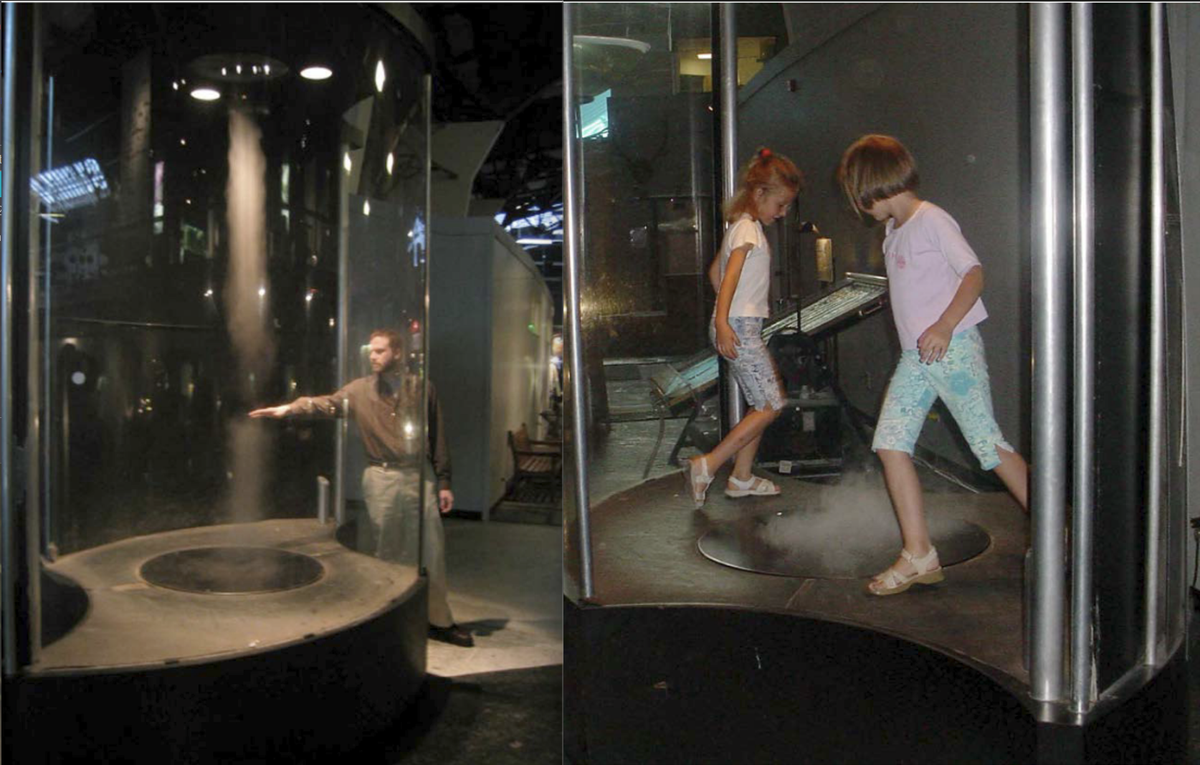
When visiting metro parks, I encountered several interactive educational stations. In my experience at science museums, as well, interactive exhibits have always been popular. They're engaging, and turn concepts tangible. Considering an interactive component to help educate state park visitors on low-impact practices, I looked for writing on how to design interactive exhibits and whether they truly are beneficial. Allen et al. (2004) explore the ways interactive exhibits can fail and how effective they are when they succeed.
Excerpts from Allen et al. (2004)
This article describes five common pitfalls of designing exhibits with high levels of interactivity or multiple interactive features: (1) multiple options with equal salience, (2) features allowing multiple users to interfere with one another, (3) options that encourage users to disrupt the phenomenon being displayed, (4) features that make the critical phenomenon difficult to find, and (5) secondary features that obscure the primary feature. Examples of each of the five problems are presented, and possible design solutions are offered.
McLean (1993) defines interactive exhibits as “those in which visitors can conduct activities, gather evidence, select options, form conclusions, test skills, provide input, and actually alter a situation based on input” (p.93). At the heart of interactivity is reciprocity of action, where a visitor acts on the exhibit and the exhibit reacts in some way. Such interactivity is an essential element in the majority of exhibits in contemporary science and children’s museums.
The idea that interactivity should improve visitor learning at museum exhibits has its roots in the philosophies of experiential education (Dewey 1938/1997) and constructivism (Piaget 1957). Dewey proposed an experiential philosophy for education, emphasizing the importance of experiences for challenging or supporting a learner’s previous understanding. Piaget valued interactions with the physical world because they encouraged learners either to assimilate new knowledge into their existing conceptual structure or to accommodate new,
conflicting ideas by restructuring their previous understanding. In sum, both philosophies hold that people learn by building their own understandings based on experience, and that educational systems should offer experiences to support learning. More recently, such ideas have been translated and specifically applied to current museum practice (e.g., Ansbacher 1998; Falk & Dierking 2000; Hein 1998; Roschelle 1995).
Research on visitor learning in museums suggests that interactivity promotes
engagement, understanding and recall of exhibits and their content (for a recent review, see Schneider & Cheslock 2003). ... In one study, Hein and Heald (1988) found that renovating a diorama exhibition to include multisensory interactive components led to increases in visitor holding time and visitors’ knowledge of the exhibition’s themes. In an art museum study, Richards and Menninger (2000) evaluated specially-designed interactive galleries at the J. Paul Getty Museum and found that holding time was greater in those galleries. Research also suggests that interactive exhibits can be memorable, with many visitors able to describe the
thoughts and feelings they had at the exhibits over 6 months after a visit (Stevenson 1991).
Specifically, we will limit our discussion and examples to Physical, Adjustable, Relevant (PAR) interactive features. By “Physical,” we distinguish these features from interactivity involving symbolic or computer-based media; we consider only those forms of direct interaction between the visitor and a physical phenomenon. By “Adjustable,” we mean that the exhibit can be varied in a way that is continuously changing, beyond a simple “on/off” push of a button. By
“Relevant,” we mean that the interactivity supports direct exploration of the phenomenon being exhibited, rather than being tangential to it; we therefore ignore cases where an interactive technique is used as a hook to entice visitors to read informational text or graphics.
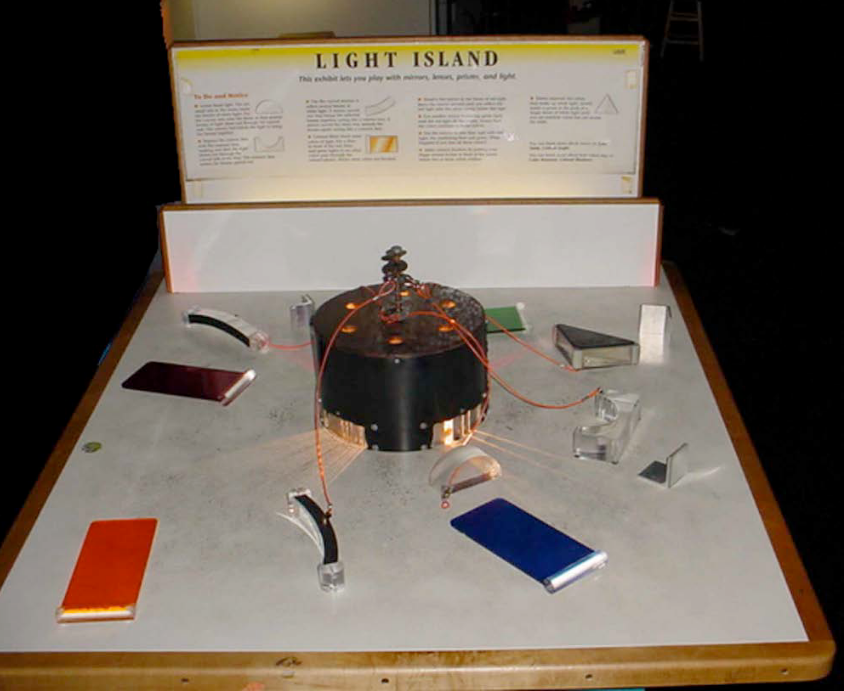
In trying to optimize the interactivity in exhibits, the Exploratorium staff sometimes use a framework with two aspects: initial and prolonged engagement. By initial engagement, we mean the degree to which a visitor can determine how to approach an exhibit and how to get started. By prolonged engagement, we mean the degree to which an exhibit offers opportunities for sustained explorations, challenges, and experimentation. We try to build our interactive exhibits,
particularly those that showcase interesting physical phenomena, to support both initial and prolonged engagement.
For this reason, we want to emphasize the importance of conducting evaluation studies in all phases of exhibit development. Many development budgets include funding for summative evaluation, conducted at the end of the process to determine the degree to which a project met its goals. However, we believe it is vital to devote a considerable portion of the evaluation effort for formative and remedial evaluation. Such studies, even with sample sizes as small as 10 or 20 visitors, can expose hidden problems with interactivity and suggest possible solutions. Although our staff members are experienced and know many effective design principles for interactive exhibits, we are sometimes surprised by the results of such studies. Often, the full complexity of an exhibit’s interactive features can be seen and understood only through the eyes of our visitors.
This article will be invaluable should I design an exhibit with several interactive components. It also confirms that interactive components are valuable for learning and retention of information, which would be extremely helpful in educating park visitors on 'leave no trace' practices or the reasons behind littering prevention.
References.
Allen, S. and J. Gutwill. (2004). Designing with multiple interactives: Five common pitfalls. Curator, 47(2), 199-212.
No generative AI was used in the creation of this post.