Who Feels Welcome at State Parks?
During our project kickoff at ODNR, we learned that an important factor in the development of park trails is the whether visitors feel welcome when they arrive at a state park. The following excerpts are from an article by Powers et al. (2024) that examines whether the access to state parks is equitable and welcoming to all demographics.
Excerpts from Powers et al. (2024)
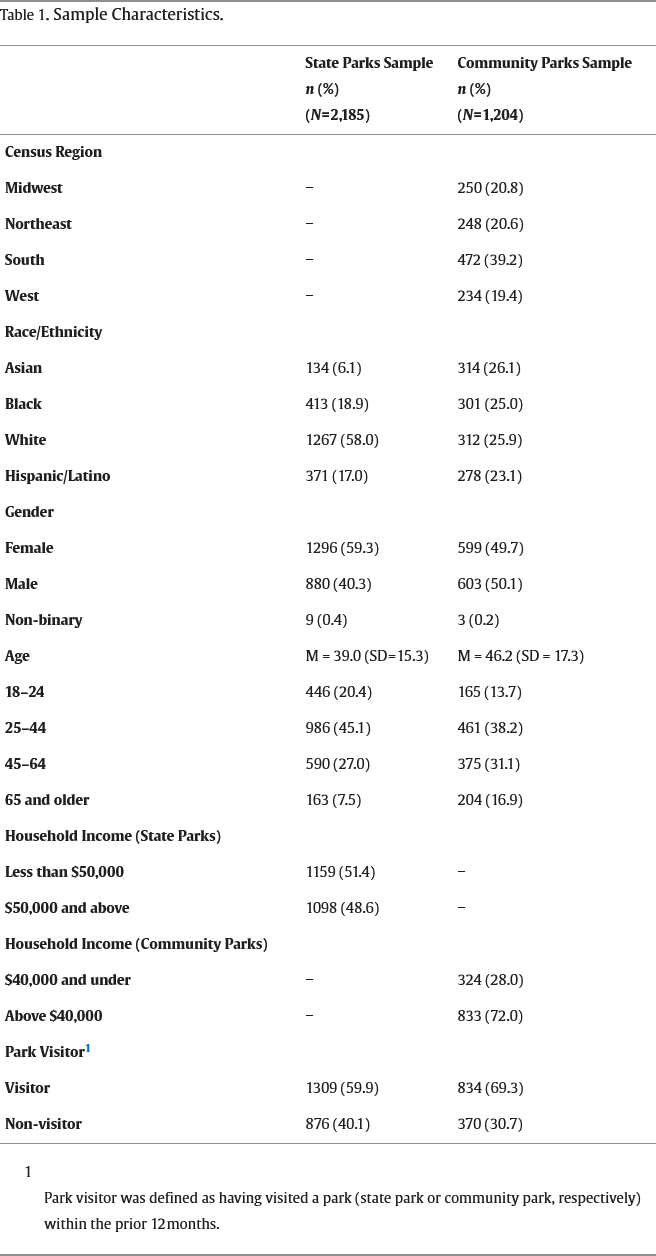
Within both the community and state parks samples in our study, respondents suggested management actions focused on more equitable communication practices (including ethno-racial representation in communication materials and outlets), outreach to racially and ethnically minoritized communities and encouraging more equitable procedural participation, ethno-racial representation among staff and leaders as a form of equitable management, and greater engagement and representation of racially and ethnically minoritized histories and cultures within the parks via things like interpretation, monuments, and educational programs; these findings corroborate research from other local contexts (e.g., (Camarillo et al., 2019, Lee et al., 2020, Powers et al., 2022, Stodolska et al., 2020). Further, safety was identified by respondents as an important factor with potential to increase welcomeness in parks, corroborating the quantitative findings of prior studies (Powers et al., 2022, Powers et al., 2022) The prevalence of these themes in the state park context suggests that findings from prior studies conducted at community or local sites are likely applicable to state parks and possibly other wildland recreation settings.
Welcomeness and belonging are essential factors related to the park visitor experience and may be especially relevant for racially and ethnically minoritized communities who have historically faced exclusion and marginalization in park settings. In this study, we took a quantitative approach to assessing perceptions of welcomeness and belonging among racially and ethnically diverse samples, specifically examining perceptions regarding state and community parks. While we observed no differences by race/ethnicity regarding community parks, findings suggest significant differences in welcomeness and belonging at state parks by race/ethnicity. Whites tend to feel more welcome and that they belong compared to racially and ethnically minoritized communities. Further, welcomeness and belonging were positive predictors of state park visitation suggesting that park agencies may be able to increase visitation among racially and ethnically minoritized populations by taking actions which promote greater welcomeness and belonging in their parks. Belonging was also a positive predictor of community park visitation, while welcomeness was not.
To promote greater welcomeness and belonging, park agencies should focus on more equitable communication and procedural participation practices; incorporating racially and ethnically diverse cultures and histories in park management, interpretation, and education; and advancing ethno-racial representation with regards to park staff, leaders, interpretation, materials, and signage. Advancing welcomeness and belonging in parks is not only essential to achieving environmental justice, but has the potential to increase the relevance and value of parks for all citizens, thus encouraging a sustainable future for parks.
I will do my best in my capstone project to keep environmental justice as a goal. I don’t believe that designers alone can fix the core problems such as the historical exclusion and marginalization of minorities, nor are we equipped to fix the roots of those problems. However, it would be a disservice not to design with those problems in mind. And, designers have the ability and responsibility to make whatever small positive changes we can, such as by including visual representation of marginalized communities, using accessible language and languages, etc.
References.
Powers, S. L., Mowen, A. J., & Drogin Rodgers, E.B. (2024). Belonging and Welcomeness in State and Community Parks: Visitation Impacts and Strategies for Advancing Environmental Justice. Geoforum, 157.