Why can't my kids stop bugging me? Am I crazy?

If you've every driven with a kid in the backseat you know all too well the infamous phrase "are we there yet?". The car is a microcosm for many issues that children face as seen in the article "Are we nearly there yet?" from The Conversation:
One reason is that our experience of time changes as we age, often resulting in the sensation of time passing more quickly as we get older. This is typified by the sensation that “Christmas comes around more quickly each year”.
Time is thought to pass more quickly as we age because, with increasing age, any duration of time becomes a smaller proportion of our life to date. For example, at seven years old, a year is 14.30% of your entire life; at 70 years old it’s only 1.43% of your life. As such, a five-hour car journey may feel longer to a five-year-old than to a 50-year-old, simply because it is a greater proportion of the five-year-old’s life.
But there’s more to it than that. As we age, we also develop a greater understanding of distance and geography. This knowledge provides us with markers and cues we use to understand how much of the journey is done and how much remains.
For example, on a journey from Manchester to Devon, I know that I’m roughly halfway there when we clear Birmingham, and this knowledge helps to structure the time for me. I also have access to the satnav, which provides an arrival time and warns me about upcoming delays. The absence of this knowledge in children means that they are more reliant on asking adults how long is left to judge the progress of the trip.
Children’s uncertainty about how long has passed and how long remains is made worse by their lack of control over the journey itself. It’s the grownups who choose which service station to stop at and which route to take. This may also contribute to the journey dragging by for children.
This is because temporal uncertainty, or the feeling of not knowing when something will happen, can slow the passage of time. As adults, many of us have significant experience of this.
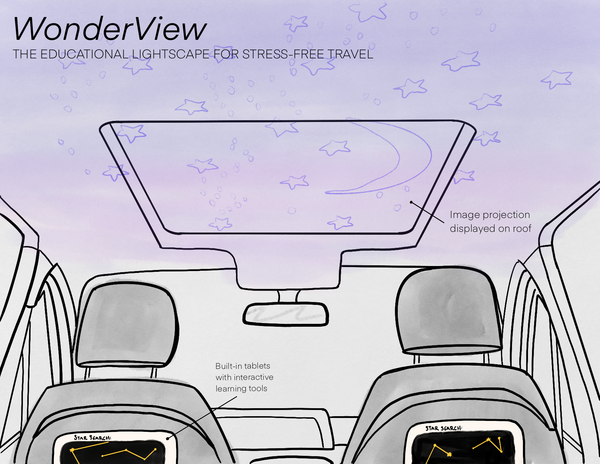
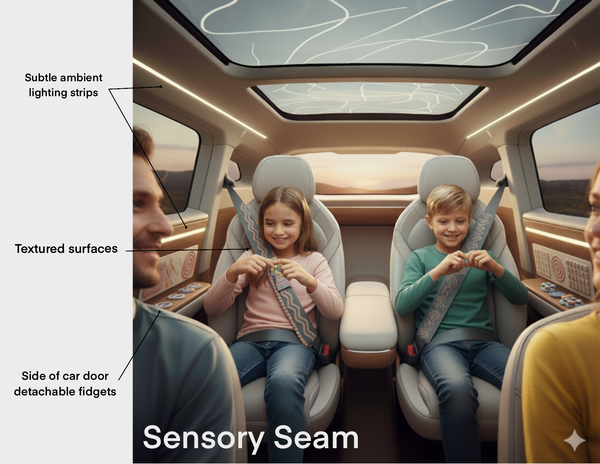
These insights help to contextualize the issues that are invisible to adults that children face while being passengers in cars. Making the passage of time more palatable to children could yield a number of benefits besides making car rides easier. Children may be able to focus better or learn how to become self-sufficient faster. A product that not only makes the passage of time entertaining but also helps children see the bigger picture could be something to strive towards.
As for temporal uncertainty, this is a fear that persists well into adulthood; think about waiting to hear back from a job interview or a second date. Teaching skills to mitigate it early will not only make the car ride easier but could also create long-lasting good habits. Alternatively, giving children more productive ways to contribute to the mood of the car ride besides screaming into the void could help to improve communication skills and reduce strain on parent-to-child relationships. This could be solved by a set way to recommend rest stops or view and comment on the journey map. Regardless, long car rides dredge up not only frustration but opportunities for designers to give a voices and tools to the youngest among us.
References
Ogden, Ruth. 2022. The Conversation. "‘Are we nearly there yet?’: why long car journeys are so excruciating for your kids". https://theconversation.com/are-we-nearly-there-yet-why-long-car-journeys-are-so-excruciating-for-your-kids-189347
Daisy D. Unsplash. 2025. https://unsplash.com/photos/a-child-has-a-bag-over-their-head-in-car-INvrDywsRmo
All original works in this article were done without the assistance of AI tools.