It’s Not Your Fault: Designing the Connections Behind Sustainability.
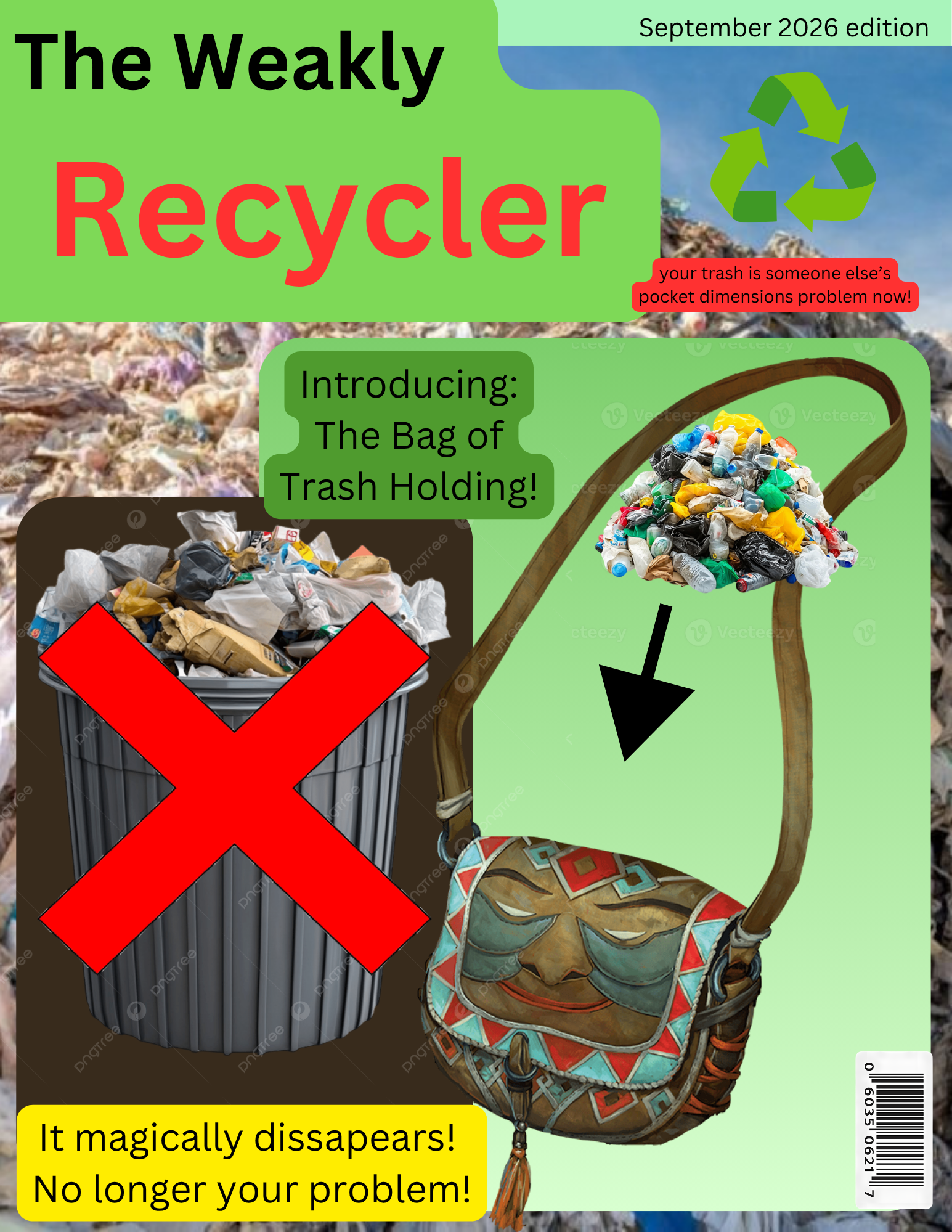
You may not realize at first what this tabloid cover is really trying to get at. You might see the less than perfect graphic design, or perhaps the silly nature of the content itself. What do you think it responds to?
In reality, this conjecture seems to be promoting some unrealistic solution to our waste problem. But what is the point in that lack of realism? The truth behind the intention actually lies in what is explicitly not said.
Imagine you’re enjoying a nice walk through your local community. You finish a tasty beverage you got along the way, and you drop the plastic bottle that it came in into the recycling bin. It’s now out of sight, and you likely never think about that particular bottle ever again.
This phenomenon is exactly what this conjecture hopes to bring light to: Our lack of consideration of our waste.
Despite that thinking, we realistically know that that bottle is not truly “gone”. We are taught to recycle, reduce our single use items, and that we should care about our waste. It creates a lot of personal pressure to practice a sustainable lifestyle. Most people, however, aren’t able to do everything they possibly could to be sustainable.
Survey
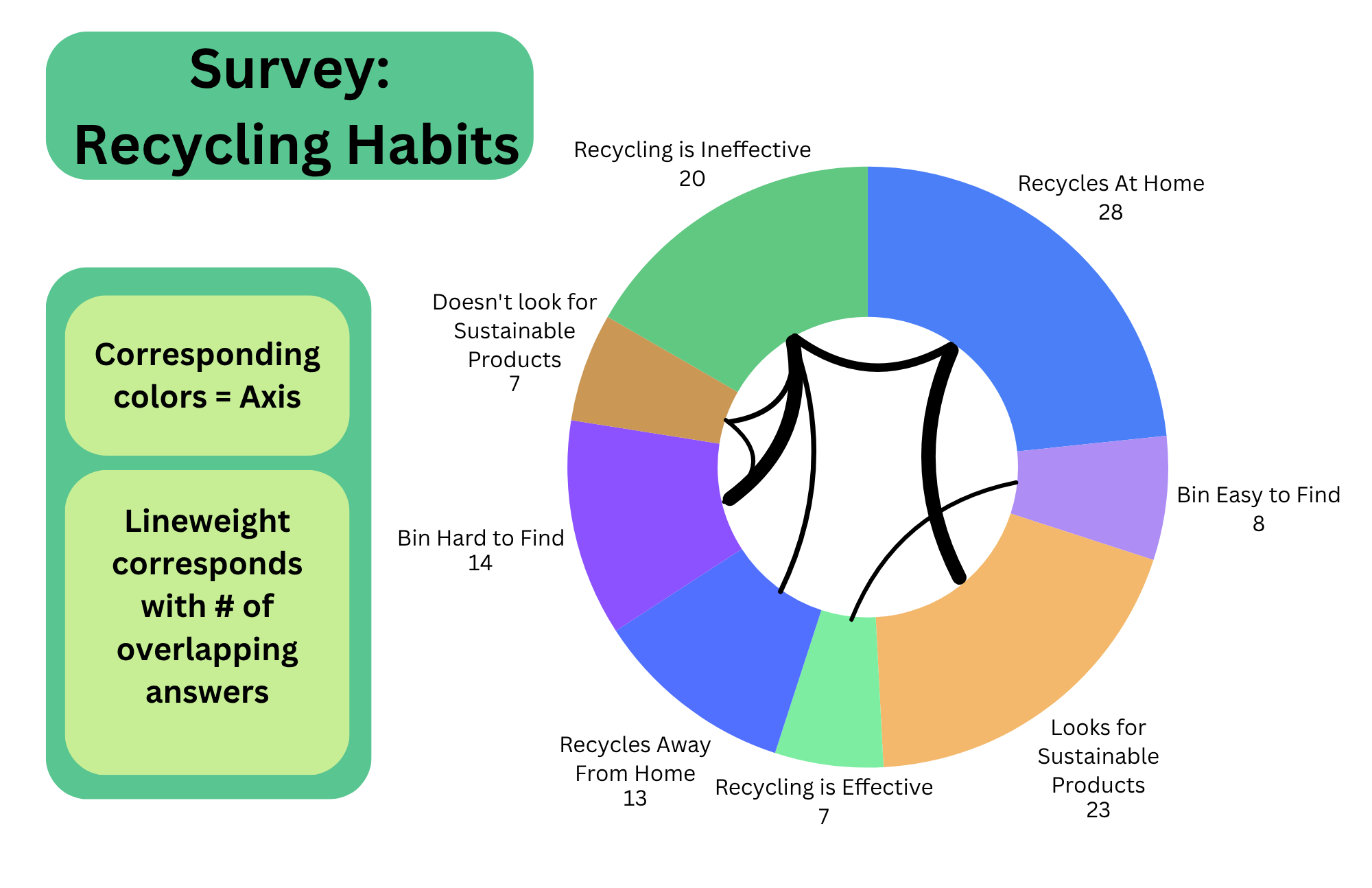
In a survey of 32 people living in the Weinland Park neighborhood just west of campus, a majority of ~71% said that they faced barriers that prevented them from recycling. Of those barriers, overwhelmingly they revolved around issues regarding a lack of education about local recycling laws, and a lack of systemic support that would facilitate additional recycling.
This however, points to a larger tension that, as discussed in Why Is It So Hard To Recycle?, sits between an individual and the systems they exist within. We are often encouraged to think about waste as an individual responsibility, such as recycling, reusable items, and buying sustainable versions of products. However, our ability to make those choices do not exist by themselves. Whether something can be recycled, where it can be recycled, how much all of that costs, and ultimately what happens to the items we recycle are shaped by the infrastructure, business, economic and policy systems around us. An individual can be moved to care about recycling, but that does not mean they have the information, time, money or convenience necessary to participate.
This exact tension is what creates this contradictory phenomenon of the "disappearing trash” where we often don’t consider our waste, despite our demonstrated knowledge about its importance. Combining these individual pressures with a lack of ability to do anything about it, has grown apathy amongst individuals.
But, if it isn’t any individual's responsibility to solve our plastic waste problem, whose is it?
Stakeholders
Businesses
During my research into how different types of businesses respond to this need for more sustainability, there were a few common motifs that we saw employed: Designing for Sustainability, and Collection initiatives. When designing for sustainability, we make design decisions on a product level that contribute to that particular product's ability to be recycled and/or repaired.
In this design conjecture, I am responding to Business Case studies referencing Niaga, who prioritized creating products that would streamline a modular, repairable, item that would further cut down on cost and waste, as well as the #WearNext campaign, that focuses on how we can reduce textile waste through collecting and redistributing.
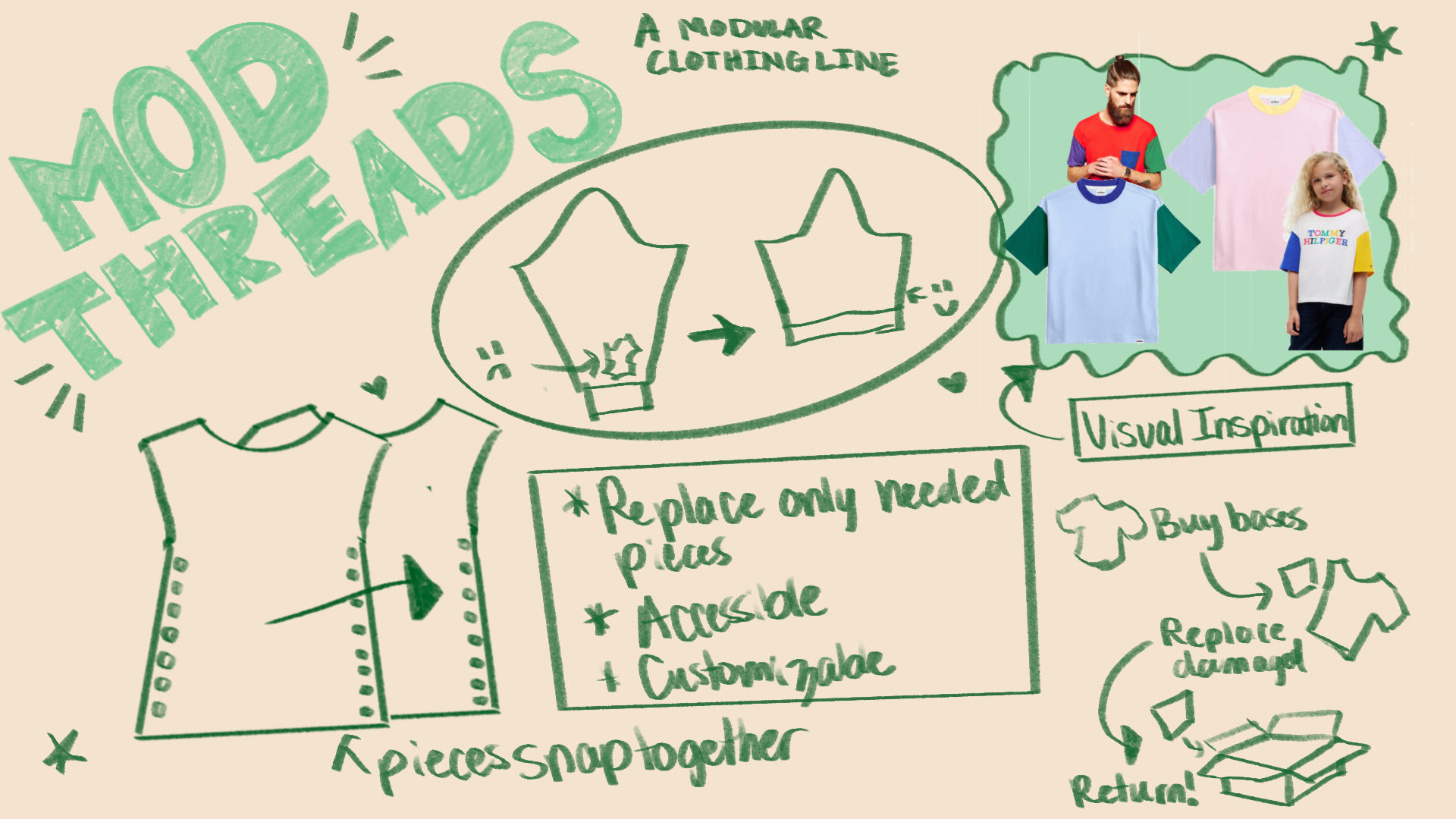
I created ModThreads, a modular clothing brand.
When thinking of modularity, we mostly see this concept applied to bulky items, such as the aforementioned furniture, mattresses, etc. We occasionally see them in smaller items, where the modularity more so serves the purpose of easy recycling so that the item may be separated by material. Clothing, however, we often do not see this concept applied.
One issue we encounter with applying modularity to clothing is because of the complex patterning involved. Pieces need to be able to fit just right, and that can change tremendously between designs.
When we focus on a clothing object such as the T-Shirt, we can cut down on those variabilities. The pattern is quite straight forward, and the style of T-shirt is one that in our popular culture, quite mainstream.
With modularity, we can even elevate the normal t-shirt experience. With the design feature of modularity, users are able to swap out pieces to achieve different aesthetics. And we even have precedent for this color-blocked style being well accepted, as seen in the style reference.
In addition, the sort of temporary style of connecting modular pieces, in this case being snaps, also serves an accessibility purpose. An underrepresented group of people includes those that struggle physically to put on shirts by pulling them over their head, and might be better served by the ability to button the shirt around themselves, without sacrificing aesthetics.
In understanding all of these positives that this form gives us, from sustainability to accessibility, however, these sort of business practices fall short on one key idea: These systems only work when individuals have the resources to participate. The replacement and recollection of these clothing pieces only works when consumers return them.
This is how businesses contribute to this “blame game” by placing the responsibility back on the consumer.
Policy
During the course of my research, I was able to conduct primary research at the Solid Waste Authority of Central Ohio’s Sanitary Landfill, and The Rumpke Resource and Recycling Center.
One thing stood out to me during my time at these locations: Central Ohio has so much going for it in terms of what is in place that allows us to recycle and divert waste from the landfill.
Rumpke’s Recycling Center boasts sorting through roughly 60 tonnes of recyclable material every hour. One of the most technologically advanced systems for recycling sits right here in Central Ohio.
At SWACO, we had the pleasure of conversation with Sean Collins, the Assistant Business Programs Manager, about his efforts to help divert waste from their landfill. He described a process that, in contrast to the amount of resources we have, seemed lackluster.
When local businesses would contact him regarding a certain waste they might have, Sean is dedicated to finding a place that can go that isn’t the landfill. But, that is no easy task. Sean has been in his position for 6 years, and has grown a circle of contacts that recycle different items, but the task is still incredibly difficult. “You can’t google these guys.”, he remarked to us when describing this process. He made it clear that there was no sort of database or infrastructure that supported finding these waste diversion efforts.
There is no central authority figure that dictates who and where what items can be recycled. This lack of infrastructure policy means that, when it comes to manufacturer waste, the blame is shifted to them to figure out what to do with their waste. And when they lack the resources and infrastructure to find that place for their waste, the place often becomes the landfill.
Community
Of our final stakeholders, the community aspect presents to us one of the most interesting cases. Communities are made of a congregation of individuals, who, as we have already noted, often lack the knowledge and resources to do much in their own right.
However, when we are able to have organized communities, we often find that they are able to solve most issues that individuals would not be able to tackle on their own.
Take the #WearNext initiative, for example.
The #WearNext initiative, which culminated into a campaign lasting from March to June in 2019, was created by partners from DSNY, New York City Economic Development Corporation (NYCEDC) and the Ellen MacArthur Foundation’s Fashion programme, with the hope to redirect the city's nearly 200 million pounds of clothing that would otherwise end up in landfills.
This initiative to promote circularity within the New York fashion sphere, was largely successful not only because of its effort to make this large amount of waste more spoken about on social media, but by their use of pre-existing technology, for which they streamlined and promoted the use of.
They utilized resources they had: partners, social media, and some existing infrastructure. From there, they were able to have a campaign that lead to tremendous success:
DSNY collected data on clothing donation volumes from seven different locations. Compared to the same time period in the previous year, 583 tonnes more clothing was collected, an average increase of 15%, with some recording up to 48% increase. Gap, Athleta, and Banana Republic cumulatively collected two tonnes of clothing over the two-month campaign.
But how was this able to come about? The answer is simple: They had community members that organized and facilitated this entire event. Without that facilitation, all of these resources would not be as effective as they were when they worked together.
Conclusion
In looking at these case studies, we see these tensions between the individual, and the system, and the problem becomes clear. Facilitation of community efforts are the key to local sustainability efforts becoming successful.
This leaves us with our key problem: How can we create stronger facilitation capabilities among those who wish to be involved in these sorts of initiatives?
References
University of Washington Recycling. (2025, April 15). 2025 Trash Art Contest winners repurpose waste into thoughtful art. UW Sustainability. https://sustainability.uw.edu/blog/2025-trash-art-winners
Morgan, B. (2021, April 21). Why is it so hard to recycle? Forbes. https://www.forbes.com/sites/blakemorgan/2021/04/21/why-is-it-so-hard-to-recycle/
Ellen MacArthur Foundation. (2021, June 17). Redesigning medium-life bulky products from scratch. https://www.ellenmacarthurfoundation.org/circular-examples/redesigning-medium-life-bulky-products-from-scratch
Ellen MacArthur Foundation. (2021, June 16). The #WearNext campaign: New York City. https://www.ellenmacarthurfoundation.org/circular-examples/the-wearnext-campaign-new-york-city
Hughes, A. (2026). Primary research: Rumpke & SWACO. Capstone News. https://capstone-news.ghost.io/primary-research-rumpke-swaco/