
A Dazzling Art Collection, Hiding in Plain Sight

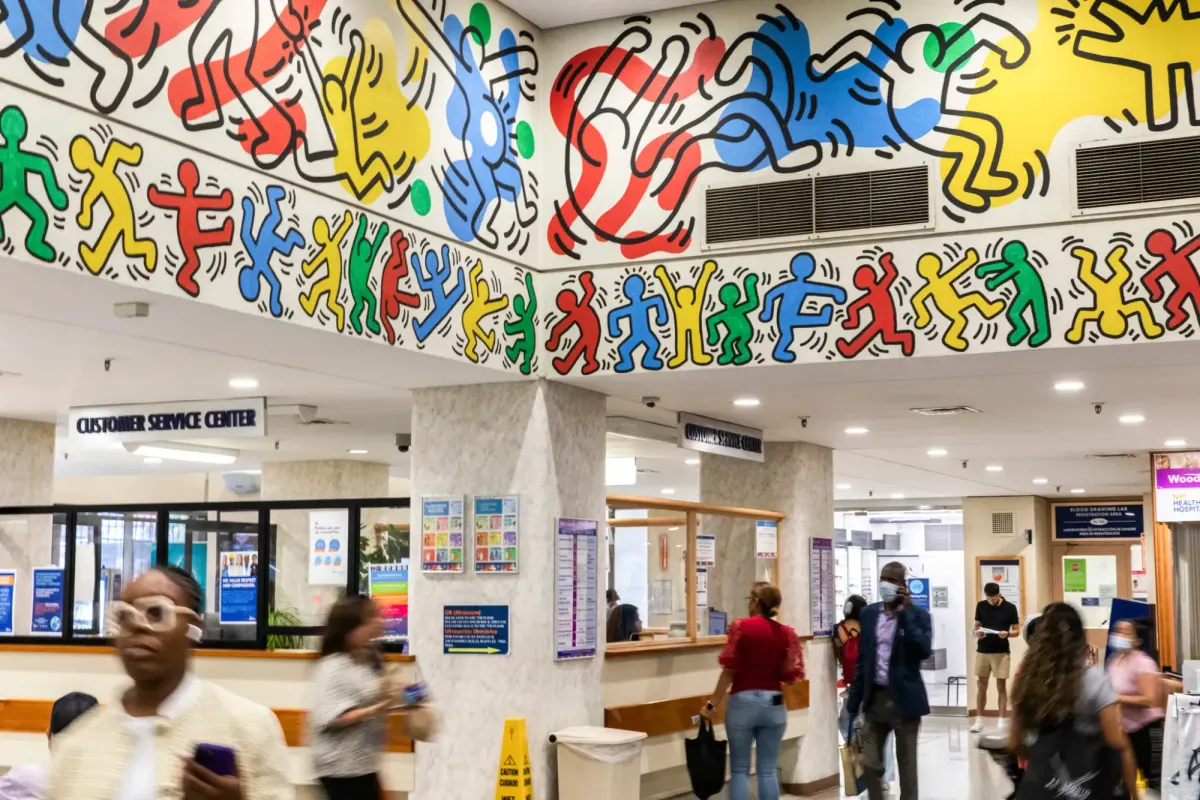
“The Haring mural is just one of the surprises among the 7,452 works of art that have been amassed over nearly a century by New York City’s sprawling public hospital system, which serves more than one million patients every year.
It is one of the largest public art collections in the country — hiding in plain sight” (Hu, 2023).
I love how the public works are so integrated in the medical system that they hide in plain sight. They make a large impact on the community, but not through a single statement.
“Though the collection has not been appraised, it is probably worth many millions of dollars, according to art experts. The Haring mural alone could fetch millions. In 2019, another Haring mural — carved out of a stairwell at Grace House, a former convent and home of a Catholic youth organization in Manhattan — sold for more than $3.8 million at auction.
A review by Heritage Auctions of just 11 other important works in the collection has put their total value between $8 million to $10 million, said Roberta Kramer, a senior vice president of strategy and business development at the auction house” (Hu, 2023).
The financial size of the collection is important, because it shows how the arts and donations made to the collection are not measured in financial gain, rather a societal one.
“In the waiting room of a Queens hospital, panels illustrated the development of medicine. A mural in a children’s ward in Lower Manhattan transported characters from Alice in Wonderland to New York destinations like the Central Park Zoo and Coney Island. A series at Harlem Hospital — one of the first major government commissions awarded to Black artists — showed Black people at work and play through history.
The earliest pieces had a utilitarian purpose: They were primarily commissioned through government agencies and programs, like the Works Progress Administration, to put people — in this case, local artists — to work during the Depression” (Hu, 2023).
This connection shows how art can uplift all aspects of a community. Making an impact on healthcare does not have to directly impact health, art can be used to uplift communities and encourage diversity in hospitals. My capstone solution does not have to be directly a medical device, but it could still impact people's well-being in a rural Ohio setting.
“Mr. Haring, by that time a celebrity known for his large public murals, painted alone at Woodhull; he became a fixture, smiling at patients and hospital workers and climbing down from his scaffolding for conversation.
His mural has become the pride of Woodhull.
“‘It is part of the hospital,’ said Dr. Lisa Scott-McKenzie, Woodhull’s chief operating officer, who in 1986 had just started as a secretary and didn’t know who the painter on the scaffolding was.
The mural is ‘deeply ingrained in who we are,’ she said, ‘and the respect that we have for our community’” (Hu, 2023).
Investing in the arts shows respect for the public community. This could be translated to designing medical solutions for a community, it is a sign of respect to uplift and empower people in their daily lives through public resources.
“Now New York’s public hospitals are re-embracing their collection, part of a growing movement in health care to heal with art. Hospital officials created a department, Arts in Medicine, in 2018 to oversee the collection and are busy planning exhibits and a new display area at Bellevue.
The artwork helps create an ‘enriched environment’ that can lower stress, anxiety and blood pressure, improve moods and lead to faster healing, said Susan Magsamen, the director of the International Arts+Mind Lab at Johns Hopkins University School of Medicine” (Hu, 2023).
“To expand public access, the collection is being digitized to display on a free app for arts and culture, Bloomberg Connects. Physical signs with QR codes are being placed next to the art.
At Woodhull Hospital the other day, Tijae Medina, 13, was getting anxious about his dental appointment. But then he turned down a gleaming white corridor and looked up to find a spotted dragon in high heels. Or was that a cow?
He instantly felt more at ease.
‘I feel like walking into a hospital is scary,’ he said. ‘It took my mind off it for a second’” (Hu, 2023).
Technology is allowing for even more people to have access to public work. I find it impactful that we can use new advancements in digital technologies to further expand physical works, and give them environments outside of just the ones they are placed in.
References
Hu, W. (2023, October 8). In stress-filled halls, an artistic balm. The New York Times. https://www.nytimes.com/2023/10/08/nyregion/nyc-hospitals-public-art.html
No generative AI was used in writing this article.



