
Advancing Technology Innovation through the Rural Health Transformation Program

The Rural Health Transformation Program is using technology to improve healthcare in rural communities by allocating $50 billion to advance rural healthcare across American. It focuses on tools such as telehealth, artificial intelligence, and electronic health records to make healthcare more accessible and efficient for people living in rural areas.
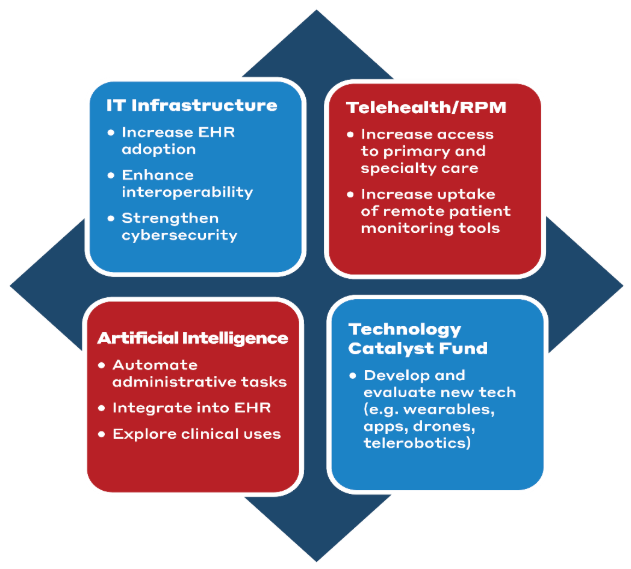
CMS has launched initiatives to modernize the health technology ecosystem and advance interoperability. The agency also encourages states to invest in data infrastructure, with about 4% of the RHTP workload funding score based on such initiatives. CMS imposes a 5% spending cap on replacing HITECH-certified electronic health records (EHRs) under RHTP, so state investments tend to focus on targeted enhancements rather than replacements (Kim & Sandalow, 2026).
States plan to use RHTP funds to increase access to telehealth and RPM. Arizona, Arkansas, and Maine propose establishing telehealth hubs to create additional community-based access points. Florida and Utah aim to utilize telehealth to improve access to specialty care, such as behavioral health and obstetrics. Kansas, Maryland, and South Carolina are investing in expanded uses of RPM and patient-facing health technologies—including apps, wearables and AI-enabled tools—in rural areas. South Carolina will purchase standards-based RPM equipment and monitoring infrastructure for diabetes, hypertension, COPD, and heart disease patients (Kim & Sandalow, 2026).
State RHTP proposals include a range of AI-focused investments, including administrative streamlining. Texas proposes using AI-automated fax processing, while West Virginia and Tennessee aim to integrate AI into EHR platforms. Maineproposes establishing a Rural AI Hub and AI Innovation Institute to provide expertise, oversight, and guidance for rural health care organizations on AI adoption (Kim & Sandalow, 2026).
Several states—including Alaska, Georgia, Nebraska, and Tennessee—propose rural catalyst fund initiatives. Alaska plans to pilot scalable technologies in remote, often roadless, settings, including unmanned drones, remote pharmacy dispensing units, and portable diagnostic tools. Outside of catalyst funds, states are piloting various emergent technologies to address care gaps and workforce shortages. Alabama proposes providing access to telerobotic ultrasound devices for pregnant women to help address the obstetric workforce shortage (Kim & Sandalow, 2026).
The RHTP is making great efforts to help advance rural healthcare. They acknowledge they don’t know if it’ll work, and it’ll take time for these states to implement some of their new technologies and protocols. However, these efforts have the potential to improve access to healthcare and provide better resources for people living in rural communities. As these programs are put into place, it will be important to evaluate their effectiveness and see whether these new technologies actually improve the quality and accessibility of rural healthcare.
This reading helped me understand how much technology is becoming a part of the future of rural healthcare. I was especially interested in the variety of solutions being explored, from telehealth and remote patient monitoring to AI, portable diagnostic tools, and even drones. It showed me that improving rural healthcare does not necessarily mean building more hospitals or clinics, but can also involve finding new ways to bring healthcare services and information to people where they already live.
Reference
Kim, D., & Sandalow, M. (2026, March 18). Advancing technology innovation through the Rural Health Transformation Program. Bipartisan Policy Center. https://bipartisanpolicy.org/explainer/advancing-technology-innovation-through-the-rural-health-transformation-program/



