
AI-Powered CPR Coach Outperforms 911 Dispatchers in Guiding Bystander Resuscitation

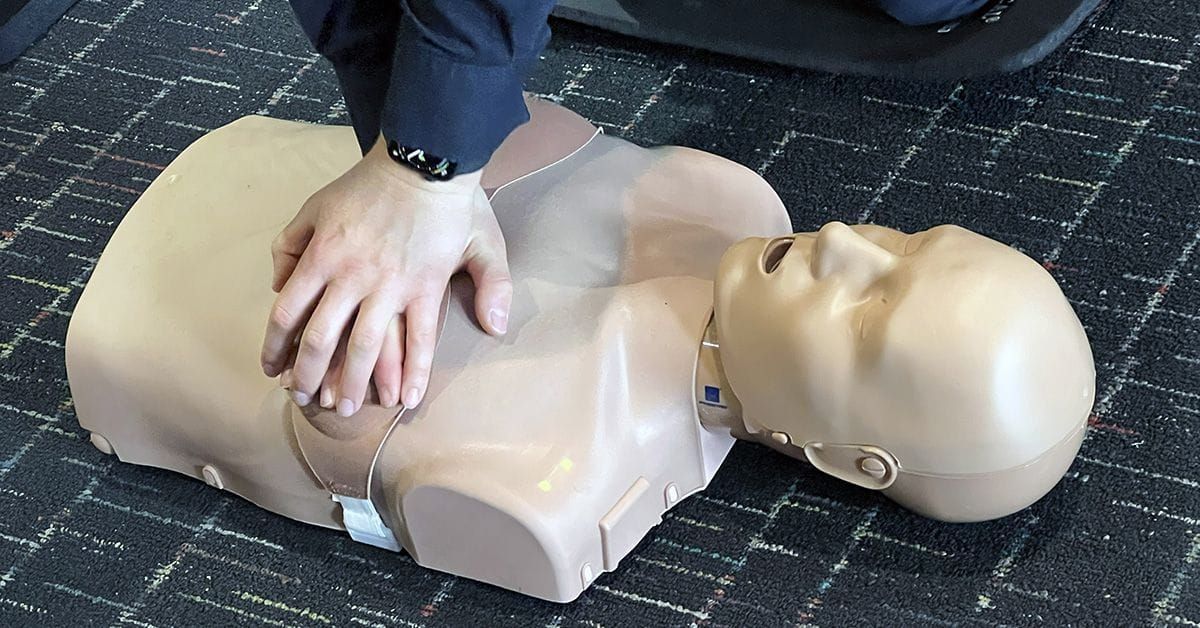
“The study, published in JAMA Internal Medicine, first benchmarks popular AI models on CPR instruction and then introduces ChatCPR, an open-source AI agent that scored 100% on guideline-based CPR checklists and significantly outperformed human dispatchers when tested against recordings from previous real 911 calls” (University of California San Diego, 2026).
“‘More than 350,000 Americans suffer out-of-hospital cardiac arrest each year, and survival sits at roughly 9%,’ added Nimit Desai, B.S., a research affiliate at the UC San Diego Qualcomm Institute, a medical student at UC San Diego School of Medicine, and lead author of the study. ‘Given that only 2% of Americans are certified to perform CPR, when someone collapses, they call 911 and wait. ChatCPR could change that and begin to save lives’” (University of California San Diego, 2026).
“The findings highlight an opportunity to study AI’s role in delivering guideline-based instructions—as a complement, not a replacement, for human responders. ‘This is about supporting people in high-stakes situations where human judgment is essential,’ added Horvat. ‘The goal is to raise the floor of performance, not to replace trained professionals’” (University of California San Diego, 2026).
“Across different situations, like drowning or collapsing while jogging, and across different patients, from toddlers to seniors, AI models performed well on the basics of CPR. On average, they scored 90% on essential steps, such as where to press on the chest and how fast to do it. Scores ranged from 79% (Gemini) to 97% (Grok and Claude). When it came to giving the best possible instructions to improve survival, performance dropped. On these more advanced steps, such as letting the chest fully rise between compressions, models averaged 70%. Scores ranged from 61% (Llama) to 75% (ChatGPT)” (University of California San Diego, 2026).
“‘In cardiac arrest, good is not good enough,’ said Cameron Dezfulian, M.D., an adult and pediatric intensivist, senior faculty member at Baylor College of Medicine, and study coauthor. ‘Missing 10 to 30% of steps can be the difference between life and death’” (University of California San Diego, 2026).
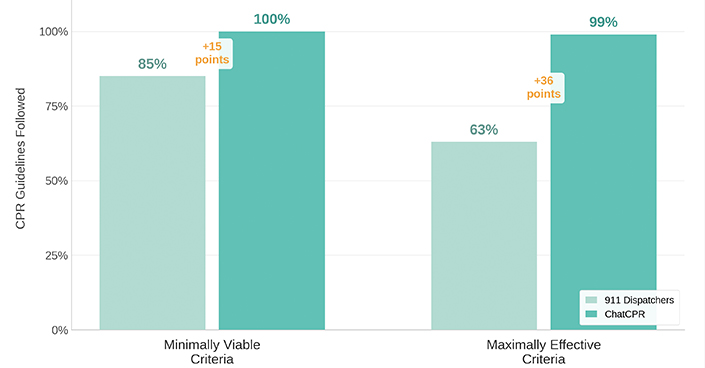
ChatCPR outperforms 911 dispatchers in guiding bystander CPR. Minimally viable criteria are basics of CPR instruction. Maximally effective criteria are comprehensive CPR instruction. Differences were statistically significant (p < 0.05).
“‘ChatCPR won every head-to-head comparison with human dispatchers,’ explained Noor Majhail, B.S., an EMS responder and study coauthor. ChatCPR scored 15 percentage points higher than the dispatcher on basic CPR steps; specifically, dispatchers met 85% of the guideline steps, and ChatCPR met 100%. For more advanced steps, the gap was even larger; ChatCPR scored 99% while dispatchers scored 63% — a gap of 36 percentage points” (University of California San Diego, 2026).
“Towards that goal, the team made ChatCPR open and free for anyone to use and study. They shared the complete system, how they tested it, and all related materials. ‘Any developer or organization can freely use, adapt, and deploy ChatCPR,’ noted Mark Dredze, Ph.D., a Professor of Computer Science at Johns Hopkins and study coauthor. ‘We encourage researchers to refine, test, and improve this technology across all platforms to provide life-saving assistance for all’” (University of California San Diego, 2026).
“‘Today, bystanders have strong legal protections against civil and criminal prosecution when intervening to perform CPR,’ added Mike Hogarth, M.D., Professor of Medicine and Director of Informatics at the Altman Clinical and Translational Research Institute at UC San Diego and study coauthor. ‘How these protections extend to AI-enabled CPR is a challenge that needs to be addressed’” (University of California San Diego, 2026).
I am really impressed by how ChatCPR was able to so heavily outperform dispatchers, especially in the emergency cases. Using AI for repetitive and specific steps seems to be a great way it should be used and integrated in our daily lives. Especially for a medical task like this, it would be able to give calm and specific instructions that might not always be perfect when done by a human.
I would like to try and test out this platform as I further explore for my final project. I wonder if this could be combined with visual data to make a device that is even better at handling medical issues. Importantly, this device would need to function offline in rural areas, which may be the distinction I can make with my project.
Reference
University of California San Diego. (2026, May 18). AI-powered CPR coach outperforms 911 dispatchers in guiding bystander resuscitation. UC San Diego Today. https://today.ucsd.edu/story/ai-powered-cpr-coach-outperforms-911-dispatchers-in-guiding-bystander-resuscitation



