
Amish Community Faces Measles Outbreak as Newborn's Death Raises Questions About Vaccine Protection and Disease
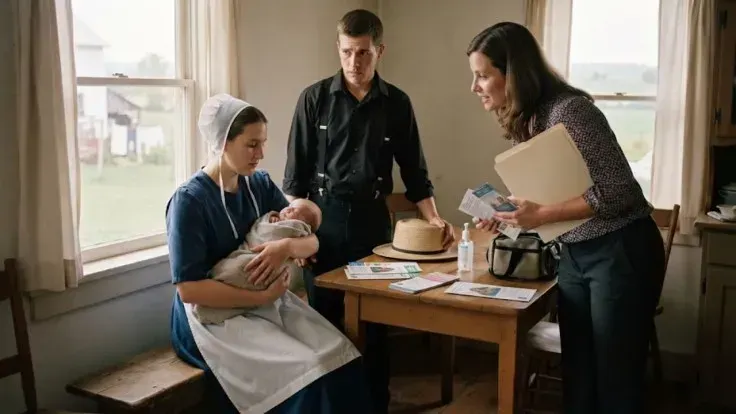
This article is relevant to my research topic because it shows the real public health stakes tied to vaccination gaps in this community. What stands out most is how carefully the article treats genuine medical uncertainty. Even the experts quoted disagree about whether measles actually caused the infant's death, and the article resists flattening that uncertainty into a simple story either way. That's a useful model for how I should handle ambiguity in my own research and design ideas. Not every gap in rural or Amish community healthcare has a clear explanation, and treating disputed cases with the same care this article does will make my own analysis more credible.
For one Amish family in Lancaster County, the measles outbreak became personal when their newborn son died shortly after birth. The infant had tested positive for measles, but exactly what role the infection played in his death remains unclear. The Lancaster County coroner said the baby died from a ruptured spleen and that the forensic pathologist who examined him did not believe measles contributed to the death. Pennsylvania health officials have nevertheless classified the case as a measles-associated death.
Measles is one of the most contagious human infections. It spreads through the air when an infected person breathes, coughs or sneezes, and the virus can remain infectious in the air for up to two hours after the person has left an area. Symptoms can take up to three weeks to appear after exposure. Those characteristics make it particularly difficult to contain once it enters a population with many people who lack immunity.
The MMR vaccine remains the strongest protection against measles. Pennsylvania health officials say two doses provide 97% protection against the disease.
The controversy surrounding the Amish newborn has become entangled with a national argument about measles and vaccination. But the medical facts are more complicated than either side of that debate suggests.
What makes this piece especially useful for my project is its emphasis that vaccination attitudes within this community aren't uniform or ideological the way outside narratives often assume. It's a reminder not to walk into conversations with families assuming a single, predictable stance on medicine or technology, since the article shows real variation even on a topic as polarized as vaccination. The piece also reinforces something practical for my design thinking: newborns and infants are a uniquely vulnerable point in this population, dependent entirely on the immunity and health decisions of the people around them rather than any protection of their own, which could be a meaningful angle to keep in mind if my project moves further toward maternal or infant care.
References
Carter, L. (2026, September 1). Amish community faces measles outbreak as newborn's death raises questions about vaccine protection and disease. Medical Daily. https://www.medicaldaily.com/amish-community-measles-outbreak-newborn-478026



