
An Enzyme's Plastic Lunch
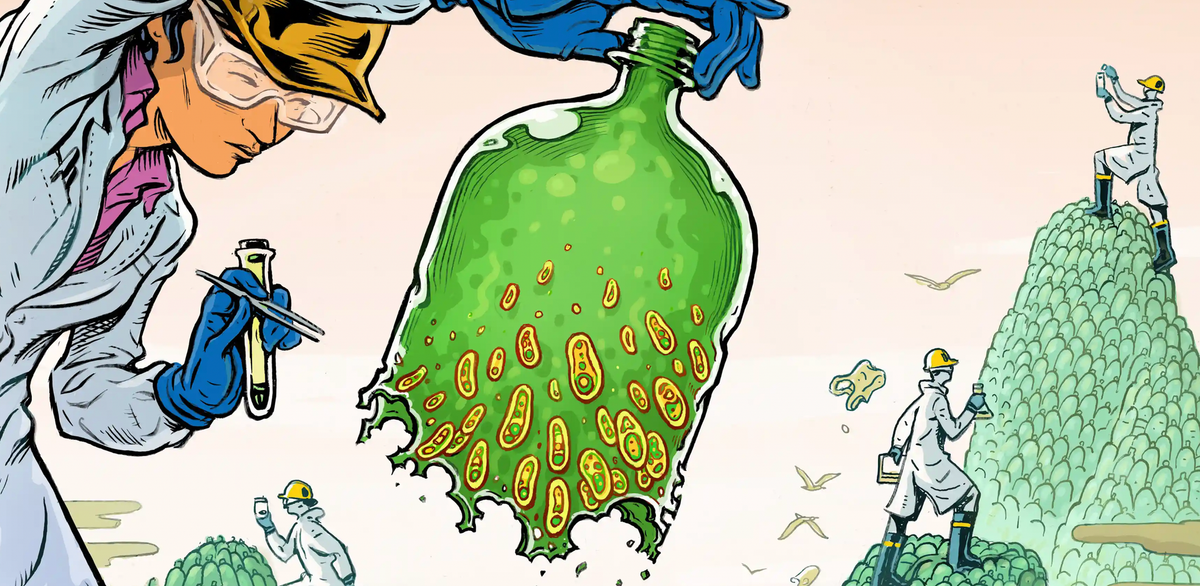
Scientists and engineers at the University of Texas have discovered an enzyme that can “eat” plastic, breaking it down much faster than it would naturally degrade. This enzyme could potentially help address an important environmental problem: what to do with the billions of tons of plastic waste piling up in landfills and polluting our land and water. The technology could allow industries to reduce their environmental impact by breaking plastics down at the molecular level and recovering the materials for reuse. It could also give companies an opportunity to recycle their own products instead of relying entirely on new materials. If this enzyme can eventually be used on a larger scale, it could help move us closer to a circular plastic economy.
The project focuses on polyethylene terephthalate (PET), a significant polymer found in most consumer packaging, including cookie containers, soda bottles, fruit and salad packaging, and certain fibers and textiles. It makes up 12% of all global waste. -UT News
Through this process, which included studying 51 different post-consumer plastic containers, five different polyester fibers and fabrics and water bottles all made from PET, the researchers proved the effectiveness of the enzyme, which they are calling FAST-PETase (functional, active, stable and tolerant PETase). -UT News
The enzyme was able to complete a “circular process” of breaking down the plastic into smaller parts (depolymerization) and then chemically putting it back together (repolymerization). In some cases, these plastics can be fully broken down to monomers in as little as 24 hours. -UT News
The team plans on expanding their work by getting a patent for this technology and testing the enzyme on polluted sites to see how well it can clean these areas. I think this is an amazing technology, and I hope the team is able to bring this project to a larger scale. It would be extremely useful to have an enzyme that can break down and purify plastic, especially if it could make recycling easier for companies. I think brands may be more willing to recycle their own products if they had a technology that required less effort and research to reuse the materials they already produce. I also find it interesting that this technology could be used outside of traditional recycling to help clean polluted environments. It is amazing to see how quickly science and technology are advancing, and it makes me wonder what other technologies exist that we have not even scratched the surface of yet.
Reference
University of Texas at Austin. (2022, April 27). Plastic-eating Enzyme Could Eliminate Billions of Tons of Landfill Waste. UT News. https://news.utexas.edu/2022/04/27/plastic-eating-enzyme-could-eliminate-billions-of-tons-of-landfill-waste/.



