
Andrew Wyeth Christina's World 1948
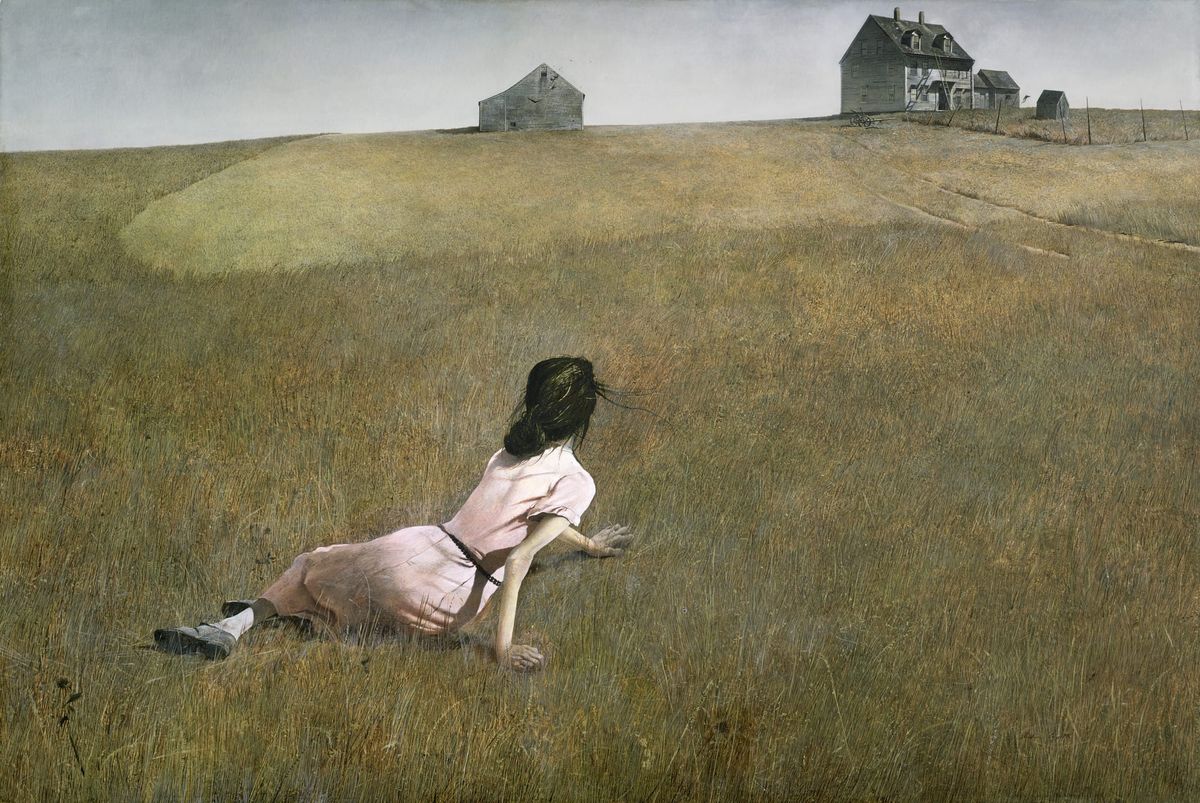
Christina's World shows a woman lying in a windswept field of dry grass, her body twisted toward a weathered farmhouse on a distant hill. The woman is Anna Christina Olson, Wyeth's real-life neighbor and close friend in Cushing, Maine, whom he painted for decades. Olson had a degenerative neuromuscular condition, now believed to be Charcot-Marie-Tooth disease, that had left her unable to walk. Rather than use a wheelchair, she chose to move around her family's farm by pulling herself across the ground, and it was seeing her do exactly this from an upstairs studio window that gave Wyeth the idea for the painting.
Set in the stark landscape of coastal Maine, Christina’s World depicts a young woman seen from behind, wearing a pink dress and lying in a grassy field. Although she appears to be in a position of repose, her torso, propped on her arms, is strangely alert; her silhouette is tense, almost frozen, giving the impression that she is fixed to the ground. She stares at a distant farmhouse and a group of outbuildings, ancient and grayed in harmony with the dry grass and overcast sky.
The high level of detail Wyeth gave to every object in his paintings encourages intense inspection, but his titles reveal the inner significance of their outwardly straightforward subjects. The title Christina’s World, courtesy of Wyeth’s wife, indicates that the painting is more a psychological landscape than a portrait, a portrayal of a state of mind rather than a place.
This painting is relevant to my research topic because it puts a human face on something easy to treat abstractly, the real, physical distance between a person and the help they need when both mobility and medical support are scarce in a rural setting. What makes it useful beyond its historical value is the ambiguity at its center. Christina's refusal of a wheelchair can be read as self-reliance, but it also raises a real design question about assistive technology, what happens when the tools meant to help someone don't fit how they actually want to live, or aren't available, or aren't trusted? That tension between assistance and autonomy feels directly relevant to automated and assistive medicine broadly, where the goal isn't just building a capable device, but understanding why someone might resist using it even when it could help. The painting also reframes rural isolation as something felt in the body, step by step across real ground, rather than just a statistic about distance to the nearest clinic.
References
Museum of Modern Art. (n.d.). Christina's world [Painting]. Andrew Wyeth. https://www.moma.org/collection/works/78455



