
Bringing office furniture full circle: Ahrend
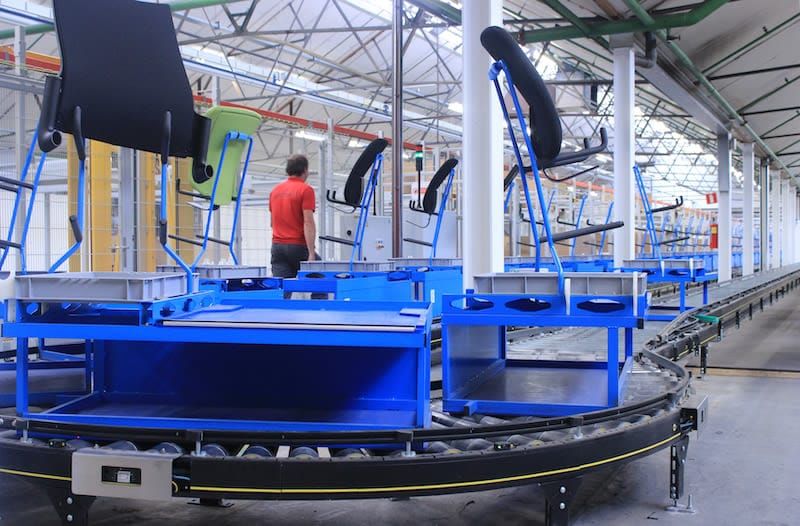
Ahrend, a Dutch furniture company, sought to revitalize the white-collar workspace by reimagining how we furnish them. The traditional model, which revolves around furniture that is bought to be used for a relatively short amount of time, and then discarded, was not only a large contributor of waste to landfills, but also an expensive practice to maintain.
Demand for office furniture is growing rapidly, by 2024, the size of the industry will be about USD 100 billion dollars. Manufacturing office furniture requires a lots of materials and energy and 80-90% of these valuable resources are lost after a short use period.
Ahrend, with conviction to innovate on tradition, developed the furniture as a service model. This FAAS model includes a furniture subscription leasing service, where customers pay a monthly fee and return the furniture when they no longer need it, as well as innovations in their products that would streamline a modular, repairable, product that would further cut down on cost and waste.
The main benefit of FAAS is the reduced need for virgin materials, which directly correlates to less energy use, reducing carbon emissions and other environmental impacts related to material extraction and processing. As an indication of potential material savings, Ahrend sold 150,000 desk chairs in 2018, which in total comprises 2,400 tonnes of material. During a 30 year period, including periodic upgrades of wheels, control mechanisms, textiles, and other components, the potential material savings from keeping such a chair in use, compared to the manufacture, use and disposal of three ‘standard’ desk chairs, could total more than 4,000 tonnes.
But in addition to the challenges in relation to why this FAAS model was created, new ones also cropped up in it's early development.
The potential benefits of capturing value and mitigating supply risks through FAAS were not widely appreciated in the Netherlands when Ahrend introduced the new option to customers. Today, we see far more awareness about circular economy and material reuse advantages at various levels. Ahrend have found that as the key players in the value chain have come to understand the rationale of the FAAS option, the easier it has become to form the necessary partnerships, contract new customers, and bring the model to scale.
In regards to circularity, this Furniture as a Service model sees benefits both on the side of Ahrend and their customers. Ahrend maintains ownership of the furniture leased through their subscription service, and in the spirit of regular maintenance, would maintain a closer relationship to their clients as opposed to a one-point contact at the point of sale. Customers, in addtion, also saw economic benefits to this model.
Ahrend customers can benefit through greatly reduced office set-up costs, as well as an increased ability to stay lean and agile, particularly advantageous if in the startup phase or in a fast-moving industry. For larger business customers, leasing rather than owning furniture reduces the level of asset-management required within its operations.
Review
As a circular economy, this dual approach of a service model and modular product design that Ahrend has created has shown to be particularly successful. This approach successfully accomplishes 2 important requirements of a circular economy: reduction of waste going to landfills, and mutual incentives amongst stakeholders. Ahrend's Furniture as a Service model, while currently only available in the Netherlands, has now become an effective case study in how seemingly wasteful practices can be innovated upon to some scale. As noted in the article, as more awareness of circular economies happened, more stakeholders were willing to participate. This scalability, in my opinion, is the biggest contributor to what makes this case successful, and points to a way forward for larger applications of circular models in a variety of sectors.
Reference
Ellen MacArthur Foundation. (2021, June 17). Bringing office furniture full circle. https://www.ellenmacarthurfoundation.org/circular-examples/bringing-office-furniture-full-circle



