
Circular Strategies for Plastics
“Plastic polymer materials are widely used in industrial and commercial applications due to their technical properties such as durability, corrosion resistance, high strength, light weight, and low maintenance when compared to metallic components [1, 2]. The production of plastic has reached a level of 381 million tonnes per year and 7.8 billion in total by 2015 [3]. However, the use of virgin plastic materials and the disposal of plastics in landfill or water bodies have caused significant environmental impacts such as eco-toxicity and greenhouse gas emissions (1.7 Gt CO2-eq by 2015) due to their non-biodegradability [4]. The disposal of non-biodegradable plastic waste has increased to 80% of production at an alarming rate in recent years, while only 20% has been recycled [5]. The linear economy that starts from extraction and ends at disposal has depleted natural resources and posed negative environmental impacts such as greenhouse gas emissions, global warming, particulate matter emissions, and eco-toxicity [6]. If the current linear economic trajectory continues, the amount of plastic in oceans is expected to be more than the total biomass of fish by 2050”
“Recycling waste plastic into new or usable products can prevent both the material extraction and disposal stages in product life cycles, which could lead to a better circular economy (CE) [7, 8]. The five ‘R’ strategies, namely, recycling, remanufacturing, repairing, reusing, and refurbishing, can be considered to convert end-of-life products into new or usable products [9]. Figure 1 shows the life cycle stages of a conventional manufacturing scenario with CE strategies incorporated at different life cycle stages. These strategies reduce resource extraction and waste material disposal, thereby significantly avoiding the environmental impacts associated with manufacturing. These allow the plastic products to be recovered after a single life cycle and generate multiple life cycles for materials while maximising their utility and value” (Jayawardane et al., 2023)
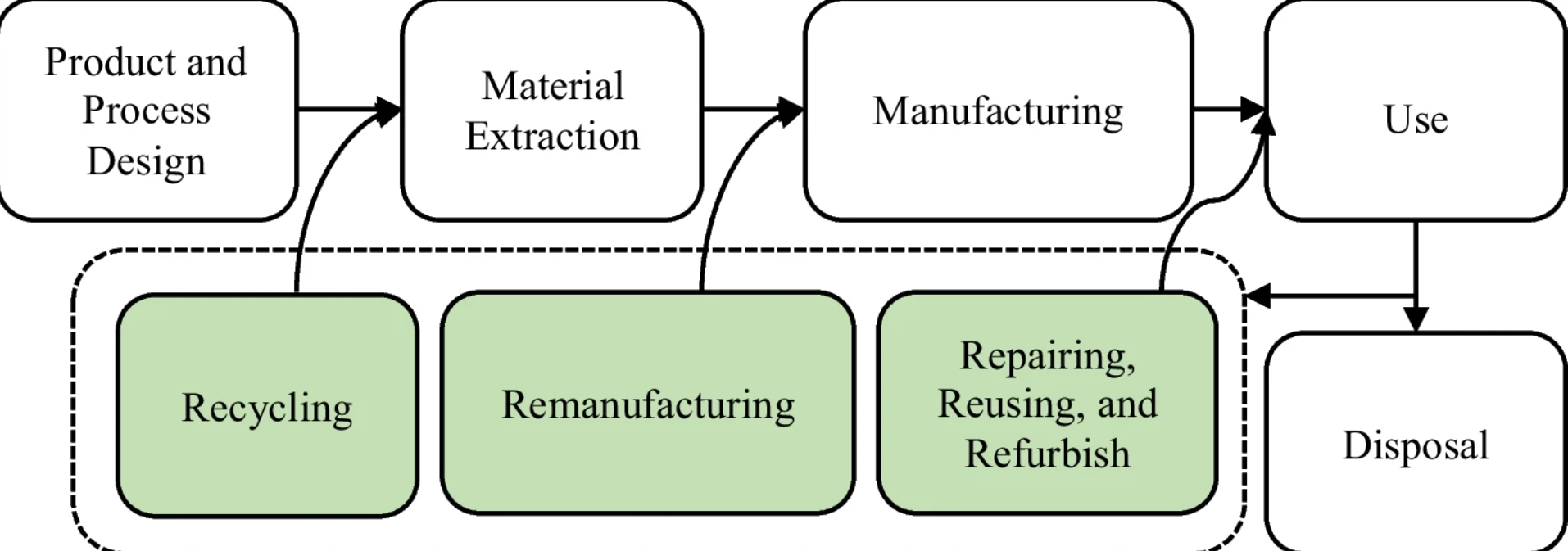
One of the main reasons that I chose to include this article in my research was because it places recycling in the larger circular framework, rather than just treating it as the only response to plastic waste. The article identifies multiple strategies that are capable of extending the material utility across multiple stages of the material life cycle. The image above is from the article, and I think that it does a great job of visually showing the circular strategies that can be used to intervene at different stages between manufacturing and disposal. After reading this article it had me begin to wonder if reprocessing the scrap that Marble Plastics creates should be the first solution or if there are other avenues the material could go through. Treating all waste as if it were equal would actually lead to more waste and loss of value.
References:
Jayawardane, H., Davies, I. J., Gamage, J. R., John, M., & Biswas, W. K. (2023). Additive manufacturing of recycled plastics: A ‘techno-eco-efficiency’ assessment. The International Journal of Advanced Manufacturing Technology, 126(3–4), 1471–1496. https://doi.org/10.1007/s00170-023-11169-8



