
Connecting the Screen to the Outside World
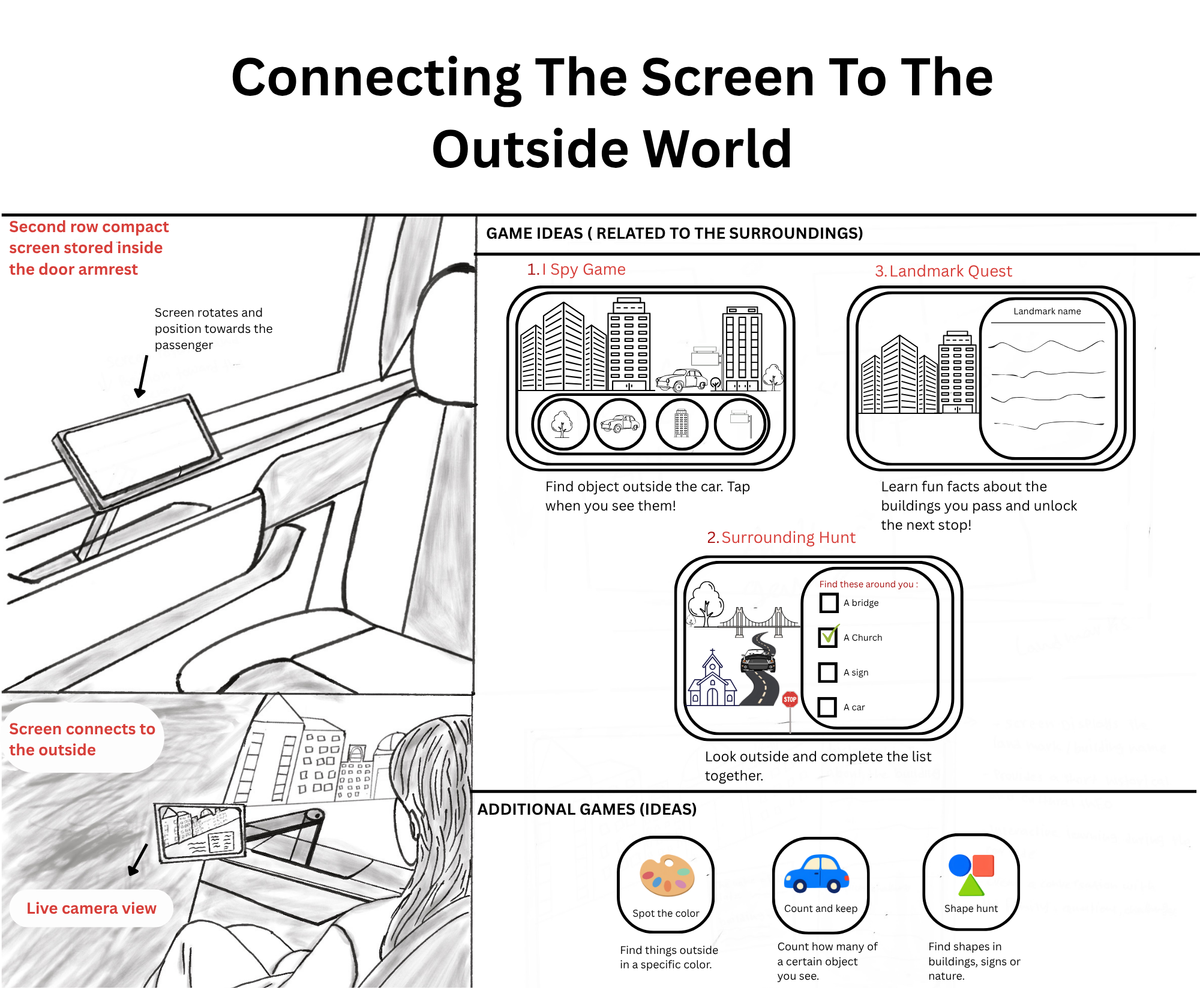
After doing some research, I started thinking about how children could explore what is around them during a car ride without having to stop at every place. I wanted to explore how technology inside the car could encourage children to look outside and interact with their surroundings. The Frank Lloyd Wright road-trip article made me think about how many interesting buildings and landmarks we pass without noticing them. The Goizueta Children’s Experience also showed me how learning can become more interesting when children can play, explore, and interact with what is around them (Roto, n.d.; Milk, 2021).
Another part that influenced this concept came from my conversations with Honda. We talked about bringing the screen closer to the passenger, which made me think about its placement and how children could interact with it.
My survey findings also influenced this approach. Parents showed interest in more conversation games, educational activities, and activities related to the surroundings. One of the opportunities that came from the survey was connecting screens to what is outside the car. The responses also showed that looking outside can already create conversation between family members. This is why I explored a compact screen stored inside the second-row door armrest that could come out and rotate toward the passenger. This idea was also inspired by airplane seat screens.
The screen would use the outside environment as part of the game. Children could play I Spy, Landmark Quest, Spot the Color, Shape Hunt, or count objects outside. They could also discover landmarks and learn short facts. Parents and siblings could participate by finding objects, answering questions, or completing challenges together, creating opportunities for family interaction.
There are still complications to consider. The screen would need to be placed where it doesn’t interfere with safety features. The games would also need to keep children focused on their surroundings and encourage family participation rather than becoming another individual screen activity. the concept uses a live camera to recognize or display things outside the car, the speed of the vehicle could also affect how clearly objects, buildings, or landmarks can be captured and recognized, especially when the car is moving quickly.
Reference
CANVA: Visual suite for everyone. (n.d.-a). https://www.canva.com/
21 fun car games for kids that make road trips so much easier. (n.d.-a). https://www.parents.com/fun/vacation/ideas/8-fun-car-game-ideas/
Roto. (2025). Goizueta Children’s Experience | Roto Design & Build Projects. Roto.Com. https://roto.com/projects/goizueta-childrens-experience
Milk, D. (2021, February 8). Frank Lloyd Wright buildings worthy of a road trip. Frank Lloyd Wright Foundation. https://franklloydwright.org/frank-lloyd-wright-buildings-worthy-road-trip/
Approximately (45%) of this work draws from the primary and secondary research I did, (40%) reflects my concept development, design decisions, and application to the family car experience, and (15%) reflects AI assistance with grammatical editing and refinement of wording. All interpretations and final design decisions remain the responsibility of the author.



