
Cow Toy by Donald Gialanella
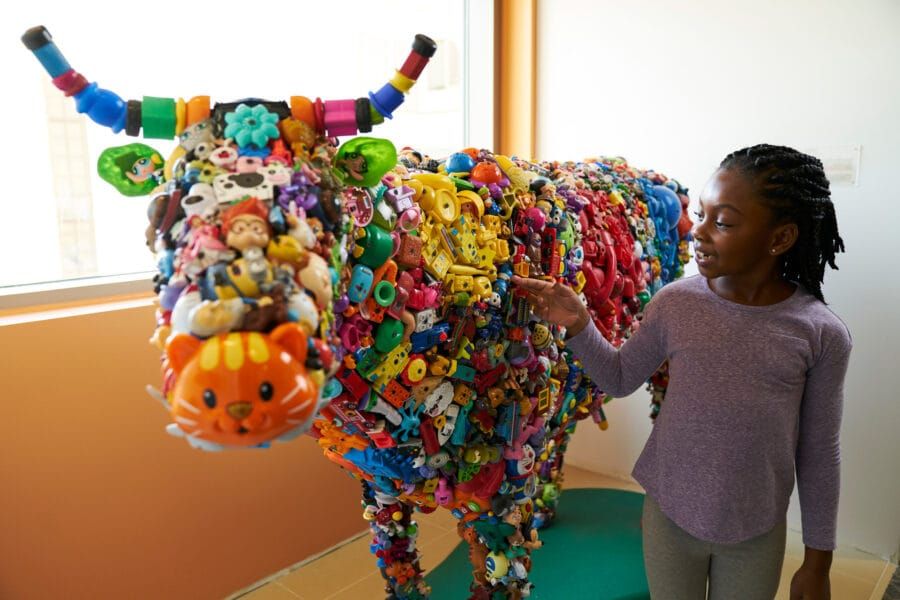
From afar, Toy Cow appears as a huge colorful cow sculpture. On closer examination, one sees it is made from an organized cacophony of hundreds of dolls, action figures and toys of every description. It’s as if some cosmic magnet pulled these colorful objects together to form a perfect cow. It incorporates everyday objects recombined in an extraordinary way.
This sculpture is made up of an astounding amount of small plastic toys that were collected in a toy drive at the same location the sculpture would come to live at: Lucile Packard Children's Hospital Stanford in Palo Alto, California.
The artist’s intention with the creation of this sculpture was to make “people smile, especially children, who delight in finding their favorite toys. It provides a positive experience to aid in the healing [process]”.
The creator remarks “The whole is greater than the sum of its parts.”, and in adhering to this ideal, created this cow made of an amalgamation of different toys.
Review
While I do not wish to minimize any sort of joy or appreciation that this sculpture has added to the lives of those who often or even only once observed this cow at the hospital in which it lives, I have to acknowledge the effect of its stagnant nature on its holistic effects.
From the perspective of adding joy to the lives of children and hospital workers that are surrounded by illness, I think the initial effect of the statue is likely quite effective. It serves the absurdism that brings joys to older individuals, because seeing a full sized cow sculpture does have a novelty effect. With children, they also describe that they would spend time looking at the sculpture, finding their favorite toys, but the process really stops there. Because the toys are screwed into the sculpture, all they can really do is look at the object.
The interaction with the sculpture stops at visual, and by way of repeated exposure, the joy that this sculpture can bring to anyone who encounters it reduces with every interaction.
In terms of its material make up, I have even more concerns. These toys, while I cannot describe the individual nature of each, seem to mostly still be functional and intact. This forced stagnation of these toys, I believe, becomes counterproductive to the goals of the artist. If the goal is to add joy to people's lives, then surely a medium in which that joy stagnates is not the best use of the material. If these donated toys were instead, able to be played with, where children’s imagination could keep their novelty in momentum, it would extend the life of that joy.
I think it should also be discussed that in the case that these toys were otherwise declared that they could not be played with, we run into this same issue of waste diversion that we have with other pieces in this art section. If we use waste to create stagnant art, we are not really resolving the issue of the waste, but instead delaying the inevitable.
Reference
Gialanella, D. (n.d.). Toy Cow [Sculpture]. Wescover. https://www.wescover.com/p/toy-cow-by-donald-g-at-stanford-childrens-health-or-lucile-packard-childrens-hospital--PHyGcoBbplm



