
Fatigue Sensor for Eyelids
This article from Science News Today, written by its editorial team, discusses a scientific advancement developed at UCLA that expands the capabilities of information capturing and analysis derived from the body’s functions.
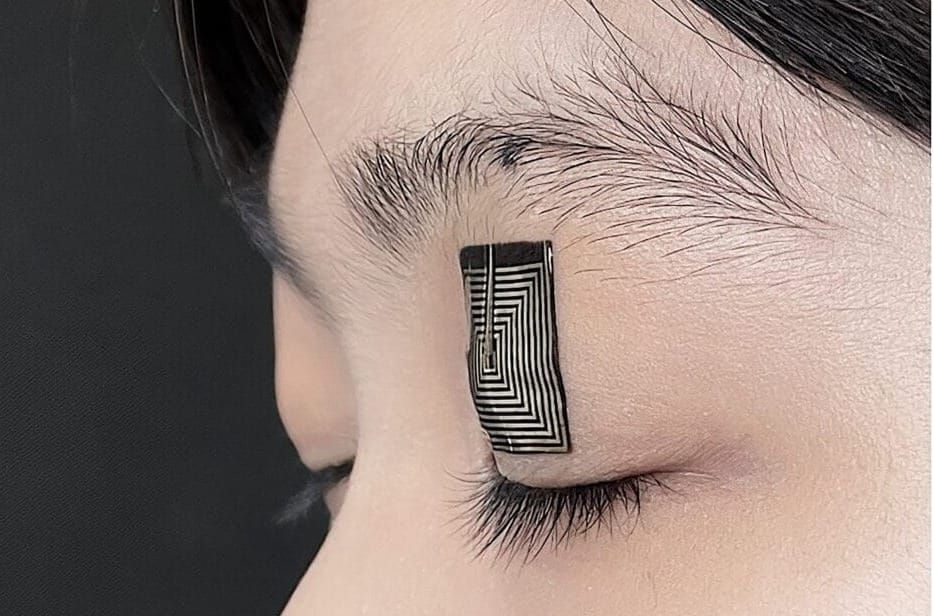
The result of their work is a soft, self-powered sensor that adheres gently to the eyelid like a second skin. Each blink compresses the material, altering its magnetic properties and generating an electrical signal. In effect, the sensor translates the language of eyelids into streams of data (Science News Today, 2025).
They patterned a thin gold coil onto a stretchable thermoplastic elastomer and placed this over a magnetoelastic film packed with microscopic magnets. As the eyelid moves, mechanical stress ripples through the material, shifting its magnetic field (Science News Today, 2025).
Unlike electrical signals that can short-circuit in moisture, magnetic fields pass through water unbothered. This gives the new device an intrinsic resilience, allowing it to operate reliably even when exposed to natural body fluids (Science News Today, 2025).
By harnessing this property, researchers could design lightweight, flexible, waterproof devices powered by the human body itself. The eyelid sensor is one of the first practical applications of this groundbreaking science (Science News Today, 2025).
The use of new technology into wearable data sensors is not new, it exists in widely popular products such as smartwatches or rings (Science News Today, 2025).
The difference here is the breakthrough in understanding fatigue, a biological data point that is difficult to assess and could aid in applications for medical aid in rural or remote areas ranging from chronic illnesses to intense activity monitoring. The amount of elderly in these environments is also substantially greater than cities, making constant monitoring very useful to know when a problem is actually arising.

Fatigue is not simply “being tired.” It is a gradual erosion of performance that seeps into both body and mind. It slows reflexes, dulls attention, clouds judgment, and heightens the risk of mistakes. In high-stakes environments—whether on a construction site, behind the wheel of a truck, in a hospital operating room, or even in classrooms—fatigue can mean the difference between safety and disaster (Science News Today, 2025).
“There’s something subtle and telling about how your eyes behave when you’re fatigued... Your blink rate changes, the speed slows down, and the patterns begin to shift” -Ph.D. candidate at UCLA, Jing Xu (Science News Today, 2025).
Especially in rural or remote environments, the ability to monitor patients after a doctor’s appointment or throughout their everyday lives could reduce the need for long-distance travel to hospitals. Continuous monitoring could also help doctors determine when an in-person follow-up is actually necessary, allowing patients to receive care when it is needed, reducing the amount of unnecessary far trips. This could also provide insight into changes in a patient’s health condition potentially allowing EMS workers or other healthcare professionals to intervene earlier before the condition becomes an emergency.
References:
Science News Today Editorial Team. (2025, September 13). Forget smartwatches—This new sensor sticks to your eyelid and knows when you’re exhausted. Science News Today. https://www.sciencenewstoday.org/forget-smartwatches-this-new-sensor-sticks-to-your-eyelid-and-knows-when-youre-exhausted
AI was used to check grammar in this reflection.



