
Health Equity and Ethical Considerations in Using Artificial Intelligence in Public Health and Medicine

“AI is now being used across various facets of public health and medicine, substantially altering how health professionals engage with their patients, communities, and health data. Two key areas where AI is making a mark are diagnostic algorithms and predictive analytics (2). For example, AI algorithms are being increasingly used to diagnose diseases from imaging scans — with higher accuracy and speed than human radiologists (3). In predictive analytics, AI can forecast outbreaks of diseases (4), hospital readmission rates (5), and a patient’s risk of developing chronic illnesses (6) by analyzing vast datasets. In this era of precision medicine, AI can help in tailoring medical treatments to individual genetic profiles, potentially improving outcomes and minimizing side effects (7). Public health surveillance, disease forecasting, and epidemic modeling are increasingly becoming important areas for integration of AI-based tools (6)” (Dankwa-Mullan, 2024).
“The deployment of AI diagnostic tools for diabetic retinopathy primarily in well-resourced health care settings or among populations with insurance coverage exemplifies an unfair distribution of technology. This approach disproportionately benefits people with greater economic means and access while potentially excluding socially or economically disadvantaged populations that may have a higher prevalence of disease but lack the resources or insurance necessary to access such advanced diagnostic tools” (Dankwa-Mullan, 2024).
“AI models are typically trained on available data, which may not adequately represent racial and ethnic minority groups or other populations that are medically underserved (11). For example, Obermeyer et al discovered that commercial algorithms, which use cost as a proxy for illness, exhibit racial bias by inadequately identifying the health needs of Black patients compared with White patients despite similar levels of chronic illnesses (12). Training data can also reflect historical biases in treatment and access to care for socially disadvantaged populations, leading AI to replicate these injustices (12). Finally, many AI tools are so-called black boxes — in which decision-making processes are not transparent — making it difficult to assess and rectify biases (13)” (Dankwa-Mullan, 2024).
“With AI’s ability to process vast amounts of personal data, safeguarding patient privacy and confidentiality becomes paramount (18,19). These safeguards involve several key concerns about data security, informed consent, and misuse of data” (Dankwa-Mullan, 2024).
“In addition, for populations with limited English proficiency, it is important to make sure informed consent forms are reviewed and explained to patients or translated. In this digital age, we can consider refining consent forms and including concise language for patients on how their data will be used in AI systems to inform their care” (Dankwa-Mullan, 2024).
“For example, AI can potentially streamline workflows and enhance diagnostic accuracy, but it also raises issues such as the potential for dehumanization in care and reduced patient–provider interactions (17). By addressing these ethical considerations proactively, working partners in public health and medicine can leverage AI to improve population health and health care outcomes while maintaining a commitment to ethical practice” (Dankwa-Mullan, 2024).
Overall, this article allowed me time to consider how any technology, not just Artificial Intelligence, can be unintentionally biased. Any new technology is inherently biased economically, as new low-volume systems are typically much more expensive. Implementing AI may hurt rural communities, due to the high costs that can be associated with the technology.
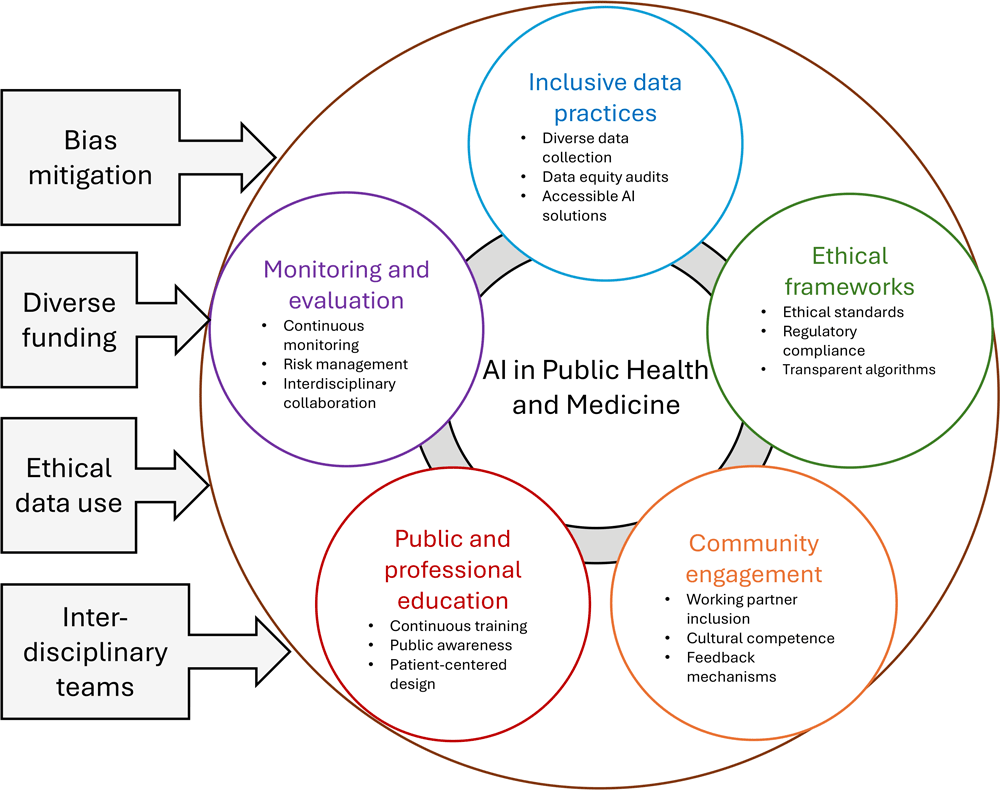
Whether or not machine learning is involved in my project, I should consider the bias mitigation diagram provided. It takes many factors into consideration, including how users' data is allowed to be shared, community engagement and education, and continuous monitoring. Overall, my biggest takeaway from this article is that implementing a new technology should not be a straightforward process. It should be a consistent loop of testing and implementing, examining any new biases as they come forward. While we are dealing with human life, any issue is large and important, at any size.
References
Dankwa-Mullan, I. (2024). Health equity and ethical considerations in using artificial intelligence in public health and medicine. Preventing Chronic Disease, 21, 240245. https://doi.org/10.5888/pcd21.240245



