
Instead of Selling, Some Rural Hospitals Band Together To Survive
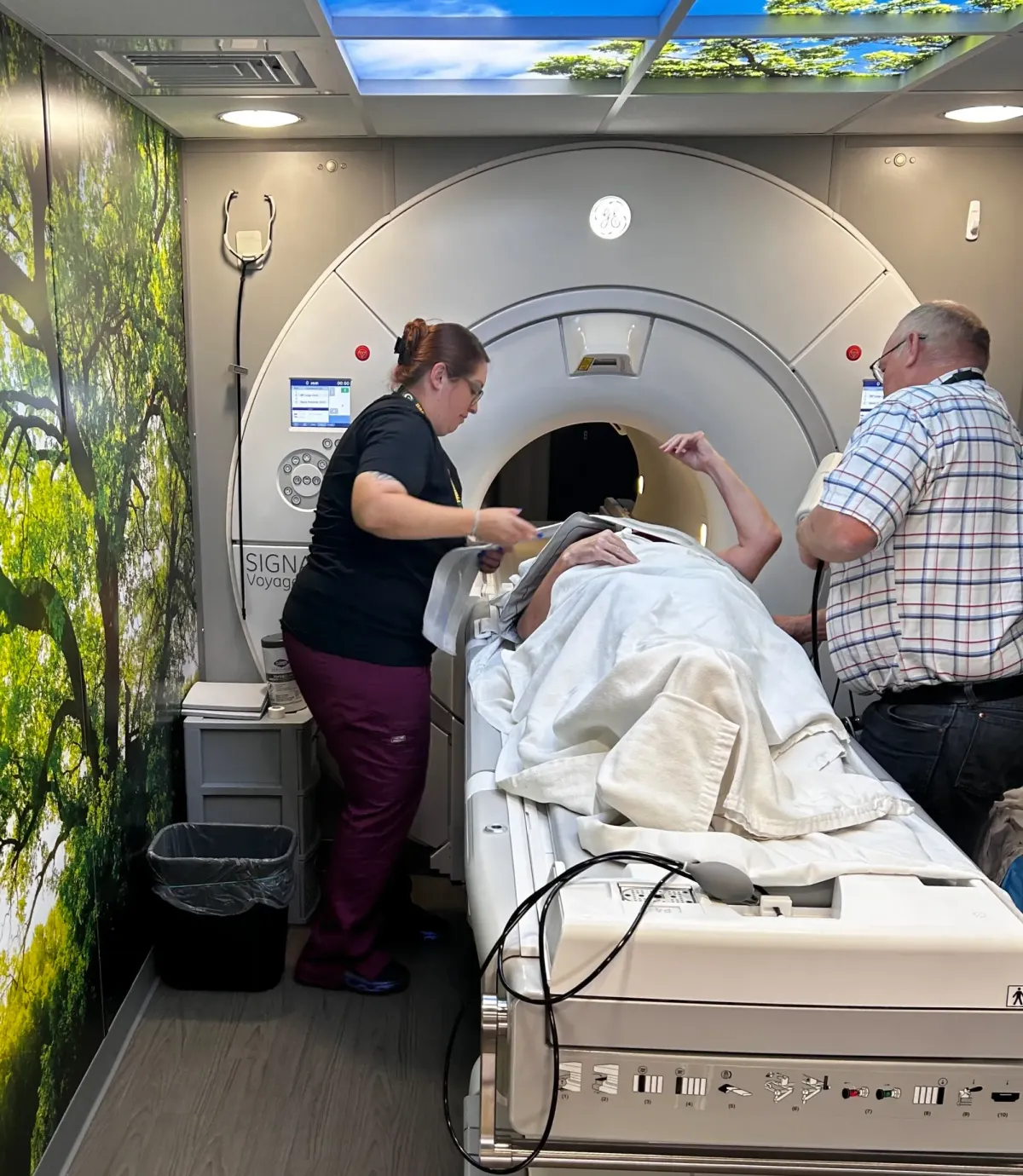
In Bowman, North Dakota, a town of 1,400 people, patients like Retta Jacobi get MRI scans inside a semitrailer that visits the local hospital every Wednesday. Without it, residents would face a 40-minute drive to reach an MRI machine the hospital could never have afforded on its own, a single scanner represents a level of capital investment no facility this size could justify for its patient volume.
Southwest Healthcare Services and 21 other independent, rural North Dakota hospitals are part of the Rough Rider Network, which used its members’ combined patient rolls to negotiate better prices for the mobile imaging truck.
Jacobi stands on a metal platform that lifted her to the entrance of a mobile MRI unit at Southwest Healthcare Services. (Arielle Zionts/KFF Health News)
For independent, rural hospitals, the networks are an alternative to shutting down or reducing services, or to giving up local autonomy and joining a large hospital system.
Anything that can help our rural hospitals and add services is awesome,” said Jacobi, who provides speech therapy to children in the local school district.
Goebel said joining a network to remain independent is also beneficial for the economy of rural areas, where hospitals are often major employers. He said health systems sometimes cut services and staff at rural hospitals they acquire.
Jacobi is taking medication and doing physical therapy after a doctor examined her MRI results. If that doesn’t work, she may need to make a five-hour round trip to Bismarck to get an ultrasound-guided steroid shot. Jacobi was thankful she could get a diagnosis and treatment advice without having to travel far for the MRI.
A single small hospital can't afford an MRI machine or the staff to run outreach programs, but a group of hospitals pooling resources can. That reframes how I think about "automated and assistive medicine" in rural settings: a device or service might work fine on its own, but still fail to reach rural communities if it's priced or structured for hospitals acting alone. It also makes me think differently about design; a good rural solution might need to be shareable across multiple small hospitals, not just affordable for one. The article does note uncertainty, though. A RAND review found no solid evidence that these networks actually save money or improve care, which is a useful reminder that a cooperative model isn't automatically a good one just because it sounds efficient.
References
Zionts, A. (2025, September 9). Instead of selling, some rural hospitals band together to survive. KFF Health News. https://kffhealthnews.org/rural-health/rural-hospitals-north-dakota-cins-rough-rider-network-closures/



