
Interview with Patrick Sours

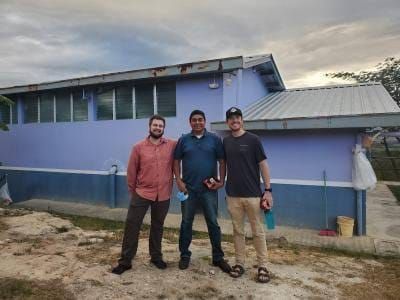
Patrick Sours is an assistant professor at The Ohio State University whose work focuses on sustainable development engineering, humanitarian engineering, and water infrastructure. His work has included community-based projects involving water systems and infrastructure in international settings (The Ohio State University Center for Latin American Studies, n.d.; The Ohio State University Office of International Affairs, 2025). Sours was suggested as an interview participant by our capstone partner, Hannah Adams from Battelle. Below are several excerpts from our conversation.
“I think it's a lot less about... We need a new technology and more how do we apply the technology, understanding all the context” (Sours, 2026, 6:01).
“Like what level of responsibility do we put on the end user community?” (Sours, 2026, 6:36).
“I am someone who have worked in water treatment for 15 years. I have never been to the Delco water treatment plant where my water comes from. I don't know what type of system they use. If it wasn't working, I would not show up there and like try to fix it” (Sours, 2026, 6:36).
“I think sometimes when we think about like rural community development or participatory development, we have this expectation of that like the end user will do it or the community will do it or we'll just work with them. But they have a lot of complexities in their own” (Sours, 2026, 6:36).
“I think sometimes we've... over romanticize this like we're going to work with the end user and get this fixed” (Sours, 2026, 7:15).
“Who are all the stakeholders and like not all of those stakeholders play the same role and not they don't need to be engaged at the same time and at the same level” (Sours, 2026, 7:29).
“The community articulated, like, we want two tanks for this borehole because we run out of water faster. We run out of water too fast. There's not enough water” (Sours, 2026, 9:09).
“We... did an analysis of the borehole and found that like it's only producing so much water... even if we add a second tank, the problem is, is the aquifer” (Sours, 2026, 9:30).
“It's like, okay, here's this list of things that we want. And here's the things that we can realistically do within the time, budget, physics, you know, all of those things. And then how do you actually come to an amicable solution” (Sours, 2026, 9:54).
“It's like that Spider-Man meme where everybody like Spider-Man's point. It's like that where like X person thought other person Y was responsible, Y thought W was responsible and W thought X and then the system ends up breaking…” (Sours, 2026, 10:44).
“The idea is that they're coming alongside them pre, middle, post to help build those relationships” (Sours, 2026, approximately 14:30).
“This idea of like leverage points within systems thinking of like, how do you identify like what, where is the, what are the possible interventions, but then how do you essentially decide which is the highest and best intervention?” (Sours, 2026, approximately 18:00).
My biggest takeaways from our conversation were the importance of listening to a community and developing a system that people can realistically understand, use, and maintain. In one example, Sours described a community experiencing an inadequate water supply. Although the community initially proposed adding a second storage tank, further analysis showed that the underlying limitation was the amount of water being produced by the aquifer rather than the amount of available storage (Sours, 2026, 9:09–9:54).
This example demonstrates the importance of understanding a problem beyond the solution initially requested by users. Sours also emphasized identifying the different stakeholders involved, understanding their respective responsibilities, and recognizing that not every stakeholder needs to participate at the same level or at the same point in the process (Sours, 2026, 7:29). For my capstone project, this reinforces the importance of looking beyond the physical design of a solution and considering the larger system around it. A proposed intervention cannot simply be assumed to work independently; its effectiveness will also depend on how users, professionals, organizations, and other stakeholders understand and interact with it.
References
Sours, P. (2026, September 14). Interview with Patrick Sours (W. Tyrrell, Interviewer) [Interview transcript].
The Ohio State University Center for Latin American Studies. (n.d.). Patrick Sours. https://clas.osu.edu/people/sours.17
The Ohio State University Office of International Affairs. (2025, July 21). Faculty spotlight: Patrick Sours and the Humanitarian Engineering program. https://oia.osu.edu/news/2025/07/21/faculty-spotlight-patrick-sours-and-humanitarian-engineering-program



